


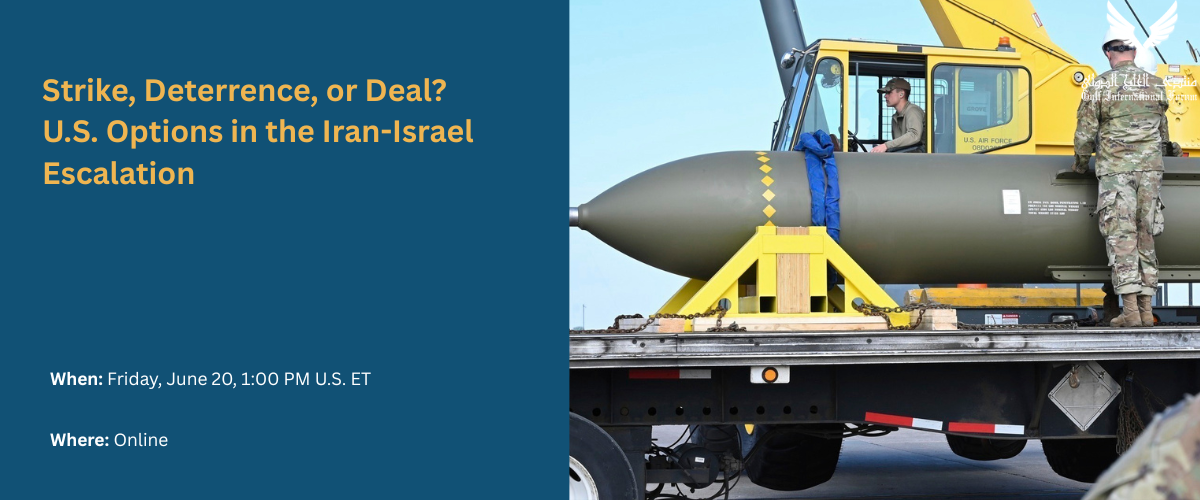
Strike, Deterrence, or Deal? U.S. Options in the Iran-Israel Escalation
As Iran and Israel engage in direct confrontation, the United States finds itself navigating a treacherous strategic crossroad. U.S. foreign policy options in the current conflict—between deterrence, de-escalation, and direct intervention—amid mounting regional and domestic pressures. President Donald Trump, in his second term, has expressed a strong desire to secure a new and better deal with Iran—one that could be framed as a legacy-defining achievement. However, Supreme Leader Ali Khamenei continues to rule out restrictions on ballistic missile development or a cap on uranium enrichment, particularly after years of maximum pressure campaigns and unmet JCPOA promises.
Meanwhile, Israel faces its own red lines. Having declared it will not allow Iran to reach nuclear breakout capability, Israel’s options are limited. Despite advanced cyber capabilities and covert operations, Israeli officials acknowledge that a comprehensive strike on Iran’s deeply buried nuclear facilities is not viable without U.S. air and logistical support. This dependence complicates Washington’s strategic calculus: direct involvement risks triggering a full-scale regional war, exposing U.S. bases across the GCC to Iranian missile attacks and escalation by Iran’s proxy networks. Yet remaining on the sidelines could embolden Tehran, undermine U.S. deterrence, and strain relations with both Israel and key Gulf allies.
The panel will explore the strategic implications of U.S. involvement—or abstention—from this unfolding crisis. What would it mean for the American military presence in the Middle East if the U.S. chose to directly support Israeli operations? Could this conflict derail the U.S. strategic pivot to Asia and its rebalancing priorities? How would Gulf states interpret a U.S. decision to avoid confrontation or to take sides?
Featuring: Dr. Gawdat Bahgat, Dr. Kenneth Katzman, Dr. Yasmine Farouk, and Tim Constantine.
Bio:
 Dr. Gawdat Bahgat
Professor of National Security Affairs, National Defense University’s Near East South Asia Center for Strategic Studies; Senior Non-Resident Fellow, Gulf International Forum
Dr. Gawdat Bahgat is a Professor of National Security Affairs at the National Defense University’s Near East South Asia Center for Strategic Studies. He is an Egyptian-born specialist in Middle Eastern policy, particularly Egypt, Iran, and the Gulf region. His areas of expertise include energy security, proliferation of weapons of mass destruction, counter-terrorism, Arab-Israeli conflict, North Africa, and American foreign policy in the Middle East.
Dr. Bahgat’s career blends scholarship with national security practicing. Before joining NESA in December 2009, he taught at different universities. Bahgat published ten books including Alternative Energy in the Middle East (2013), Energy Security (2011), International Political Economy (2010), Proliferation of Nuclear Weapons in the Middle East (2007), Israel and the Persian Gulf (2006), and American Oil Diplomacy (2003). Bahgat’s articles have appeared in International Affairs, Middle East Journal, Middle East Policy, Oil and Gas Journal, and OPEC Review, among others. His work has been translated to several foreign languages.
Dr. Bahgat served as an advisor to several governments and oil companies. He has more than 25 years of academic, policy and government experience working on Middle Eastern issues. Dr. Bahgat has contributed to CNN, BBC, Washington Post and Al-Jazeera. He has spoken at Tufts University, Columbia University, London School of Economics, Swiss Federal Institute of Technology in Zurich, Swiss Foreign Ministry, Yildiz Technical University in Istanbul, Qatar University, Kuwait University, Oman Diplomatic Institute, Griffith University (Australia), and India School of Business.
 Dr. Kenneth Katzman
Senior Non-Resident Fellow, Gulf International Forum; Senior Fellow, The Soufan Center
Dr. Kenneth Katzman is a Senior Non-Resident Fellow at Gulf International Forum. Dr. Katzman is a Senior Fellow at The Soufan Center. His work focuses on geopolitical and regional dynamics in the Middle East—with a focus on Iran—as well as United States strategy. In late 2022, Dr. Katzman retired from his longtime position as a Senior Analyst with the Congressional Research Service (CRS), an arm of the U.S. Congress that provides analysis and advice to members of the U.S. Congress in their legislative and oversight responsibilities. In that post, Dr. Katzman served as a senior Middle East analyst, with special emphasis on Iran, Iran-backed groups operating in the Middle East and South Asia, the Persian Gulf states, Iraq, and Afghanistan. During his more than 30-year tenure at CRS, he provided reports and briefings to Members of Congress and their staffs on U.S. policy on these countries and issues, and provided analysis of related legislative proposals. On about a dozen occasions, he has testified before various Committees and Subcommittees of Congress on his areas of expertise. He also participated in several congressional delegations to the region at the Member and staff level. During 1996 and again during July 2001—March 2002, he was assigned to the majority staff of the House Foreign Affairs Committee to work on Middle East issues, including organizing hearings and helping to draft legislation such as the Iran Sanctions Act (1996).
As a well-known expert on the region, Dr. Katzman has delivered numerous presentations and briefings at conferences and meetings in Washington D.C. as well as throughout Europe, Asia, the Middle East, and South and Central Asia. He has also written numerous articles in various outside publications, including a book entitled The Warriors of Islam: Iran’s Revolutionary Guard (Westview Press, 1993) which was the subject of his Ph.D. dissertation. Since 2017, he has been a contributor to The Soufan Center, including serving as a key drafter of several of the Center’s reports on U.S. policy toward Iran. Dr. Katzman has been quoted frequently on the region and appeared in many regional media, including Al Jazeera, Al Hurra, Al Arabiya, Sharq News, Al Araby, and Al Ghad TV.
In recent years, Dr. Katzman has worked with numerous region-related think tanks and institutions. He has authored scholarly articles for organizations including The Atlantic Council, the Gulf International Forum, the Arab Gulf State Institute of Washington, and the Arab Center D.C. Among his earlier outside publications, during 1998, he wrote expert working papers on the ballistic missile capabilities of Iran and Iraq for the Commission to Assess the Ballistic Missile Threat to the United States (“Rumsfeld Commission”). In late 1999, and again in 2010, the Atlantic Council published his detailed monographs on U.S. sanctions on Iran.
Dr. Katzman holds a Ph.D. in Political Science from New York University (1991). During May 1985—June 1989, Dr. Katzman was an analyst at the Central Intelligence Agency, where he prepared written reports for U.S. Middle East policymakers on leadership dynamics in Iran, Iraq, and the Persian Gulf states. Two years in the private defense consulting industry followed his tour at the CIA.
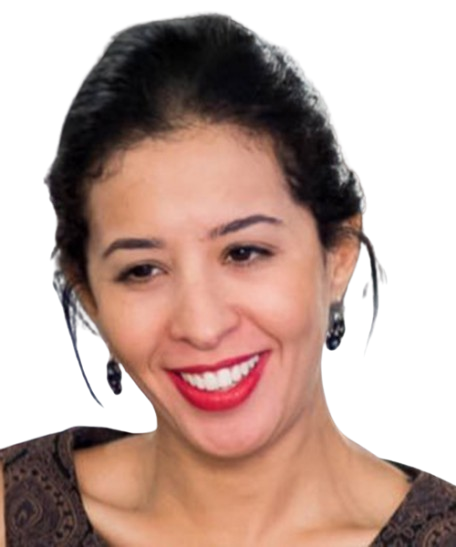 Dr. Yasmine Farouk
Gulf and Arabian Peninsula Project Director, Crisis Group
Dr. Yasmine Farouk is the Gulf and Arabian Peninsula Project Director at the Crisis Group. She leads the organisation’s research, analysis, policy prescription and advocacy on the Arab Gulf countries and supervises its work on Yemen.
Yasmine has over 20 years of experience in research and practice focused on the Gulf region and Egypt. Before joining Crisis Group, she served as a senior adviser at the European Institute of Peace, was a visiting scholar at the Carnegie Endowment for International Peace, and held the position of nonresident scholar at the Baker Institute for Public Policy at Rice University. Her previous roles include consulting for the Cabinet of the Egyptian Prime Minister and serving as the research director at the Cairo International Center for Conflict Resolution, Peacekeeping, and Peacebuilding (CCCPA) at the Egyptian Ministry of Foreign Affairs.
Her academic background includes teaching at Cairo University, receiving a Fulbright scholarship at Yale University, and conducting research on the Arab Human Development Report. She holds a BA in political science from Cairo University and a Master’s and PhD in international relations from Sciences Po Paris.
 Tim Constantine
Host of “The Capitol Hill Show”
Tim has the unique position among talk radio’s elite as having been on the other side of the interview microphone almost as much as he has been the one asking the questions. Never mean, but always seeking truth and accuracy, he is a breath of fresh air in today’s world of mindless talking points from the left or the right.