The Islamic Republic and the Authoritarian Playbook
Despite its revolutionary heritage, Iran mirrors the authoritarian patterns of its regional rivals more than ever.

At a conference on Iranian-Arab relations in Doha before he became foreign minister, Abbas Araqchi likened Iran’s foreign policy to a hand-woven Persian carpet: built on patience and arduous work, the end-product was uniquely beautiful. This metaphor reflected a view dominant among many Iranian elites that the Islamic Republic was distinct from its Arab neighbors; a more pragmatic actor guided by its national interests and capable of adopting a more nuanced approach to international affairs.
Yet, amid the current war between Iran, the United States, and Israel, a closer look at the behavior of Iran’s theocratic elites and the country’s current trajectory challenges this assertion. Since the 1979 revolution, the Islamic Republic has not deviated from patterns seen in neighboring Arab regimes. Rather, it has come to resemble them. The Islamic Republic’s ideological thinking remains rigid, its leaders prioritize regime survival over the well-being of Iranian society, and corruption has become a deeply entrenched aspect of the political system. Unless Tehran addresses these systemic shortcomings, Iran’s future may come to resemble one of the countries destabilized by the Arab Spring, or worse.
Ideology Clouds Strategic Thinking
Ideology and ethos have shaped Iran’s foreign policy, just as they have in several Arab regimes. During the Cold War, countries such as Iraq, Syria, and Egypt embraced pan-Arabism in ways that often ignored the national interest, producing costly and destabilizing outcomes that still resonate today. After overthrowing the Shah’s secular regime, Iran embraced a revolutionary Islamism, which ultimately undermined the country’s standing in the region.
Though Tehran supported armed militia groups and attempted to export the Islamist revolution, the strategic gains were very limited relative to the diplomatic and economic costs. Iran’s ideological posture essentially turned it into a rogue state, deepening regional mistrust and promoting strife rather than fostering stability.
Beyond Islamism, Iran’s commitment to Third-Worldism and anti-colonialism reinforces its tradition of defiance. An inclination toward demonstrations of sovereignty and independence can be traced to Mohammed Mosaddegh, Iran’s last nationalist prime minister who was overthrown in a Western-backed coup in 1953. Mosaddegh pursued an intransigent approach to foreign policy, cementing Tehran’s control over key industries and directly challenging the United Kingdom and other Western powers, a theme that still resonates in the Islamic Republic today. After the 1979 revolution, anti-Americanism became a core pillar of governing ideology, putting the country back on a collision course with the West. This radical ideology caused its adherents to overlook its own unsustainability, which only undermined Iran’s geostrategic position.
Protecting the Regime, Neglecting the People
Another defining trait of the Iranian regime that it shares with several Arab dictatorships is the prioritization of the regime’s security over the welfare of its citizens. Leaders such as Saddam Hussein, Bashar al-Assad, and Muammar Gaddafi consistently placed regime survival over the needs of their people. Iran’s 1979 revolution was in part a consequence of similar neglect: the Shah’s pursuit of internal loyalty and regional power came at the expense of the people. Post-revolutionary Iran has not fared much better. Since the establishment of the theocracy, living standards for the average Iranian have steadily declined, a trend that has accelerated in recent years.
While the quality of life at home has suffered, the regime has invested heavily in non-state armed groups such as Hezbollah and the Houthis. This support only brought about more stringent international sanctions, which further impoverished average Iranians. Even as Israel and the United States strike Iranian proxies and Tehran’s deterrent capabilities weaken, Iranian citizens continue to bear the brunt of economic hardship. Official estimates place roughly 30 percent of Iranians below the poverty line, though the real number is likely higher amid persistent currency depreciation and price inflation.
These conditions have increasingly fueled public anger. Anti‑regime protests in December 2025 and January 2026 reflected widespread discontent over declining living standards and Tehran’s foreign‑policy choices, including its insistence on uranium enrichment. It is no wonder that demonstrators chanted “neither Gaza nor Lebanon, my life for Iran” when they took to the streets, criticizing the regime’s spending on foreign proxies while Iranians struggled at home.
Patronage and Power
Like many of its Arab neighbors, Iran’s ruling class and government institutions are deeply corrupt. Although the Islamist revolutionaries of the past denounced the corruption of the Shah, the problem has persisted: in 2025 Iran ranked 153 out of 181 countries in the Corruption Perceptions Index. This corruption is particularly visible in the Islamic Revolutionary Guard Corps (IRGC), which swears allegiance to the regime rather than the Iranian people. The IRGC has embedded itself so deeply in the economy that it has become central to almost all major economic interactions. Current estimates suggest that the IRGC directly or indirectly controls 50 percent of Iran’s GDP, with much business activity effectively dependent on association with the organization.
In this environment, corruption scandals have become part and parcel of the political culture. Last year’s Debsh Tea Scandal involved $3.7 billion in smuggled funds linked to imported tea, implicating more than 60 individuals, two of whom were former regime ministers. Another case involved the family of the interim Friday prayer leader, Kazem Sedighi. According to the case, a seminary linked to Sedighi transferred a valuable plot of land in northern Tehran to Sedighi’s family company, netting the cleric $20 million. Perhaps the most obvious display of corruption is the aghazadehs—the sons and daughters of officials—who continue to profit illegally from the power exercised by their parents. These elites are routinely scrutinized for their lavish lifestyles and displays of luxury on social media. This concentration of power highlights Iranian elite advantage, widens the gap between average Iranian citizens and the political and economic elites, and reinforces authoritarianism and political instability.
Regardless of the outcome of the U.S.–Israel war with Iran, the Islamic regime will likely face the same fate as Egypt, Syria, or, to a lesser extent, Tunisia. With the selection of Mujtaba Khamenei as the new Supreme Leader, there is broad consensus that the IRGC’s influence in the political system will expand, further entrenching conditions that make a transition to democracy all but impossible. Rampant corruption, an obliterated middle class, water scarcity, minority disenfranchisement, and a weak and divided opposition leave few paths toward a smooth transition to liberal democracy. Together, these factors make Iran’s current political and economic model unsustainable. Even if the Islamic Republic manages to take a step towards democratic reform, the circumstances could easily produce a return towards authoritarian practices.
The views and opinions expressed in this article are those of the authors and do not necessarily reflect the views of Gulf International Forum.
Issue: Politics & Governance
Country: Iran

Dr. Massaab Al-Aloosy is a researcher focusing on Iraq, Iran, and Shia non-state armed groups. He holds a PhD from the Fletcher School-Tufts University and is the author of The Changing Ideology of Hezbollah, Palgrave 2020.
Why Iran Never Knows When to Stop
July 27, 2026At first glance, Iran’s negotiating difficulties appear to stem from disagreements between pragmatists seeking sanctions relief and hardliners determined to resist compromise. Yet that explanation…
Iraq’s Corruption Crackdown
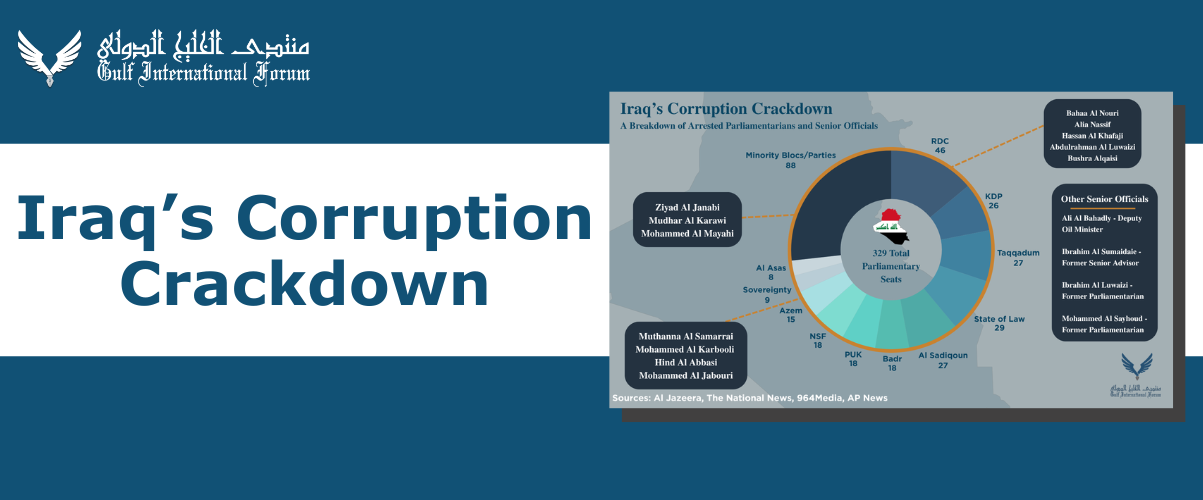
July 22, 2026*A breakdown of arrested parliamentarians and senior officials as of June 28, 2026.
Sheikh Hamad and the Making of Modern Qatar
July 15, 2026There is a question that haunts every small state: how does a nation survive and stay relevant in a region built for giants? For most…