A Gulf Apart: Analyzing AI in Saudi Arabia and the UAE
The GCC states have adopted distinct AI policies, resulting in far-reaching consequences for their relations with technological superpowers and for dynamics within the GCC.

As the fourth industrial revolution unfolds, the strong desire by GCC countries, particularly the United Arab Emirates (UAE) and the Kingdom of Saudi Arabia (KSA), to assert themselves as Artificial Intelligence (AI) hubs raises geopolitical questions as to which countries and companies may benefit the most and how.
The AI Revolution in the Gulf
A recent PWC report expects Middle East and North African states to accrue around 2 percent of the total global benefits of AI by 2030, amounting to $320 billion. In Saudi Arabia, AI is projected to account for 12.4 percent of the Kingdom’s GDP. In the UAE, AI is anticipated to account for nearly 14 percent of its GDP. In Bahrain, Kuwait, Oman, and Qatar, AI is expected to account for $45.9 billion or 8.2 percent of their combined GDP by 2030. Other reports by McKinsey and Roland Berger offer more conservative figures but nonetheless stress the exponential nature of AI led growth.
As both the UAE and Saudi Arabia seek to diversify away from their dependence on oil for government revenue, AI has been identified as a key sector and driver for future economic growth. While the UAE is already a leader in the sector, Saudi Arabia is rapidly building the foundations for an AI-driven economy. In the UAE, G42—a leading AI and cloud computing company with major investors such as the Mubadala and the Abu Dhabi Investment Authority sovereign wealth funds—partnered with the Abu Dhabi Growth Fund to launch a $10 billion tech fund in 2022. In Saudi, the Public Investment Fund (PIF) has focused on infrastructure development and securing supply chains with a particular focus on ensuring access to critical minerals, essential for tech-driven industries. As stated in its Vision 2030, Saudi aims to launch over 300 AI startups and attract approximately $20 billion in investment to its data and AI sectors.
By maintaining a more flexible regulatory framework at the national level, governments aim to stimulate AI innovation and attract investment, as overly restrictive rules may discourage experimentation and slow progress. Moreover, given the unpredictability of how other countries will regulate AI, the Emirates and Saudi are not willing to risk falling behind in a global race for technological leadership by imposing stringent controls. According to White & Case LLP, Riyadh has yet to enact formal AI regulations and instead relies on guidelines to establish practice standards and general principles. By contrast, Abu Dhabi has issued several decrees and guidelines related to AI regulation, with free zones such as ADGM and DIFC regulating AI through more relaxed amendments to existing data protection laws.
On Critical Infrastructure
The UAE and Saudi Arabia are well positioned to develop the necessary infrastructure for massive data centers to feed AI models, given their access to energy supplies and strong financial health. According to DC Byte, a platform that analyzes the global data center market, current data center capacity in the UAE is 235 megawatts and 123 megawatts in Saudi Arabia. This capacity is relatively low compared to European countries highlighting the potential for significant growth in this sector. To close this gap, Abu Dhabi aims to add 343 megawatts to its current capacity, while Riyadh plans to increase its capacity by 467 megawatts before 2030. Despite its smaller population, the UAE has an advantage because it developed its first data centers over two decades ago through the Dubai Internet City initiative.
Policymakers in both countries face the difficult challenge of ensuring that these heat-generating, water-intensive computing facilities function efficiently in a harsh desert environment. Indeed, data centers are often criticized for their electricity consumption and water usage. As droughts in the Middle East become more severe, demands of these facilities will likely exacerbate water scarcity throughout the region. Justification for the existence of such centers may be increasingly challenged.
Investments in the Future
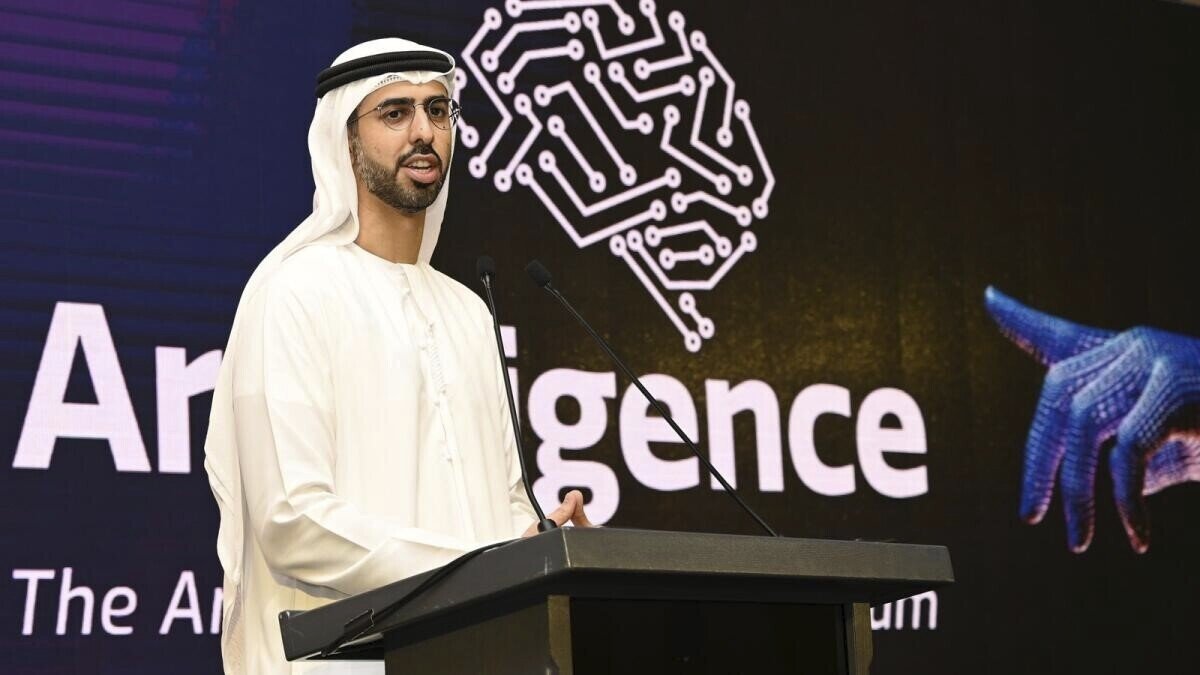
The UAE has positioned itself as a global leader in AI, becoming the first country to appoint an AI Minister in 2017 and establishing the world’s first university dedicated solely to AI research—MBZUAI. Both the Ministry of AI and MBZUAI have played a crucial role in developing some of the world’s most advanced large language models (LLMs). For instance, the Abu Dhabi-administered Advanced Technology Research Council’s (ATRC) Falcon AI is a leading competitor to Meta and Google, while MBZUAI’s Jais, launched in 2023, is considered the world’s most advanced Arabic LLM. Building on this momentum, G42 and Mubadala partnered in 2023 to launch MGX, an AI investment firm focused on semiconductors, AI infrastructure, and core AI technologies, with plans to manage $100 billion in assets in the next five years.
To foster a domestic startup ecosystem, Saudi Arabia has launched several key initiatives, including the $1 billion Generative AI Accelerator (GAIA) and The Garage, a massive complex hosting over 300 fledgling firms, in partnership with the King Abdullah University of Science and Technology (KAUST). In February 2024, the PIF introduced Alat, an investment fund focused on semiconductors and AI, with plans to invest $100 billion by 2030. These initiatives aim to solidify Saudi Arabia’s position as an international leader in AI and technological innovation.
However, development and harnessing of AI must be carefully managed in both countries. Leaders in Abu Dhabi and Riyadh are aware of the potential challenges posed by the current “youth bulge”. Given the nature of social contracts in these countries and an overreliance on public sector employment, AI could present a risk to government legitimacy if the youth perceive it not as a tool to improve productivity, but as one that disrupts the labor pool. Wisely navigating this transition will be crucial if both countries wish to reap demographic dividends. Nevertheless, considering these states’ historical reliance on a single resource—first pearls, then oil—and the rent-seeking economic habits that developed as a result, Gulf nations are well-aware of the potential consequences.
Threading the Geopolitical Needle
With growing U.S.-China tensions over cutting-edge technology the UAE and Saudi Arabia have become increasingly sensitive to these matters and have shifted their foreign policies to their advantage.
In the UAE, G42 has been critiqued for alleged ties to China, prompting Abu Dhabi-based AI firms to cautiously distance itself from China in order to ensure continued access to advanced U.S. technologies. In January 2024, the Select Committee on Strategic Competition between the U.S. and the CCP, expressed concern that G42 may act as a conduit by which Chinese companies or government offices may syphon advanced American technology. Moreover, American intelligence reports warned that G42’s interactions with sanctioned Chinese companies such as BGI Group may enable the Chinese government to access genetic data of millions of Americans. To allay American concerns, not only has G42 announced the phasing out of Huawei equipment, but its investment vehicle has divested entirely from Chinese companies, including a $100 million stake in ByteDance. These efforts have not gone unnoticed by the US; in April 2024, Microsoft and G42 signed a $1.5 billion partnership aimed at expanding digital infrastructure through Azure cloud platforms. While the agreement may be viewed as Washington’s attempt to keep the UAE within its sphere of influence, Abu Dhabi clearly recognizes that the United States remains a key ally in achieving its national AI objectives. The recent unveiling of the Stargate Project—a $500 billion investment in U.S. AI infrastructure—underscores the strong ties between Abu Dhabi and Washington, with MGX serving as one of the four initial equity funders.
In contrast, Saudi Arabia has adopted a more ambiguous position and has maintained ties with both Washington and Beijing. In May 2024, the venture capital arm of Saudi Aramco announced a $400 million investment in Chinese AI firm Zhipu AI that aims to compete with OpenAI to develop generative AI models. Huawei has also been a major actor in enabling Saudi Arabia. Huawei launched the National AI Capability Development Program in partnership with the Saudi Data and Artificial Intelligence Authority (SDAIA) in 2020 and committed $400 million to Saudi cloud regions while opening a new data center in Riyadh in 2023.
U.S. firms have not sat idle, either. Google, AWS, Oracle, and Microsoft have collectively announced nearly $10 billion in investments to establish new cloud regions in Saudi. Such partnerships cannot be viewed in isolation from the broader trends shaping the U.S.-Saudi bilateral relationship. Indeed, much of the discourse these last two years has centered on potential nuclear cooperation and more formal security guarantees. With Google signing the first deal to power AI data centers with nuclear energy, it is likely that such discussions will play a central role in future negotiations, as Saudi Arabia seeks to make progress on both its civilian nuclear program and AI industry. These agreements demonstrate Saudi Arabia’s multivector foreign policy, balancing its ties with both the U.S. and China.
Divergent regulatory and investment strategies risk creating fragmented AI ecosystems, driven by broader U.S.–China tensions. In this environment of “tech decoupling” and competing spheres of influence, it is plausible that Saudi Arabia and the UAE—pursuing different partnerships—could develop distinct AI stacks that shape their respective foreign policies over the long run. While both Abu Dhabi and Riyadh stand to gain substantially from AI-related investments and advancements, significant challenges remain.
Emerging ventures like DeepSeek, with capabilities in large-scale analytics and data-driven innovation, could further influence how AI ecosystems evolve in the Gulf. By offering cutting-edge research and, allegedly, cheaper infrastructure, DeepSeek has the potential to accelerate local AI development while raising complex questions about data sovereignty and cross-border collaborations within the GCC’s diverse regulatory landscape. Ultimately, both the UAE and Saudi must navigate a successful transition to knowledge-based economies and integrate their youth populations—a process requiring prudent, forward-thinking stewardship.
The views and opinions expressed in this article are those of the authors and do not necessarily reflect the views of Gulf International Forum.
Issue: Economy & Innovation, Society & Culture
Country: KSA, UAE

Alexander White earned a bachelor’s degree in International Relations from the London School of Economics (LSE) before joining the Arab Studies graduate program at the Georgetown School of Foreign Service (SFS). Alex has interned at the United Nations with the African Group of Negotiators on Climate Change and was a party delegate at COP26 in Glasgow and COP27 in Sharm El Sheikh. More recently, Alex was a research intern at CSIS Indonesia in Jakarta where he focused on information disorder in presidential elections, radicalization patterns of pro-IS actors and political violence in West Papua. At the SFS, his research focuses on geopolitics of the Middle East, climate change and national development strategies on the Arabian Peninsula.
The Middle East’s Corridor Boom Meets Reality
July 22, 2026In recent years, particularly since the outbreak of the recent conflicts in Gaza and Iran, the Middle East has seen a resurgence of connectivity projects….
Iraq’s Fiscal Shock and the New Government’s Bargain
July 20, 2026The disruptions to shipping through the Strait of Hormuz have left Iraq facing more than an immediate export shock. Transport has remained constrained, insurance and…