Beyond the Alaska Summit: The Gulf States’ Role in Ending the Ukraine War
The Alaska Summit highlighted great-power theatrics, yet the Gulf states may prove the real guarantors of peace.

The war in Ukraine has reshaped the foundations of a world order that has been in place since the end of the Second World War. In spite of, and perhaps because of, mounting casualties on both sides, the outlines of a peace plan are beginning to take shape. While the Alaska Summit between U.S. President Donald Trump and Russian President Vladimir Putin that took place on August 15 offers hope for an end to the conflict, it has become increasingly clear that any lasting peace will require the buy-in from more than just the world’s great powers. What is needed most is active involvement from influential regional actors, including the Gulf states.
In recent years, the most powerful GCC states—Saudi Arabia, the UAE, and Qatar chief among them—have positioned themselves as important diplomatic players capable of delivering peaceful resolutions to the most complex international crises. These states have maintained a balanced approach to global politics, leveraging trust and independence to engage with a wide array of actors.
While the Alaska Summit may be remembered for its extravagant moments—the red carpet, the runway handshake, and the flyover of an American B2 bomber flanked by F-35s—the language used by both Presidents Trump and Putin was less than productive. Both sides emphasized the importance of “continued support for diplomatic dialogue” to foster “a climate of trust in Europe” and discussed the need to advocate for a peaceful resolution to the crisis. In the end, the Summit did little in the way of achieving a lasting peace in Ukraine. Leveraging their newfound influence, relative independence, and widespread trust as interlocutors, the GCC states should push the United States and Russia closer to resolving the conflict.
Gulf Mediation in Action
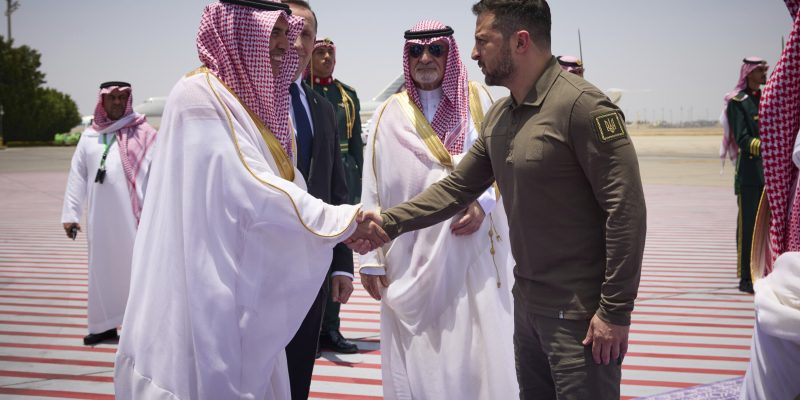
The GCC states have already proven their success at mediation throughout the conflict. According to the UAE Ministry of Foreign Affairs, Abu Dhabi has facilitated the exchange of 3,771 POWs since the beginning of the war. For its part, Qatar has reunited 107 children displaced by the conflict with their families. Saudi Arabia’s approach to the conflict has emphasized the Kingdom’s neutrality, allowing it to emerge as “a friend to both Ukraine and Russia.” This status empowered Saudi Arabia to host a number of prominent diplomatic events, such as President Zelensky’s speech at the 2022 Arab League Summit, a 2023 international summit in Jeddah that was attended by more than 40 countries, and a recent meeting between the United States and Russia in Riyadh in February 2025.
The GCC states’ ability to influence the Ukraine conflict stems from their increasingly influential role as energy titans. As central actors within OPEC+, Saudi Arabia and Russia have been coordinating their oil productions since 2022. Similarly, in March 2025, Putin discussed the importance of cooperation with UAE President Mohammed bin Zayed (MBZ), another crucial OPEC+ partner. The two leaders emphasized the need for “close coordination” in order to maintain market stability.
Simultaneously, Qatar has expanded its ties with Europe, which gives Doha significant leverage over Kyiv’s Western backers. Following the imposition of international sanctions on Russia, Qatar signed a 27-year contract with Royal Dutch Shell and a deal with TotalEnergies to supply the French energy giant. The 2024 EU-GCC summit reinforced these ties, and the planned 2026 Summit, due to be hosted in Saudi Arabia, will likely further cement the blocs’ closeness. This use of energy diplomacy has ultimately enabled the Gulf states to balance relations with all sides of the conflict and establish themselves as reliable economic partners.
The leading Gulf states should also leverage their immense financial power to aid reconstruction in the areas devastated by the Russia-Ukraine war. In 2025, during one of Saudi Arabia’s attempts to broker a ceasefire, Saudi Crown Prince Mohammed bin Salman (MBS) pledged his country’s support for the reconstruction of Ukraine in a meeting with Ukrainian President Volodymyr Zelensky. The two leaders discussed policies to enhance trade, financial flows, Ukraine’s agricultural sector, as well as potential partnerships in gas, oil, and petrochemicals.
Toward a Sustainable Peace
Given their special status as rising powers within an emerging multipolar international system, the Gulf states have demonstrated their ability to act as effective mediators across an array of seemingly intractable conflicts. By reaffirming their diplomatic independence, building trusted relationships, and pledging their commitment to ending conflicts across the globe, the Gulf states have demonstrated their willingness and capability to promote peace.
As commercial and financial heavyweights, the Gulf states possess the resources and the legal foundations to support Ukrainian reconstruction. Indeed, some Gulf states have already taken steps toward this goal; Ukraine and the UAE recently signed a Comprehensive Economic Partnership (CEPA) deal aimed at boosting their economic partnership. The deal is expected to contribute $369 million to the UAE’s GDP by 2031. This deal aims to assist Ukraine’s economic recovery and offer new opportunities for collaboration in many sectors.
The strategic approach of the Gulf countries to international affairs—rooted in soft power and a “win-win” logic—provides a viable and realistic pathway to peace in Ukraine. As recent history shows, the GCC states can offer more than symbolic gestures. The Gulf monarchies have demonstrated a deliberate and repeatable strategy for resolving conflict. But the conflict between Ukraine and Russia may be their biggest challenge yet.
The views and opinions expressed in this article are those of the authors and do not necessarily reflect the views of Gulf International Forum.
Issue: Geopolitics
Country: GCC

Dr. Diana Galeeva is a former Non-Resident Fellow with Gulf International Forum. She previously was an Academic Visitor to St. Antony’s College, University of Oxford (2019-2022). Dr. Galeeva is the author of two books “Qatar: The Practice of Rented Power” (Routledge, 2022) and “Russia and the GCC: The Case of Tatarstan’s Paradiplomacy” (I.B. Tauris/ Bloomsbury, 2022). She is also a co-editor of the collection “Post-Brexit Europe and UK: Policy Challenges Towards Iran and the GCC States” (Palgrave Macmillan, 2021). Dr. Galeeva completed her bachelor at Kazan Federal University (Russia), she holds MA from Exeter University (UK) and Ph.D. from Durham University (UK). Beyond academia, she was an intern at the President of Tatarstan’s Office for the Department of Integration with Religious Associations (2012) and the Cabinet of Ministers of the Republic of Tatarstan (2011) (Russia).

China’s Technology Development Push Meets Gulf Diversification
October 6, 2026China’s “new quality productive forces” (NQPF) are often understood as a domestic effort to revive growth, upgrade industry, and reduce dependence on Western technology. Yet…

Riyadh Shifts Toward Minilateralism as Regional Threats Mount
September 9, 2026Saudi Arabia’s signing of the Mecca Joint Defense Agreement with Türkiye and Pakistan on August 7 marks a crucial development in the evolution of the…

Toward a New Order in MENA Regional Geopolitics
September 2, 2026This report is a byproduct of the workshop “Toward a New Order in MENA Regional Geopolitics: What’s Next for the Region’s Geopolitical Equilibrium?,” hosted in…