Contrasting Visions and Popular Discontent in Iran’s Presidential Election
Iran’s presidential elections highlighted divergent foreign policy views. Some candidates supported direct negotiations with the West, others rejected any concessions, and a balanced approach advocating dialogue within limits was also presented.

On Friday, June 28, 2024, Iranians headed to the ballot centers to cast their votes in the presidential elections. Initially, six candidates were in the race, but a day before the elections, two conservative candidates withdrew, leaving four contenders: one reformist/moderate and three from the conservative/hardline camp of the Islamic Republic. As no candidate secured 50% of the votes, the two with the highest vote counts, Hardliner Saeed Jalili and Reformist Masoud Pezeshkian, will advance to the second round.
A week before the elections, on Monday, June 24, the six candidates participated in the campaign season’s fourth debate, broadcast on national television. The debate focused on Iran’s status in the international community, the impact of Western sanctions on its economy, and the candidates’ foreign policy strategies. This debate offered crucial insights into the varied perspectives within the Islamic Republic on handling relations with the West, Russia, and China.
The experience of more than four decades of international sanctions has had deleterious effect on the Iranian economy, and the candidates’ plans to address this issue will unquestionably have a significant impact on the final result. However, the candidates find themselves in a difficult spot. On the one hand, they must reassure voters that they will improve the country’s economy, which will necessarily require reconciliation with the West. On the other hand, they must also prove their revolutionary credentials to the powers that be—the political and religious elites that control the levers of power. Navigating this impossible contradiction will test the skills of even the most deft would-be president.
Seeing Sanctions Differently
Candidates’ views on sanctions differ significantly, but fall within three general perspectives. The first, held by the only reformist candidate, Masoud Pezeshkian, and the traditional conservative candidate, Mostafa Pourmohammadi, judges that the sanctions are too harmful to the country’s economy not to be immediately addressed. Consequently, Pezeshkian and Pourmohammadi advocate for immediate negotiations with the West, including potential concessions on Iran’s nuclear activities as a bargaining chip.
The second position, adopted by the radical conservatives Saeed Jalili, Alireza Zakani, and Amirhossein Ghazizadeh, is diametrically opposite the first. It sees any effort to negotiate sanctions relief as a betrayal of the country and of the revolution. These candidates have argued that the tendency of reformist and moderate leaders to acquiesce to Western demands led to the conclusion of the 2015 nuclear negotiations agreement known as the Joint Comprehensive Plan of Action (JCPOA). Though Iranians were initially enthusiastic about the deal as a way to free the country from debilitating sanctions, U.S. President Donald Trump’s unilateral withdrawal from the deal in May 2018 left it worse off than it was in 2014. By the logic of the archconservatives, Western perfidy makes any deal with Iran unreliable, and Iran should simply try to work around the sanctions however possible.
The third perspective, espoused by pragmatic conservative Mohammad Baqir Qalibaf, is the most untraditional of the three. In an effort to maintain his revolutionary credentials while recognizing the public’s concerns, Qalibaf has asserted that Iran could seek sanctions relief, including some form of negotiation with the West, without abandoning its core security interests.
The reformist Pezeshkian has called the international sanctions regime an economic war against Iran, the foremost victims of which are the country’s poorest citizens. He criticized the embargo traders—the businessmen, private companies, and government officials who rake in huge profits for mediating the import of goods due to the ban on sales under sanctions—as corrupt middlemen with their own interests, rather than their country’s, at heart. Pezeshkian, who advocates for a return to the JCPOA, slammed the other candidates for having no alternative to bring about sanctions relief.
Pourmohammadi, the traditional conservative candidate, is considered the “phenomenon” of the election because—despite being a revolutionary and fundamentalist—he has abandoned traditional talking points and spoken plainly about the obstacles facing Iran. For the hardliners, Pourmohammadi’s approach is nothing short of political heresy, but has won him an unusual degree of support among Iranians frustrated with the country’s staid politics. He considers sanctions relief a priority due to the country’s dire economy. In Pourmohammadi’s view, to unlock international commerce and improve living conditions for Iranians, Tehran must pursue sanctions relief by some means. Whereas his fellow conservatives wear their country’s isolation as proof of its revolutionary credentials, Pourmohammadi has advanced the more realistic argument that sanctions must be overcome if Iran is to strengthen its position vis-a-vis its adversaries.
Conversely, Zakani and Ghazizadeh—both dropped out of the race a day before elections—proudly consider themselves the ideological heirs of Ebrahim Raisi, the late president, and consider the sanctions regime an opportunity to build up Iran’s domestic capacity. Zakani has argued that Iran is capable of neutralizing the worst effects of international sanctions, but that diplomacy must also play a role in long-term relief.
Jalili has taken an unusual approach to the debate. He has reasoned that instead of emphasizing only negotiations to lift the sanctions, Tehran should also take measures to raise the costs on foreign parties that have imposed restrictions on the Islamic Republic. According to him, Iran should secure its economic future by “utilizing opportunities” available to it. In this way, economic growth can be decoupled from the presence of foreign capital.
Of all of the candidates, Qalibaf’s attitude toward the sanctions has been the most nuanced, and perhaps the most intelligent. Some of this is undoubtedly borne of political calculation; the former IRGC officer does not want to act against the opinions of the radical revolutionaries, so that he will be supported by them later. At the same time, he does not want to lose the votes of the youth, who are less revolutionary and advocate for negotiations with the West. Qalibaf suggests that if elected, he will prioritize diplomacy and dialogue with the world. But such diplomacy will necessarily take place within the bounds established by Supreme Leader Ali Khamenei and the Islamic Republic’s political elites; Qalibaf has consistently advocated for ensuring internal government consensus before pursuing foreign policy decisions.
East or West?
While all candidates recognize that sanctions will have an effect on the next president’s foreign policy decisions, their proposed solutions take wildly different forms. Traditional conservative candidates have generally adopted the policy of “Looking to the East,” which has become a central element of Iran’s foreign policy. This is the preferred strategy of Supreme Leader Khamenei, although some insiders have warned that Iran may find itself dominated by China and Russia if it aligns too closely with the East. Nevertheless, Ghazizadeh, Zakani, and Jalili have indicated in their public comments a belief that the East is ascendant while the West is in decline. Consequently, in their view, Iran must integrate itself into the new order advocated by Beijing and Moscow to secure a prosperous future.
By contrast, Pezeshkian has openly declared that he would speed up his relations and negotiations with the West. Although he has stressed the need for good relations with Moscow and Beijing, he has also emphasized the importance of revisiting negotiations with Western powers, including the United States. Rather than picking a side, Pezeshkian has claimed that his government’s foreign policy will be neither anti-Western nor anti-Eastern, but open to all.
As usual, Qalibaf’s position threads the needle. Although he has stated that he does not oppose interaction with the Western world, he also considers Iran’s relationship with the East a main pillar of its foreign policy. He says that he believes the Islamic Republic should leverage all of the opportunities granted by Iran’s relations with China and Russia (and one should not forget that the BRICS group and the Shanghai Cooperation Organization could prove a decisive source of foreign investment).
The Financial Action Task Force, the intergovernmental anti-money laundering organization that has blacklisted Iran over terror financing concerns, has become one of the candidates’ debate topics. Iran has not joined some of its conventions, and when Hassan Rouhani’s government announced its desire to settle the country’s issues with the FATF—with an eye towards eventual membership—it faced opposition from revolutionary radicals. In one of the debates, Pourmohammadi revealed that in 2016, Jalili, then serving as Khamenei’s representative in the Supreme National Security Council, stated that he did not oppose the FATF, but he did not want it to be approved by the reformist Rouhani government. After this revelation, Jalili faced widespread criticism from Iran’s reformists, who condemned the conservatives’ willingness to use the economy, the lifting of sanctions, the livelihood of the people, and even core national interests as political chess pieces.
If the June 24 debate and the previous contests have confirmed anything in the eyes of ordinary Iranians, it is that there is little hope for fundamental political change in Iran. Across the debates, the candidates accused each other of treason and likened attempts to remove sanctions through negotiations to Westernization and defeatism. For the hardline conservatives, the fact that Iran could sell two million barrels of oil per day on the global market served as proof that the sanctions were ineffective—even though they dramatically worsened the economic conditions for ordinary Iranians. But Pezeshkian and his foremost advisor, former Iranian Foreign Minister Mohammad Javad Zarif, have rejected this rosy assessment of the country’s economic outlook and reminded the country of its precarious future. What, they asked, would the conservatives do if Donald Trump returns to the White House and places ever-greater sanctions on oil exports?
Desperate to improve their quality of life, ordinary Iranians have consistently called for the regime to seek sanctions relief—but many believe the government is exceedingly unlikely to heed their calls. Under these impossible circumstances, the most popular electoral choice among Iranian voters may be the simplest: the choice to ignore the election altogether.
The views and opinions expressed in this article are those of the authors and do not necessarily reflect the views of Gulf International Forum.
Issue: Politics & Governance
Country: Iran

Dr. Mohammad Salami holds a Ph.D. in International Relations. He is a specialist in Middle Eastern policy, particularly in Syria, Iran, Yemen, and the Persian Gulf region. His areas of expertise include politics and governance, security, and counterterrorism. He writes as an analyst and columnist in various media outlets. Follow him on Twitter: @moh_salami
Why Iran Never Knows When to Stop
July 27, 2026At first glance, Iran’s negotiating difficulties appear to stem from disagreements between pragmatists seeking sanctions relief and hardliners determined to resist compromise. Yet that explanation…
Iraq’s Corruption Crackdown
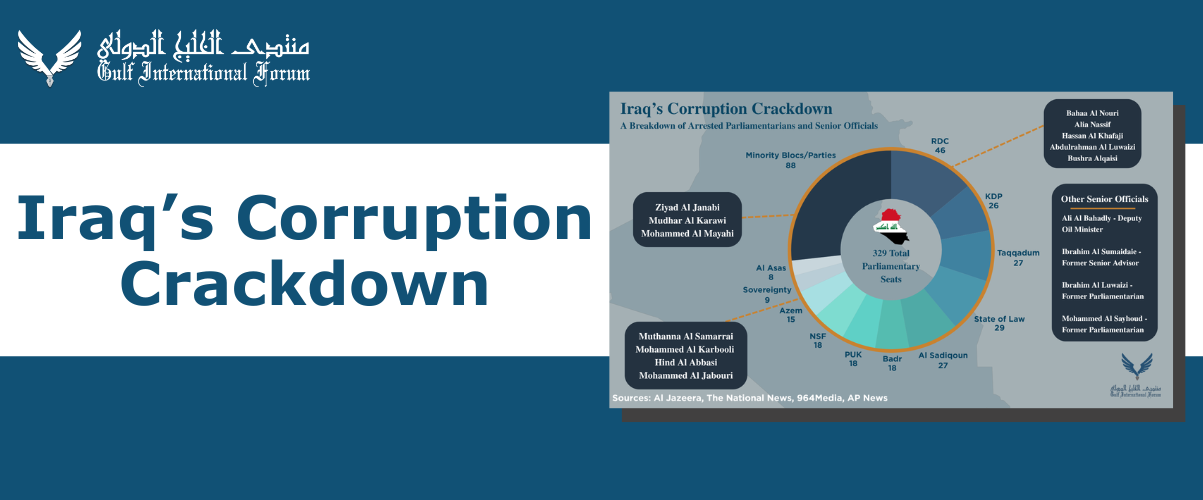
July 22, 2026*A breakdown of arrested parliamentarians and senior officials as of June 28, 2026.
Sheikh Hamad and the Making of Modern Qatar
July 15, 2026There is a question that haunts every small state: how does a nation survive and stay relevant in a region built for giants? For most…