


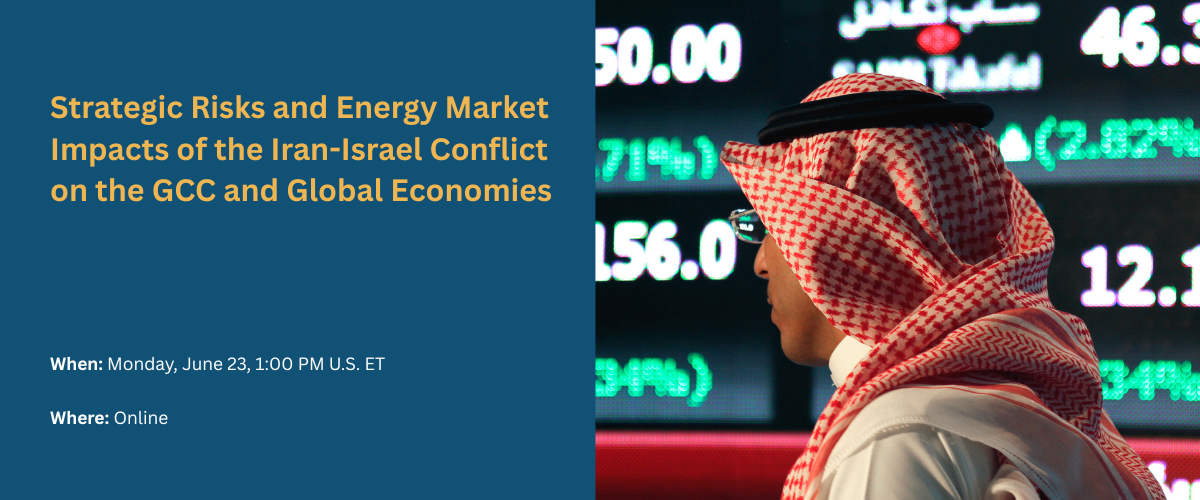
Strategic Risks and Energy Market Impacts of the Iran-Israel Conflict on the GCC and Global Economies
Synopsis:
The confrontation between Iran and Israel has introduced new volatility into global energy markets, with immediate repercussions for oil and gas supply chains, regional stability, and the economic outlook of the Gulf Cooperation Council (GCC) states. Escalating tensions increase the likelihood of supply disruptions, particularly through the Strait of Hormuz, a vital chokepoint through which roughly one-fifth of global oil passes. Any disruption to maritime transit or infrastructure—whether through direct military strikes, cyberattacks, or proxy escalations—could lead to sharp spikes in oil and gas prices, strain global supply chains, and heighten inflationary pressures.
GCC economies face both direct exposure to conflict spillovers and broader structural challenges. While high energy prices may result in short-term revenue gains for oil and gas exporters, these benefits are offset by increased geopolitical risk, investor uncertainty, and potential constraints on foreign direct investment. Qatar’s LNG exports, the UAE’s infrastructure security, and Saudi Arabia’s diversification strategies are all vulnerable to regional instability and reputational risk.
In the longer term, persistent geopolitical instability could accelerate the global shift away from reliance on Middle Eastern hydrocarbons, prompting consumers and investors to diversify supply routes and invest more heavily in energy transition strategies. Additionally, prolonged conflict risks undermining confidence in the region’s role as a reliable energy supplier and economic hub. The cumulative effect may reconfigure global energy flows and weaken economic resilience across the GCC if not mitigated by coordinated risk management, diplomatic engagement, and strategic adaptation.
Featuring: Rachel Ziemba, Alia Moubayed, Dr. Justin Dargin, and Dr. Harold York.
Bios:
 Rachel Ziemba
Founder, Ziemba Insights; Senior Non-Resident Fellow, Gulf International Forum
Ms. Rachel Ziemba is a Senior Non-Resident Fellow. She is the founder of Ziemba Insights, a macroeconomics and policy due-diligence advisory firm. Additionally, Ms. Ziemba is an Adjunct Fellow at the Center for a New American Security, and an Adjunct Lecturer at NYU, Center for Global Affairs. Ms. Ziemba is also a Senior Advisor at Horizon Engage. Her research topics include coercive economic policies such as sanctions, economic resilience and the role of state-owned investors including sovereign wealth funds.
 Alia Moubayed
Managing Director, Jefferies
Alia Moubayed is an experienced economist and policy practitioner with more than 25 years of experience in government, international financial institutions, think tanks and financial markets. She is currently the Chief Economist and strategist for the Middle East, North Africa, Pakistan at Jefferies, an investment bank based in London. Prior to that, She was the Director of the Geo-economics and Strategy Program at the International Institute for Strategic Studies (2017-18), after spending 8 years as MENA Chief Economist at Barclays (2008-2016) focusing on economics and geopolitics of the Middle East. Before that, she joined the Young Professionals Program at the World Bank and worked as senior economist covering Indonesia and countries in the Western Balkans (2002-2008). She also held various research and policy responsibilities in Lebanon (1994-2002). Alia holds a BA in Economics and an MBA from the American University of Beirut, as well as a Master equivalent in Public Policy and Public Administration from the Ecole Nationale d’Administration (ENA) in France. She is also the founder of AWEAMENA – the Association of Women in Economics Across the Middle East and North Africa aimed at promoting the role of women in economic policy making in the region.
 Dr. Justin Dargin
Senior Visiting Fellow, the Middle East Council on Global Affairs
Dr. Justin Dargin is a Senior Visiting Fellow at the Middle East Council on Global Affairs, specializing in the intersection of Middle East energy markets, geopolitics, and climate change.
Previously, he served as a senior MENA energy and climate scholar at the University of Oxford, where his research focused on developing macroeconomic decarbonization pathways for energy-rich Arab states. Prior to that, he was a MENA Fulbright Scholar and a fellow at Harvard University’s Kennedy School, where he pioneered the first policy frameworks for Gulf carbon market development.
Dr. Dargin has advised energy companies, governments, and multilateral organizations on energy investment strategies, climate diplomacy, and decarbonization efforts. His earlier roles include Legal Advisor to OPEC and Research Fellow at the Oxford Institute for Energy Studies.
His work has earned several international awards, including the Harvard Arab Alumni Association Prize, the St. Gallen Symposium Wings of Excellence Award, and the UN Sustainable Endowment’s Building a Clean Energy Future Award. He also founded an award-winning NGO focused on expanding access to clean energy and sustainable development in the Global South.
Dr. Dargin has authored numerous articles, book chapters, and several books. His forthcoming publication, The Gulf’s Climate Reckoning: Decarbonization, Development, and the Future of the Petro-States (Cambridge University Press, 2025), examines the region’s evolving climate and energy landscape.
His analysis has been featured in Time Magazine, The Financial Times, Al Jazeera, The New York Times, and other global media outlets. He holds a Ph.D. from the University of Oxford and earned his law degree magna cum laude from Georgetown University Law Center.
 Dr. Harold York
Nonresident Fellow in Energy and Global Oil in the Center for Energy Studies, Rice University’s Baker Institute for Public Policy
Dr. Harold York is the nonresident fellow in energy and global oil in the Center for Energy Studies at Rice University’s Baker Institute for Public Policy. He has over 30 years of experience working on strategic issues that shape the energy and mining industries.
Before the Baker Institute, Dr. York was the Head of Commodity Strategy for Petroleum at BHP. He is also the Chief Energy Strategist at Turner Mason & Company, an energy consulting and advisory firm focused on the crude oil, refining, midstream and biofuels industries. He has additional industry experience with ExxonMobil and management consulting with McKinsey & Company, Charles River Associates, and Wood Mackenzie. Skip holds a PhD in Economics from the University of Virginia and an undergraduate degree in Economics from the University of Wyoming. He did post-graduate work at IIASA (International Institute of Applied Systems Analysis) in Vienna, Austria.