Failing the Future: The Abysmal Condition of Higher Education in Iraq
Iraq’s education system, once among the best in the Middle East, has deteriorated due to economic collapse, international sanctions, corruption, and political interference since the Gulf War. This decline, compounded by inadequate funding, outdated infrastructure, and rampant academic corruption—including widespread fake diplomas—threatens the future of the country’s intellectual and professional standards.

Iraq’s education system was once hailed as one of the best in the Middle East, but it sharply deteriorated after the end of the Gulf War and the imposition of international sanctions against Iraq in 1991. Today, almost no Iraqi colleges are included in the prestigious Shanghai university ranking; the country’s foremost university, the University of Baghdad, barely registers. The deterioration in Iraq’s education system came as part of a broader collapse of the country’s economy throughout the 1990s and particularly after 2003; in addition to declining investments, it became plagued by corruption and political interference. Under Saddam Hussein’s rule, students were drawn to Iraqi universities primarily for the sake of employment rather than education, as university graduates were promised public jobs, regardless of the need or the fields they chose to enter.
Underfunded and Underprepared
These problems—initiated with the collapse of the Iraqi economy in 1991—deteriorated to unprecedented levels after the 2003 invasion, the country’s subsequent civil war, and the rise of ISIS. Iraq’s higher education is currently beset by inadequate infrastructure, outdated facilities, and limited access to necessary resources which makes it very challenging to nurture a new Iraqi generation well-equipped to deal with numerous difficulties the country is facing. The allocated budget for education in Iraq has been hovering around $7 billion, but more than 70% of this total goes to primary and secondary rather than tertiary education. Although it may be that the money is best used in that way, the fact remains that the budget for the Ministry of Higher Education and Scientific Research constitutes only 1-2% of the national budget, a shockingly inadequate number if Iraq is to regain its higher education system.
Moreover, most of this miniscule budget is being spent on maintaining the functionality of the ministry, such as paying the salaries of teachers and administrators, without additional investments in education. According to a report by the World Bank, Iraq’s infrastructure for higher education is woefully unprepared to integrate incoming students, nor is it providing proper training for the teaching staff. The space between the public universities’ limited capacity and the numbers of Iraqi students interested in an education is being exploited by private universities that fail to meet the most basic standards in teaching. As a result, attempts by the Iraq government to promote the country as an attractive destination for international students have largely flopped.
Degrees of Corruption
The failure of the Iraqi government to invest in its higher education system is compounded by inimical political interference. A decline in academic freedoms, government meddling in faculty appointments, and ideological influences on universities’ curricula have compromised the integrity of Iraqi academic institutions. A member of the Iraqi parliament, for example, recently accused political parties of undermining academic institutions by shuffling the deans of universities and departments. Abdul Razzaq al-Issa, the former Minister of Higher Education and Scientific Research, admitted that the major parties’ partisan political agendas have a direct influence on the policies of the universities—a pattern with clear detrimental effects on scientific and professional standards within Iraq. In fact, at least in some instances, the government has failed to protect the faculty from its own security forces. For two years, the assistant dean at one of Iraq’s largest universities was threatened, and later was beaten and jailed, by a police officer without any consequences. This incident was one of many in which, in the words of one scholar, “Iraq’s intellectual and technical class [was] subject to a systematic and on-going campaign of intimidation, abduction, extortion, random killings and targeted assassinations.”
Corruption, in its various forms, is another major contributor to the deterioration of Iraq’s higher education system. A member of the Iraqi parliament’s higher education committee revealed that many within the government used fake diplomas in order to become employed—including other members of the parliament. The Popular Mobilization Forces, the Iraqi militia umbrella linked to the country’s pro-Iran parties, also stated that 2,000 of its members would gain entry to public universities—a step primarily chalked up to the PMF’s political influence, given that its members’ GPAs are far lower than other, better qualified students. This corruption is not confined to students studying in Iraq; approximately 27,000 university degrees were simply bought by Iraqi students from three Lebanese universities, with prices that averaged $5,000 for a master’s degree and $10,000 for a PhD. The Education Committee revealed that nine out of every ten higher education degrees obtained by graduate students outside Iraq since 2003 were fake or forged.
The inability of the Iraqi government to maintain minimum standards of higher education will have troubling effects for the country’s future. The next generation of Iraqis—already affected by the U.S. invasion and the carnage of civil war—will have little exposure to advancements in the sciences and virtually no ability to gain experience in academic research. Moreover, because a college degree is regarded only as a tool to enter the job market rather than a useful end in and of itself, Iraqis will be incentivized to cheat—as evidenced by the astonishing number of fake diplomas among Iraqi leaders—and will disregard the value of knowledge on its own merits.
The reforms in Iraq’s higher education system must come as an extension of general reforms in the country. In addition, the country’s meager investment in higher education has direct impacts on its quality, and consequently leads to a widening gap between Iraq and the rest of the world. For Iraq to fully recover from its past, it is critical for this trend to be reversed.
The views and opinions expressed in this article are those of the authors and do not necessarily reflect the views of Gulf International Forum.
Issue: Politics & Governance
Country: Iraq

Dr. Massaab Al-Aloosy is a researcher focusing on Iraq, Iran, and Shia non-state armed groups. He holds a PhD from the Fletcher School-Tufts University and is the author of The Changing Ideology of Hezbollah, Palgrave 2020.
Why Iran Never Knows When to Stop
July 27, 2026At first glance, Iran’s negotiating difficulties appear to stem from disagreements between pragmatists seeking sanctions relief and hardliners determined to resist compromise. Yet that explanation…
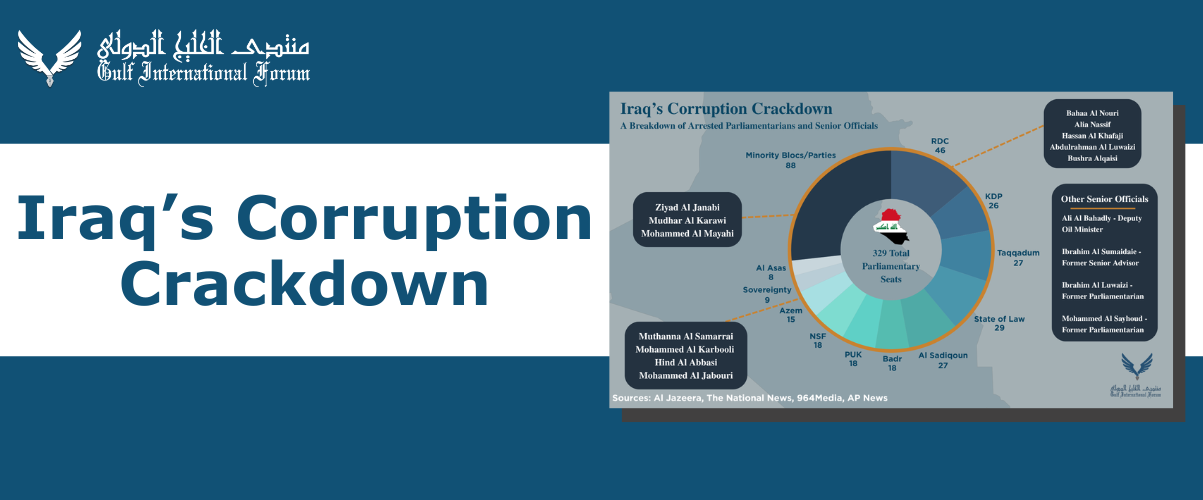
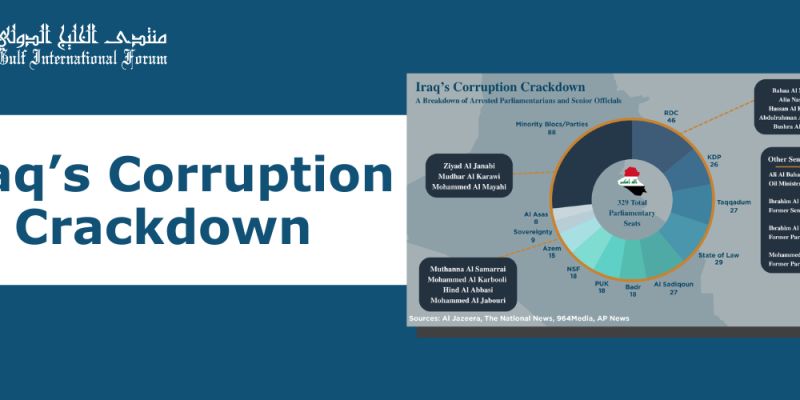
Iraq’s Corruption Crackdown
July 22, 2026*A breakdown of arrested parliamentarians and senior officials as of June 28, 2026.
Sheikh Hamad and the Making of Modern Qatar
July 15, 2026There is a question that haunts every small state: how does a nation survive and stay relevant in a region built for giants? For most…