From Amir of Pardons to a New Vision: Charting Kuwait’s Political Transition under Shaykh Mishal
The leadership transition in Kuwait, from Shaykh Nawaf to Shaykh Mishal, marks a critical juncture in addressing the nation’s longstanding political gridlock and economic challenges. While Shaykh Nawaf’s reconciliatory measures, like issuing pardons, played a role in easing political tensions, Shaykh Mishal’s approach, focusing on governance reforms and economic diversification, may offer a different path towards stability and progress in Kuwait.

Kuwaiti Amir Shaykh Nawaf al-Ahmed al-Jaber al-Sabah passed away last week following a nearly three-year reign. Shaykh Nawaf is perhaps best known during his time as amir for having pardoned dozens of Kuwaitis accused of political crimes, calming recurring tensions and earning him the nickname of the “amir of pardons.” Shaykh Nawaf had previously served as defense minister during the Iraqi invasion of Kuwait in 1990-91; over the course of his long career, he also served as minister of labor and interior, as well as deputy chief of the National Guard and governor before his appointment as Crown Prince in 2006. Shaykh Mishal al-Ahmed al-Jaber al-Sabah, Shaykh Nawaf’s half-brother and crown prince and the former director of the Kuwait State Security Service, took the throne on December 16.
Untangling Kuwait’s Perpetual Gridlock
Throughout his rule, Shaykh Nawaf worked to build up trust between the opposition-heavy parliament and the unelected segments of the political executive. In the summer of 2022, he helped to defuse an open-ended political crisis by issuing pardons to opposition lawmakers convicted of disrupting parliament, many of whom had been forced to leave the country; he also ended a dispute over the legitimacy of the sitting parliament by dissolving it and calling for new elections in the summer of 2022. In announcing the new elections, Shaykh Mishal, delivering the speech on behalf of Shaykh Nawaf, proclaimed: “Our goal with this constitutional solution is the firm and sincere desire for the people themselves to have the final say in the process of correcting the political course anew by choosing who represents the right choice.” Shaykh Nawaf also pledged that the government would not interfere in the election, in hopes of resetting relations between the political opposition and executive, which had been strained since the Irhal protests against the al-Sabah prime minister that emerged in 2009.
Despite Shaykh Nawaf’s significant efforts, and in large part due to Kuwait’s idiosyncratic political system, the relationship between the executive branch and the political opposition has remained difficult. The parliament is regularly filled with “opposition” lawmakers, but broad restrictions on political organizing and the individual agendas of Kuwaiti MPs have led to chaos and a systemic failure to implement badly-needed institutional changes.
Perhaps in an effort to end the gridlock, shortly before the amir’s death, parliament approved a draft law to reform the country’s election system by introducing party-like lists, as well as by abolishing the single-non transferable vote (SNTV) system put in place by Shaykh Sabah (Shaykh Nawaf’s predecessor) in 2012. It is uncertain whether this system, which is preferred by many opposition figures in parliament, will be put in place, and what effect it will have on the composition of parliament.
The New Agenda
What is certain, however, is that the new amir has a vision for the country. In his first speech as Kuwait’s ruler, Shaykh Mishal took a direct and clear stance, criticizing both the cabinet and the parliament and stating that the two had together “harmed the interests of the people and the country.” Although Shaykh Mishal indicated that he would abide by his predecessor’s pardons, he expressed dissatisfaction with them, saying that they were “not consistent with the simplest rules of justice and fairness”—subtly suggesting that such pardons would not be forthcoming during his term in office. In the same speech, the new amir also announced that he would freeze promotions and new appointments, having signed a decree pausing state hiring on 5 December. The cabinet, unsurprisingly, reacted to the speech by resigning en masse; Shaykh Mishal’s first official act as Amir was to accept their resignations.
In the days ahead, Shaykh Mishal has indicated a desire to improve relations between cabinet and parliament. One positive consequence of improved intra-governmental relations would be to advance Kuwait’s efforts at diversifying its economy away from a reliance on hydrocarbons. Indeed, although Kuwait registered a surplus over the past fiscal year—helped in large part due to the spike in oil prices following the Russian invasion of Ukraine—more than 93 percent of government revenue continues to come from hydrocarbons. The process of labor force nationalization and progress towards Vision 2035 are likely to continue on the domestic front. In his speech, Shaykh Mishal also referenced a need to fight corruption and strengthen government accountability.
On the regional front, it is very unlikely that Kuwait will dramatically change its foreign policy stances. Kuwait has always sought to be a neutral mediator in the region, (though it has taken an outspoken stance in admonishing Israel for the high civilian death toll in the Gaza Strip). In his speech, Shaykh Mishal emphasized “the continuation of the pioneering approach and the role of the State of Kuwait with friendly and brotherly countries on various issues of common interest,” specifically to “preserve his country’s regional and international commitments in the Gulf.”
Kuwait faces two ongoing regional border disputes. The first relates to the Durrah/Arash gas field, in which Iran and Saudi Arabia also have claims and which the Kuwait Oil Company plans to exploit in coming years. The second relates to the Khor Abdullah maritime border with Iraq, which had originally been negotiated in 2012 but whose settlement was recently nullified by the Iraqi Supreme Court. Despite potential tensions with Iran and Iraq, Kuwait will remain closely linked with its Gulf Cooperation Council allies; indeed, the country hosted joint military exercises with the GCC last month and is likely to continue strengthening regional cooperation, particularly in light of the continued Houthi threat.
In terms of succession, there is no set pattern, as long as the amir is a descendant of Shaykh Mubarak al-Sabah, who ruled Kuwait in the nineteenth century. Until 2006, all amirs had served previously as Kuwait’s prime minister, but this pattern was broken after the rule of Shaykh Sabah (r. 2006-2020). With the accession of Shaykh Mishal, we may see the next amir coming from a security background. The consequences of this shift are unclear. In the past where the roles of prime minister and amir were linked, future amirs were vulnerable to challenges from political opposition during their roles as prime ministers. This scenario presented the risk of a no-confidence vote, serious rebuke, and an impediment to their future appointment as amirs. However, if future amirs are no longer sourced from ministerial positions, this threat diminishes. While this shift might enhance stability, it simultaneously weakens a vital mechanism for executive power regulation.
In short, the most likely outcome for Kuwait in the near term is stability under Shaykh Mishal, who is likely to calm parliamentary discontent and pursue reforms to make governance more efficient and transparent, as well as pushing for economic diversification goals. On the regional and international stage, Shaykh Mishal is likely to push for a continuity of Kuwait’s current foreign policy.
The views and opinions expressed in this article are those of the authors and do not necessarily reflect the views of Gulf International Forum.
Issue: Politics & Governance
Country: Kuwait

Dr. Courtney Freer is an Assistant Professor in the Department of Middle Eastern and South Asian Studies at Emory University and a senior nonresident fellow at the Gulf International Forum. Her academic work focuses on domestic politics and Islamism in the Gulf states; she is the author of Rentier Islamism: The Influence of the Muslim Brotherhood in Gulf Monarchies (Oxford University Press, 2018), The Resilience of Parliamentary Politics in Kuwait: Rentierism, Ideology, and Mobilization (Oxford University Press, 2024) and co-author with Alanoud al-Sharekh of Tribalism and Political Power in the Gulf: State-Building and National Identity in Kuwait, Qatar and the UAE (IB Tauris, 2021). Courtney holds a BA in Near Eastern Studies from Princeton University, an MA in Middle Eastern Studies from The George Washington University, and. DPhil in Politics from the University of Oxford. She has held positions at the US-Saudi Arabian Business Council, Brookings Doha Center, and the London School of Economics and Political Science.
Why Iran Never Knows When to Stop
July 27, 2026At first glance, Iran’s negotiating difficulties appear to stem from disagreements between pragmatists seeking sanctions relief and hardliners determined to resist compromise. Yet that explanation…
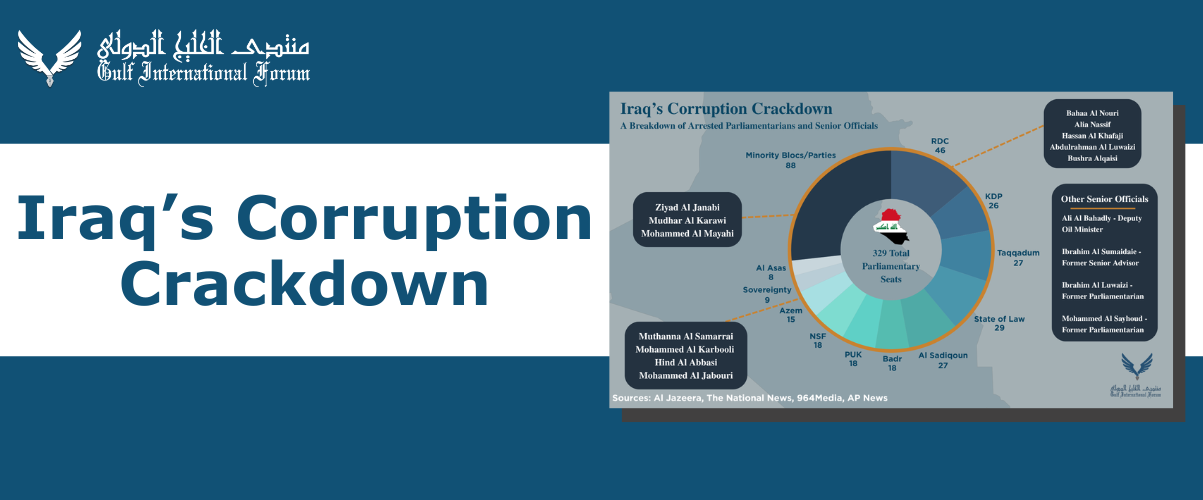
Iraq’s Corruption Crackdown
July 22, 2026*A breakdown of arrested parliamentarians and senior officials as of June 28, 2026.
Sheikh Hamad and the Making of Modern Qatar
July 15, 2026There is a question that haunts every small state: how does a nation survive and stay relevant in a region built for giants? For most…