From Sanctions to Seizures: The New U.S. Push to Halt Iranian Oil Shipments
The Trump administration’s new approach to enforcing sanctions is more hands-on than ever before.

According to media reports, the Trump administration is thinking about physically intercepting and inspecting Iranian oil tankers on the high seas as part of a major escalation of Washington’s so-called “maximum pressure” campaign against the Islamic Republic. According to March 2025 reports, American authorities are considering using the Global War on Terror-era Proliferation Security Initiative (PSI) as a legal basis to board and inspect ships suspected of transporting Iranian petroleum.
Washington plans to use the world’s natural sea lane chokepoints to slash Iran’s oil exports and pressure Tehran into making major concessions over its nuclear program. Such efforts, however, run the danger of inciting a strong response from Iran and its trading partners, or disrupting global energy markets.
The Next Evolution of Maximum Pressure
During President Trump’s first term, the maximum pressure campaign sought to limit Iran‘s financial and commercial relationships with the world and pressure the regime to abandon its nuclear program. Though the plan is intuitive, it almost immediately ran into reality when Washington struggled to find quantifiable evidence of its success. Iran’s smuggling networks made around $53 billion in oil earnings for the regime in 2023, despite the fact that many of Trump’s restrictions on trade with the Islamic Republic remained in place. Moreover, President Trump never fully denied that maximum pressure hoped to depose the regime in Tehran, which only hardened Iran’s determination to undermine the policy.
Since taking office in January, the Trump Administration has already slapped two fresh rounds of sanctions on Iran. On February 6, the Treasury Department imposed restrictions on three crude oil ships and related companies that it accused of transporting Iranian crude to China. The second round, on February 24, greatly broadened the scope of the penalties to encompass more than 30 people and 13 vessels, including five Very Large Crude Carriers, or VLCCs. In the past, Iran’s “shadow fleet”—a network of antiquated tankers that operate outside of Western insurance and regulatory oversight—has enabled Iran to evade previous sanctions. Its recent moves suggest that the United States appears determined to crack down on Iran’s ability to circumvent sanctions. Indeed, the more aggressive enforcement activities being mulled by the White House are, at their core, an attempt to increase the effectiveness of the maximum pressure campaign, not a divergence from it.
Seizing Control
The PSI, a 2003 agreement signed by more than 100 countries to stop the trafficking of weapons of mass destruction, would, in theTrump administration’s view, serve as the legal foundation for its expanded maritime interdiction policy. PSI grants member states the right to board merchant vessels if there is “reasonable suspicion” that they are “transporting prohibited weapons.” Enforcement efforts have focused on strategic chokepoints in international trade lanes, especially the Strait of Malacca in Southeast Asia. This narrow channel, which separates the Malay Peninsula from Sumatra, carries around 30 percent of the world’s crude oil. It has also emerged as the focal point for Iranian attempts to circumvent sanctions.
About 40 miles east of the Strait of Malacca, Iran has concentrated a significant number of “dark fleet” tankers. These are old ships that operate under flags of convenience without Western insurance, to obfuscate their ownership and activities. These vessels conduct covert ship-to-ship oil transfers, guaranteeing that billions of dollars’ worth of sanctioned oil reach Chinese purchasers each year, despite China’s public position that it will not acquire Iranian oil.
According to Bloomberg, operators have increased the number of these transfers since 2020, with more than a dozen ship meetings taking place per day. An estimated 350 million barrels of oil, worth more than $20 billion, were traded in this offshore network in early 2024, demonstrating Iran’s reliance on expensive, high-risk trades to get around sanctions. Tehran’s economic existence depends on these operations, while China gains from cheap oil and protects its large companies from American secondary sanctions.
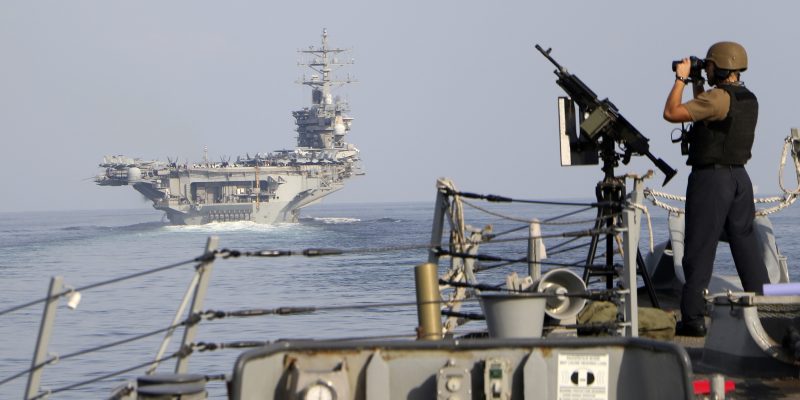
By harnessing its large naval presence near the strait, the United States seeks to delay and disrupt Iranian shipping and cause intense financial uncertainty for Tehran. The goal, at least for now, is not to seize all Iranian oil shipments—a nearly impossible task. “You don’t have to sink ships or arrest people to have that chilling effect,” a source familiar with the administration’s plans told Reuters.
The China Factor
It is no coincidence that the United States is considering clamping down on these illicit transfers amid renewed competition with China. In February, Republican senators alleged that China was providing Iran with chemicals for missile propellants. In a letter to Secretary of State Marco Rubio, they called on the government to “identify and sanction any entities involved in transferring missile propellants to Iran, including Chinese companies and ports facilitating Iranian shipments.” The senators also signed a statement that connected attempts to “impose costs on Communist China” by increasing pressure on Iran. This implies that maritime interdiction could form one aspect of a larger U.S. policy that targets Iran’s economic-military links with China, as well as Tehran’s nuclear aspirations.
Maritime trade flows could be significantly impacted by the strategy. Operations at Singapore Port, the biggest bunkering and transshipment facility in the world, could be disrupted by extensive interception efforts near the Strait of Malacca. Regional ports may also encounter inefficiencies and delays as ships attempt to avoid inspections or reroute entirely.
Strategic Challenges and Implications
Of course, there are practical and political obstacles to implementing a water-tight maritime interception policy. Implementing unilateral regulations on the high seas presents difficult international legal issues. The United States would need to coordinate with its regional allies and partners, especially from countries that control important maritime chokepoints—many of whom have no inherent interest in disrupting merchant shipping in their territorial waters.
Previous attempts by the United States to seize Iranian oil proceeds have led to retaliation. In early 2023, Iran allegedly arrested a number of foreign vessels in the Gulf after the United States confiscated approximately one million barrels of Iranian oil. The Pentagon responded by sending more troops to guard shipping routes. More intense interdiction efforts might lead to comparable or harsher retaliation, which would put international trade and the lives of merchant vessel crew members at risk.
History has also shown that Iran is adept at finding inventive ways to skirt international sanctions. It has consistently developed new strategies, including reflagging ships and using intricate webs of shell corporations, to conceal ownership and transactions. Time will tell whether the United States is capable of identifying and countering these increasingly sophisticated techniques.
Beyond its ability to cut Iran’s oil revenue, the success of the administration’s policies will ultimately depend on their wider geopolitical impact. Intensifying the maximum pressure campaign will undoubtedly affect regional stability, international energy markets, and Iran’s nuclear aspirations. The possibility for economic or military retaliation may cause international markets to become unstable. If prices at the pump begin to rise, Washington’s commitment to these measures may begin to wane.
The views and opinions expressed in this article are those of the authors and do not necessarily reflect the views of Gulf International Forum.
Issue: Economy & Innovation
Country: Iran

Dr. Umud Shokri is an accomplished energy strategist and senior foreign policy advisor with over two decades of experience. With a Ph.D. in International Relations, he specializes in global energy dynamics, climate change, clean energy technologies, energy security, and geopolitics. Currently a Senior Visiting Fellow at George Mason University, Dr. Shokri has significantly influenced policy and strategy development across the energy sector, including authoring “US Energy Diplomacy in the Caspian Sea Basin.” His work spans from analyzing oil and gas market trends to advising on sustainable energy policies, collaborating with government entities, academic institutions, and industry stakeholders to address global energy challenges. In his role as a Black Sea State Department Title VIII Fellow, Dr. Shokri focuses on Azerbaijan’s energy transition and preparations for COP29, exploring the country’s shift towards renewable energy and its socio-economic and geopolitical impacts. His commitment to environmental sustainability is reflected in his advocacy for aligning with ESG frameworks and guiding entities towards real-world greenhouse gas emission reductions. Through his research and engagement with policymakers, Dr. Shokri contributes valuable insights to the discourse on energy transition and climate action at both regional and global levels.
Saudi Arabia’s E-Commerce Boom: Why Traditional Small Businesses Risk Falling Behind
November 5, 2026Saudi Arabia’s digital marketplace is expanding rapidly. By the third quarter of 2026, the kingdom had 52,259 active e-commerce commercial registrations, up 25 percent from…
The Middle East’s Corridor Boom Meets Reality
July 22, 2026In recent years, particularly since the outbreak of the recent conflicts in Gaza and Iran, the Middle East has seen a resurgence of connectivity projects….
Iraq’s Fiscal Shock and the New Government’s Bargain
July 20, 2026The disruptions to shipping through the Strait of Hormuz have left Iraq facing more than an immediate export shock. Transport has remained constrained, insurance and…