In an Uncertain Era, Bahrain Hedges Its Bets
Manama is caught between the United States and its adversaries at a delicate geopolitical moment.

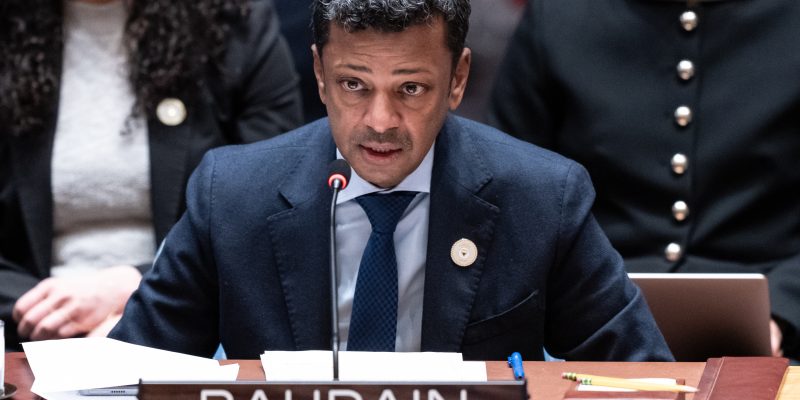
Last month, Bahrain became the latest Gulf state to declare its intention to invest large sums in the United States when Crown Prince and Prime Minister Salman bin Hamad Al Khalifa pledged $17 billion during his visit to Washington, DC. Manama’s investments follow promises of $1.4 trillion by the UAE, $1.2 trillion by Qatar, and $600 million by Saudi Arabia—albeit with the obvious problem that several of these pledges would amount to more than 100 percent of their nations’ GDP.
The Bahraini investments, notably, are in many ways linked to the bilateral Comprehensive Security Integration and Prosperity Agreement (C-SIPA) between Manama and Washington, signed in September 2023. C-SIPA not only seeks to enhance security cooperation, but also to improve economic ties between Bahrain and the United States. With Bahraini King Hamad Al Khalifa scheduled to travel to the United States later this year, it is likely that the two sides could cement additional agreements on investments in American-manufactured airplanes, computer services, the American aluminum industry, and artificial intelligence. Most notably, the two states signed an agreement in July that empowers Bahrain to develop a civilian nuclear energy program.
During the Crown Prince’s visit, U.S. President Donald Trump praised Bahrain as a “fantastic ally.” Indeed, Bahrain has remained a steadfast partner during a tumultuous period in the Middle East. In 2020, it signed the U.S.-brokered Abraham Accords to normalize ties with Israel. It also played a key role in America’s ongoing campaign against Houthi attacks in the Red Sea. Manama has hosted the US Navy’s Fifth Fleet since 1946, and is home of US Naval Forces Central Command. Further, Bahrain is the only Arab state that has publicly participated in “Operation Prosperity Guardian,” the U.S.-led security operation targeting the Houthis. Ideologically, the Bahraini leadership appears to be aligned with the Trump administration’s more assertive stance on Iran—a particularly important topic for Bahrain given Iran’s past claims to the island and Bahrain’s own Shia-majority population, a demographic point of concern for its Sunni monarchy. Notably, Bahrain is the only GCC state that has not restored diplomatic ties with Iran since their 2016 rupture, rejects Islamism more generally, and is closer to Israel than most Gulf states.
The China Issue
Of course, even the best of friends do not agree on everything, and increasingly America’s Gulf allies are seeking to expand strategic partnerships with its strategic competitors—to Washington’s consternation. Bahrain’s development of economic ties with both the United States and China, as well as its stated openness to joining the BRICS+ bloc, could indicate hedging behavior. Indeed, Bahrain’s increasingly close relationship with China, its occasional efforts to mend ties with Iran, and its recently declared “steadfast position in supporting the Palestinian cause” in spite of its ties to Israel could lead to tensions with Washington. However, such moves should ultimately be read as Bahrain’s efforts to balance various partners at home and abroad, rather than an attempt to fundamentally alter the American security umbrella or exit it altogether. Whether Trump will accept such strategic hedging remains to be seen.
When it comes to ties with China, Bahrain, like its GCC neighbors, signed an MoU to promote the Belt and Road Initiative, and ties remain warm. In May 2024, Bahrain’s King Hamad visited Beijing for the China-Arab States Cooperation Forum, during which the two signed a comprehensive strategic partnership agreement. Speaking in China, the king stated, “We believe in the necessity of adopting a peaceful dialogue and diplomacy approach based on good neighborliness and on-interference in internal affairs.” He went on to request Chinese support to restore Bahraini ties with Iran and applauded the Chinese decision to recognize Palestine as a state at the United Nations. Further, in May 2025, China announced visa-free travel for citizens of Bahrain, Kuwait, Oman, and Saudi Arabia; with their addition to the program, nationals from all six GCC nations can visit China without visas. And although Bahrain exports relatively little oil to China, energy flows vital to GCC government revenues continue to play a major role in the larger geopolitical relationship. As of 2023, China purchased 20 percent of GCC hydrocarbon exports, and the Gulf states have increasingly turned East for other imports.
A Geopolitical Gap Remains
The Trump administration’s approach to Iran may also unnerve Bahrain. Washington has pledged to return to maximum pressure, as evidenced by its strike on Iranian nuclear facilities in June. But these actions were met with statements of concern from GCC leadership. On the topic of a potential nuclear deal with Iran, the Bahraini Crown Prince said, “Should the Iranians want to negotiate, the ball’s in their court […] They are the ones who stand to benefit from a negotiation.” Trump appeared to be interested in negotiating a new nuclear deal, but also asserted that negotiations would aid the Iranian cause, suggesting that the onus was on Tehran to make a deal to save its struggling economy and that he was content to wait.
While Bahrain undoubtedly remains suspicious of Iranian intentions in the region, the ruling Al Khalifa family also fears unrest among the country’s Shia majority. The fact that several Bahraini Shia opposition figures have found refuge in Iran since the crackdown on Arab Spring protestors in 2011 has fueled the government’s rhetoric about foreign (e.g. Iranian) attempts to destabilize the kingdom. Nevertheless, relations between Manama and Tehran appeared to be on the mend before the U.S. strikes in June. In October 2024, Iranian Foreign Minister Abbas Araghchi made the first official visit by Iran’s top diplomat to Bahrain since 2010.
Bahrain’s relations with Israel could also potentially complicate any future rapprochement with Iran, particularly in light of the recent 12-day war. Many ordinary Bahrainis oppose the monarchy’s relatively friendly stance towards Israel. Indeed, in 2020, a group of 17 Bahraini political and civil society groups condemned the government’s accession to the Abraham Accords, stating, “What results from normalization will not enjoy popular backing, in line with […] adherence to the Palestinian cause.” In November 2023, shortly after the war in Gaza began, Bahrain’s popularly elected parliament issued a statement claiming that it had recalled its ambassador from Israel and that the Israeli ambassador had left Bahrain; it added that economic ties would be frozen due to Bahrain’s “solid and historical stance that supports the Palestinian cause and the legitimate rights of the Palestinian people.”
As of July 2025, Bahraini-Israeli ties still continue below the surface—reflecting the divided stance on Israel between the monarchy and Bahraini society as a whole, and extreme caution over the issue in Manama. Interestingly, in January 2025, the Israeli government named a new ambassador to Bahrain. Months later, however, in April 2025, former Bahraini Ambassador to Israel Khaled Yousef Al-Jalahma was officially reassigned, leaving the role vacant.
As a country with limited hydrocarbon reserves and manpower, Bahrain seeks to diversify its economic ties while safeguarding its national security. Its positions vis-à-vis Iran and Israel could force it to make difficult decisions about its geopolitical alignment in the coming months, though it is likely to remain a strong security partner with the United States. Nevertheless, growing economic ties with China and anxieties about Israeli behavior mean that the smallest state of the GCC is more than willing to balance its military partnerships with America with the chance to explore economic partnerships elsewhere.
The views and opinions expressed in this article are those of the authors and do not necessarily reflect the views of Gulf International Forum.
Issue: U.S. – Gulf Policy
Country: Bahrain

Dr. Courtney Freer is an Assistant Professor in the Department of Middle Eastern and South Asian Studies at Emory University and a senior nonresident fellow at the Gulf International Forum. Her academic work focuses on domestic politics and Islamism in the Gulf states; she is the author of Rentier Islamism: The Influence of the Muslim Brotherhood in Gulf Monarchies (Oxford University Press, 2018), The Resilience of Parliamentary Politics in Kuwait: Rentierism, Ideology, and Mobilization (Oxford University Press, 2024) and co-author with Alanoud al-Sharekh of Tribalism and Political Power in the Gulf: State-Building and National Identity in Kuwait, Qatar and the UAE (IB Tauris, 2021). Courtney holds a BA in Near Eastern Studies from Princeton University, an MA in Middle Eastern Studies from The George Washington University, and. DPhil in Politics from the University of Oxford. She has held positions at the US-Saudi Arabian Business Council, Brookings Doha Center, and the London School of Economics and Political Science.

Trump’s War on Iran Runs Through Baghdad
October 8, 2026Seven months into the war with Iran, the Strait of Hormuz remains a major point of contention. Goldman Sachs estimates that Gulf oil flows have…

Toward a New Order in MENA Regional Geopolitics
September 2, 2026This report is a byproduct of the workshop “Toward a New Order in MENA Regional Geopolitics: What’s Next for the Region’s Geopolitical Equilibrium?,” hosted in…

The Geopolitics of the U.S.–Saudi Nuclear Deal
August 18, 2026In late July, the Trump administration announced a landmark civil nuclear cooperation agreement with Saudi Arabia. Signed in accordance with Section 123 of the Atomic…