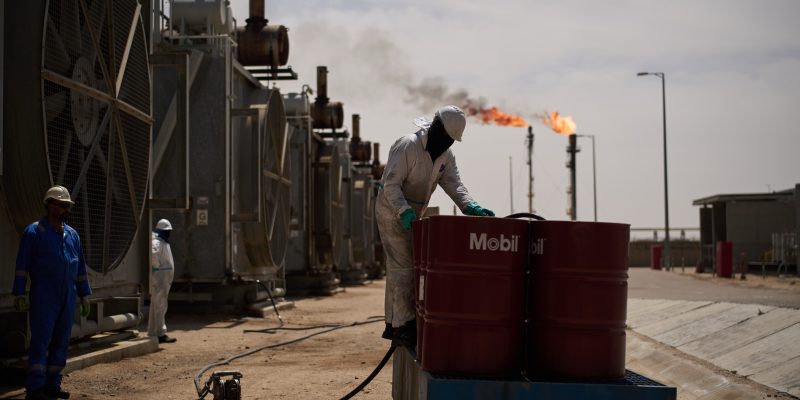
Iraq on the Fault Line: Proxy Warfare and State Fragility After Khamenei
Embedded militia networks and political paralysis are transforming Iraq into a frontline for the region’s latest conflict.

The current U.S.–Israeli operation against Iran escalated sharply following a coordinated strike on Iranian military infrastructure and senior leadership, culminating in the killing of Iran’s Supreme Leader, Ayatollah Ali Khamenei. What had long been a shadow confrontation with occasional kinetic warfare escalated into direct conflict. Tehran responded with missile and drone attacks against U.S. assets and civilian sites across the Gulf Cooperation Council (GCC) states, widening the battlefield beyond Iran’s borders and transforming the conflict into a regional confrontation.
Iran’s decision to target the Gulf states, including civilian infrastructure and energy hubs, has created a strategic inflection point for regional security policies. States that had pursued hedging or neutrality are now reassessing their alliances and considering direct entry into the conflict. Simultaneously, the Gulf states are strengthening collective defense postures that extend beyond recent intra-GCC divisions.
This expansion reflects a consistent pattern in Tehran’s strategic playbook: confrontation is projected outward rather than confined. Through a combination of direct strikes and proxy groups, Iran is deliberately inserting pressure across a region where military, economic, and political infrastructures overlap. The result is a blurring of formal declarations of neutrality and actual strategic exposure. Geographical proximity to Iranian military reach, combined with ties to Western security frameworks, has effectively drawn previously “neutral” spaces into the operational theater, reshaping the geostrategic landscape of the Gulf.
Within this shifting landscape, Iraq occupies a uniquely volatile position. Its vulnerability does not stem from formal entry into the war, but from the internal integration of Iranian-aligned armed actors within its own security and political systems. Unlike the Gulf states, which face primarily external risks, Iraq’s vulnerability is internal: Iranian-backed actors embedded in its security and political systems make the country a potential conduit for regional escalation without formal state involvement.
Iraq as a Proxy Arena
Following the killing of Khamenei, Iraqi Popular Mobilization Forces (PMF)-linked channels circulated footage showing rocket and drone operations targeting Kuwait and American bases in Northern Iraq. Among the groups claiming responsibility is Saraya Awliya al-Dam, which first emerged in 2020 after the killing of the head of the Islamic Revolutionary Guard Corps, Qassem Soleimani. Unlike established Iraqi political factions, this group has no identifiable public leadership and operates through masked operatives. Its opacity appears deliberate. Such formations enable operational alignment with Iranian command structures without visible Iraqi leadership intermediaries. Over the years, the group has claimed attacks on U.S. facilities, airports, Iraqi military sites, and other key locations in Erbil, functioning as a direct cover for Iranian-aligned targeting. Its reported ties with Asaib Ahl al-Haq situate it firmly within Iraq’s broader militia ecosystem.
Its recent claim of targeting Kuwait signals an expansion of activity beyond domestic targets. Meanwhile, attacks near Erbil International Airport increase the risk of retaliatory measures by the United States and Israel on Iraqi soil. Each incident narrows the space for de-escalation and reinforces the perception that Iraq is becoming one of Iran’s final offensive cards to play. Baghdad is left managing consequences generated by actors operating within its security framework but beyond its effective political control.
Protests and Political Deadlock
The killing of Khamenei also triggered visible domestic anger inside Iraq. Protests erupted near Baghdad’s Green Zone, where the U.S. embassy and major government institutions are located. Demonstrators gathered in what was framed as both mourning and retaliation, expressing solidarity with Iran and anger toward the United States. Iraqi security forces deployed crowd-control measures to prevent breaches into the fortified zone. These protests were driven purely by religious alignment and political sentiment. In such moments, militia narratives that frame operations as defensive responses to foreign aggression gain added social resonance.
These events unfolded amid prolonged governmental gridlock. Following recent elections, Iraqi political blocs remain divided over leadership formation and coalition arrangements. The absence of a consolidated executive authority during a period of regional war weakens Iraq’s institutional resilience, fragments crisis coordination, and reduces the state’s ability to assert what little authority it may have left over armed factions. Political deadlock does not simply delay policy formation; it creates permissive conditions for decentralized actors to shape the trajectory of events. External powers may interpret ambiguity as a sign of incapacity rather than strategic neutrality, further constraining Iraq’s ability to exercise sovereignty.
The Risk of ISIS Resurgence
This internal paralysis is particularly dangerous because it coincides with emerging security shocks that demand coordinated state response. Beyond militia escalation and political fragmentation lies a new security concern; the destabilizing fallout from northeast Syria’s collapsing detention system. More than 20,000 individuals with alleged ties to the Islamic State (ISIS) are now unaccounted for after al-Hol camp was abandoned by the Kurdish Syrian Democratic Forces in the absence of international coordination. Around 5,700 male detainees were transferred into Iraq following fears of prison breaches, even as Iraqi intelligence officials warn of renewed ISIS activity and an increase in active cells inside the country.
Iraq has established reintegration and prosecution mechanisms for ISIS prisoners. However, a regional environment characterized by cross-border confrontation and political distraction reduces institutional bandwidth. ISIS’s resurgence does not require territorial conquest. It requires fragmentation, distraction, and weakened coordination among Iraq’s overstretched security institutions. If militia escalation and governmental paralysis continue simultaneously, extremist actors will find space to reorganize within neglected security gaps.
The convergence of proxy conflict, political vacuum, and extremist opportunism would represent a compound threat. Security institutions stretched between managing regional escalation and preventing insurgent revival may struggle to maintain coherence. Whether Iraq remains a contained arena or drifts deeper into instability will depend on the trajectory and duration of the military operation against what remains of the Islamic Republic. Without political consolidation and clearer authority over armed actors, Iraq risks becoming a frontline in the war to shape the future of the Middle East.
The views and opinions expressed in this article are those of the authors and do not necessarily reflect the views of Gulf International Forum.
Issue: Politics & Governance
Country: Iraq
Hiba Abdulwahhab is an Iraqi researcher and analyst focused on Iraq’s governance, armed factions, Iranian influence in the region, and questions of Iraqi national identity, alongside broader themes in Middle East politics and security. She has collaborated with the Gulf International Forum, the Wilson Center’s Middle East Program, and the Washington Center for Human Rights. She holds a master’s degree in public and international Affairs from Virginia Tech and another in Arabic Language and Linguistics from PennWest University, as well as a bachelor’s degree in law from Baghdad University.
Why Iran Never Knows When to Stop
July 27, 2026At first glance, Iran’s negotiating difficulties appear to stem from disagreements between pragmatists seeking sanctions relief and hardliners determined to resist compromise. Yet that explanation…
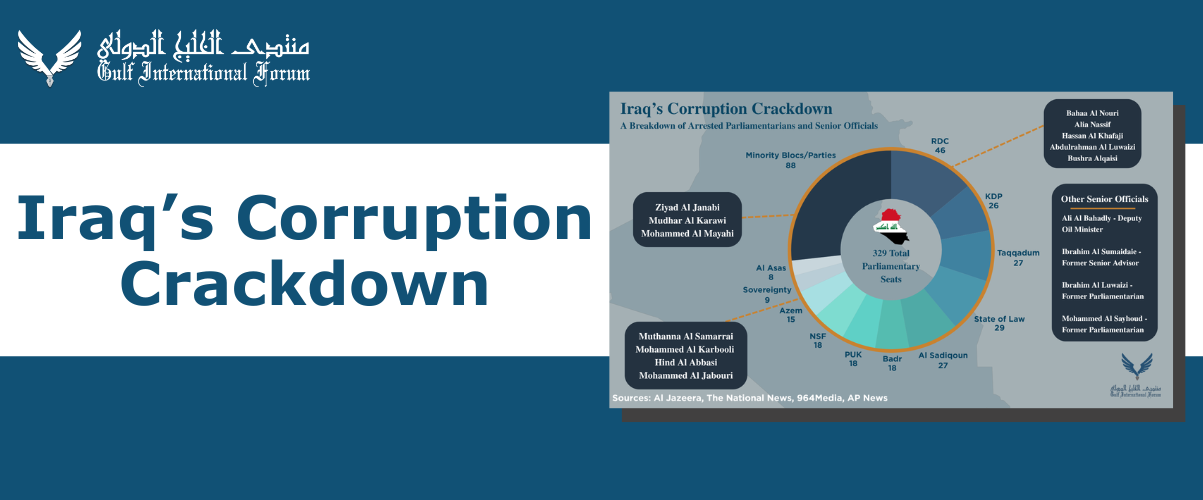
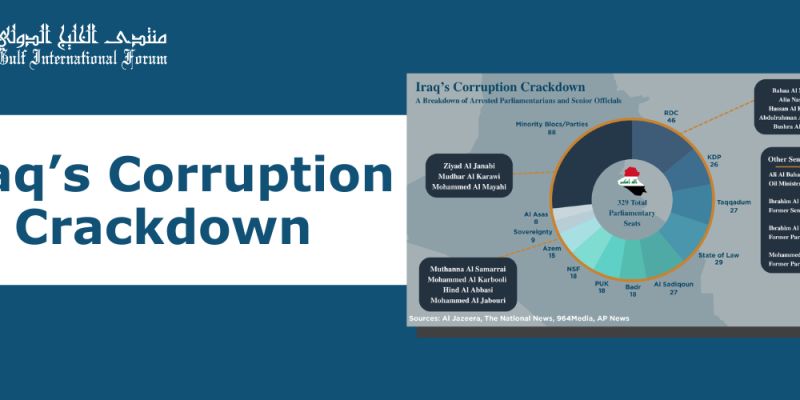
Iraq’s Corruption Crackdown
July 22, 2026*A breakdown of arrested parliamentarians and senior officials as of June 28, 2026.
Sheikh Hamad and the Making of Modern Qatar
July 15, 2026There is a question that haunts every small state: how does a nation survive and stay relevant in a region built for giants? For most…