Kuwait Caught Between Protection and Exposure
Attacked with hundreds of Iranian drones and missiles, Kuwait now faces the dual challenge of diversifying security ties and managing domestic fallout.

Although all Gulf Cooperation Council (GCC) states have faced Iranian strikes on civilian and state infrastructure at an unprecedented scale, Kuwait stands apart due to the fact that it is the only one to have been invaded and occupied in recent history. The legacy of the 1990–1991 Iraqi invasion and occupation of Kuwait has helped shape a far less activist foreign policy than that of neighboring states such as Qatar and the United Arab Emirates (UAE). However, Kuwait now finds itself in the crosshairs once again, this time amid the U.S.–Israeli war with Iran. This renewed exposure will likely carry significant implications for both Kuwaiti foreign policy and domestic politics.
Exposure and Escalation in the Gulf
Debate is already underway among commentators and academics across the Gulf over the need to recalibrate relationships with the United States, which has major military bases in Bahrain, Kuwait, Qatar, and the UAE. There have also been calls for greater security coordination across the region, reflecting an increasing desire for self-sufficiency, as confidence in the U.S. security umbrella has been shaken. As Mohammed Baharoon has noted, that umbrella has “holes.” These gaps will not lead to an abandonment of U.S. security relations, but rather to a reworking of U.S.–Gulf military ties.
Ironically, this same security architecture has left Kuwait exposed. American military facilities in the country have been targeted, alongside civilian infrastructure and diplomatic posts elsewhere in the region, signaling the potential for further escalation. Notably, on April 7, protesters attacked the Kuwaiti Consulate in Basra, underscoring the fragility of the situation in Iraq. The attack took place after rockets, allegedly coming from the direction of Kuwait, killed at least three and wounded five civilians. The Kuwaiti Foreign Ministry has insisted that it is “not a party to any regional or international dispute, and it has not and will not allow its territory to be used to launch an attack on any country.” But the perception among Iran and its proxies in Iraq is that attacks are being launched from Kuwaiti territories due to the U.S. presence, and that Kuwait must therefore be punished.
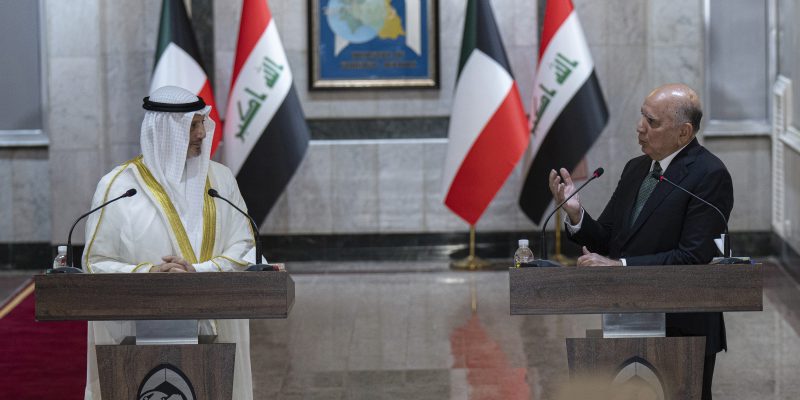
The Iraqi Foreign Minister condemned the attack on the Kuwaiti Consulate and claimed that the state has launched an investigation into the incident, signaling Baghdad’s desire to rein in nonstate actors. The incident highlights how quickly regional tensions can boil over into low-level violence, driven in part by perceptions of Gulf complicity in U.S. attacks in the region. This dynamic is not limited to Kuwait. Saudi Arabia and Bahrain summoned Iraqi envoys following drone attacks on their territory, which were also launched from Iranian-backed armed groups operating in Iraq. In March, Bahrain, Jordan, Kuwait, Qatar, Saudi Arabia, and the UAE sent a statement to the Iraqi Government calling on it to take action against attacks targeting their territories by Iran-backed groups. Baghdad maintains that attacks are not originating from its territory, despite Kuwaiti claims to the contrary.
Regionally, there is a growing need for renewed engagement on security coordination across the Gulf. Efforts are likely to focus on strengthening the security architecture of the GCC while increasing local weapons manufacturing capabilities. Given their proximity to Iran, GCC states have long sought to manage bilateral relationships with Tehran, though these ties have rarely been close. This is unlikely to change, even in the event of a U.S.–Iran agreement.
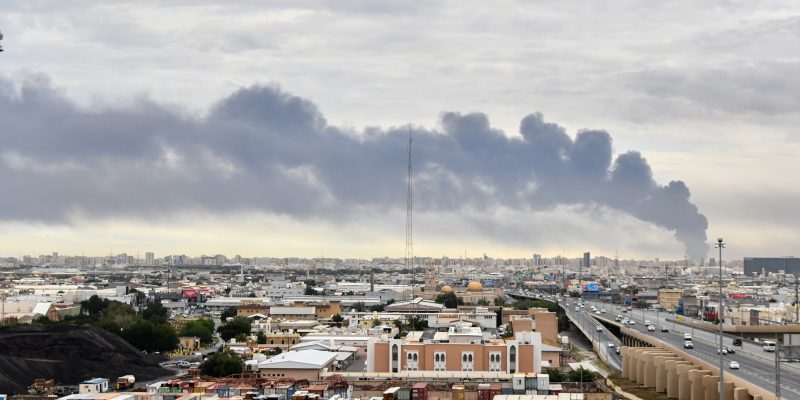
A further complication is the potential for high reconstruction costs should hostilities escalate further or form part of any eventual settlement. Kuwait’s airport, Camp Buehring, Ali Al Salem airbase, desalination plants, and oil refineries have all come under attack, despite high interception rates by Kuwaiti armed forces.
Domestic Repercussions and Political Control
One of Kuwait’s primary suspicions of Iran, even during periods of engagement, has been its involvement in domestic affairs. Violent events in the 1980s, along with the discovery of the Abdali cell in 2015, heightened fears of Iranian interference. In April, Kuwait’s State Security Agency arrested 24 Kuwaitis on charges of terrorist financing and involvement in terrorist activities. Former MPs were included, such as the head of a Shia political group, the National Islamic Action bloc. If these patterns persist, they risk accelerating the sectarianization of politics across the Gulf, particularly as suspicions grow around a potential Iranian “fifth column” emerging among the Gulf’s Shi’i communities. Claims about the presence of IRGC- and Hezbollah-linked cells throughout the region have only reinforced these concerns.
Amid heightened security anxieties across the region, authoritarianism is also likely to become more pronounced. In mid-March, Kuwait, whose parliament has been dissolved for nearly two years, put in place Law No. 13 of 2026, intended to protect military interests. One provision allows for prison sentences of up to 10 years for anyone who “disseminates news, publishes statements, or spreads false rumors related to military entities” with the purpose of undermining confidence in them. In a related case, it was confirmed that an American-Kuwaiti journalist, Ahmed Shihab-Eldin, was arrested over a month ago on charges of “spreading false information, harming national security, and misusing his mobile phone” after posting videos related to the war, including footage of a U.S. fighter jet crash near a base in Kuwait. He has since been released, and his Kuwaiti citizenship revoked.
At a time when IRGC- and Hezbollah-linked activity is under heightened scrutiny and a very fragile ceasefire has taken hold, it is politically convenient for such states to introduce legislation related to free expression and charges of espionage. These developments are reinforcing broader patterns of political tightening and more assertive state control.
Kuwait, like the rest of the Gulf, is watching closely as negotiations between the United States and Iran unfold, even as it must manage its own relationship with Tehran. Kuwaiti officials have repeatedly emphasized that the country has been attacked though it is not part of the war. This moment could spur greater regional security cooperation, both within the Gulf and across the broader Middle East, while also prompting a potential recalibration of ties with Washington, which have proven a liability in recent weeks.
Since the Iranian proxies’ attacks on Saudi Arabia’s oil facilities in 2019, Gulf states have increasingly questioned the reliability of U.S. security guarantees, prompting discussions about strengthening local capabilities. The current crisis will not dismantle the regional U.S. security architecture, but it may accelerate these diversification efforts. At the same time, these regional dynamics are likely to carry significant domestic implications, reinforcing more authoritarian governance trends amid heightened security concerns over Iranian interference.
The views and opinions expressed in this article are those of the authors and do not necessarily reflect the views of Gulf International Forum.
Issue: Geopolitics, U.S. – Gulf Policy
Country: Kuwait

Dr. Courtney Freer is an Assistant Professor in the Department of Middle Eastern and South Asian Studies at Emory University and a senior nonresident fellow at the Gulf International Forum. Her academic work focuses on domestic politics and Islamism in the Gulf states; she is the author of Rentier Islamism: The Influence of the Muslim Brotherhood in Gulf Monarchies (Oxford University Press, 2018), The Resilience of Parliamentary Politics in Kuwait: Rentierism, Ideology, and Mobilization (Oxford University Press, 2024) and co-author with Alanoud al-Sharekh of Tribalism and Political Power in the Gulf: State-Building and National Identity in Kuwait, Qatar and the UAE (IB Tauris, 2021). Courtney holds a BA in Near Eastern Studies from Princeton University, an MA in Middle Eastern Studies from The George Washington University, and. DPhil in Politics from the University of Oxford. She has held positions at the US-Saudi Arabian Business Council, Brookings Doha Center, and the London School of Economics and Political Science.

China’s Technology Development Push Meets Gulf Diversification
October 6, 2026China’s “new quality productive forces” (NQPF) are often understood as a domestic effort to revive growth, upgrade industry, and reduce dependence on Western technology. Yet…

Riyadh Shifts Toward Minilateralism as Regional Threats Mount
September 9, 2026Saudi Arabia’s signing of the Mecca Joint Defense Agreement with Türkiye and Pakistan on August 7 marks a crucial development in the evolution of the…

Toward a New Order in MENA Regional Geopolitics
September 2, 2026This report is a byproduct of the workshop “Toward a New Order in MENA Regional Geopolitics: What’s Next for the Region’s Geopolitical Equilibrium?,” hosted in…