Kuwait Turns East: The Rise of Chinese Investment in the Gulf
Kuwait is eagerly seeking foreign direct investment—and China has emerged as a willing partner, turning economic ties into deeper political and economic cooperation.

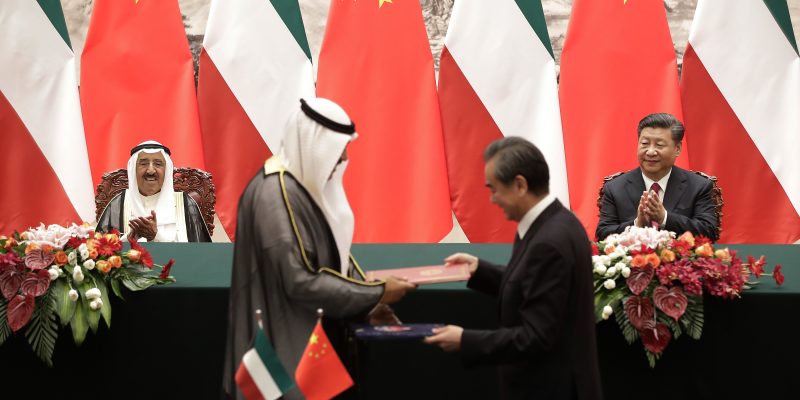
When Chinese Vice President Han Zheong arrived in Kuwait on an official visit in early November, it underscored a trend that has been building quietly for years: China’s deepening relationship with Kuwait has become increasingly important to Beijing’s diplomatic and economic agenda. What once appeared to be routine cooperation has evolved into more deliberate and visible engagement, marked by repeated leadership meetings and an increasing stream of investment deals. President Xi Jinping and Amir Mishaal Al-Ahmad Al-Sabah have met twice since 2022, an unusual level of engagement that signals a steady deepening of diplomatic and economic ties. At the same time, Chinese firms have expanded their presence across Kuwait’s development sector, embedding Beijing more firmly in the country’s long-term economic strategy.
Kuwait’s Push for Foreign Investment
Since the launch of Kuwait’s “Vision 2035” economic plan in 2017, the Kuwaiti government has emphasized increasing foreign direct investment (FDI) as a key strategy for diversifying its economy away from its traditional reliance on hydrocarbons. The 2013 Promotion of Direct Investment Law laid the groundwork for this goal and continues to guide efforts to achieve Vision 2035 initiatives. Yet Kuwait continues to lag behind its neighbors: in 2024, its FDI inflows averaged just $614 million, compared to $45.6 billion for the UAE and $16 billion for Saudi Arabia. Similarly, in terms of diversification away from hydrocarbon assets, oil accounted for 90 percent of Kuwaiti exports in 2024; this figure stands at roughly 25 percent in the UAE.
Kuwait’s parliament—historically the most powerful legislative body in the Gulf—has often been cited as a factor in the country’s slower economic development, largely due to its periodic resistance to international development agreements. In 2008, for instance, the parliament rejected a $17.4 billion deal with Dow Chemical, sparking controversy and recrimination. However, following Amir Mishaal’s dissolution of parliament 18 months ago, unelected branches of government now face heightened pressures to deliver reforms and attract FDI.
China has emerged as a key source of investment, channeling funds into the Gulf through its Belt and Road Initiative (BRI). In August alone, Kuwait’s cabinet reviewed 22 recently signed Memoranda of Understanding with Beijing, covering projects ranging from the Mubarak Al-Kabeer Port and renewable energy development to housing and a large wastewater treatment plant. The Mubarak Al-Kabeer Port project was revived in February after nearly a decade on hold, partly in response to Iraq’s $17 billion Development Road project. Designed to position Kuwait as a logistics hub for “East-West trade,” the port sits at the center of China’s BRI ambitions.
Trade and investment between Kuwait and China remain significant. In 2024, Kuwaiti exports accounted for $11.37 billion of the $16 billion trade between the two countries, and Beijing has since become the second-largest investor in Kuwait’s economy. Yet China maintains larger trade flows with Saudi Arabia and the UAE—part of a broader shift in its Gulf strategy between 2016 and 2022, when Chinese trade with the GCC states more than doubled. Public opinion in Kuwait toward this engagement is largely favorable. A March 2023 poll found that 62 percent of Kuwaiti respondents considered China an economic partner, and 19 percent viewed it as a friend. These figures underscore that, while shared values are not necessary for productive economic ties, Chinese engagement is increasingly shaping Kuwait’s development trajectory.
Beyond Investment: The Expansion of Defense and Cultural Ties
Over the past decade, Kuwait’s relationship with China has broadened into logistics and defense cooperation. The two states began joint military training in 2019 and, as of 2025, have agreed to open a jointly run ammunition factory in Kuwait. Kuwaiti Deputy Defense Minister Dr. Sheikh Abdullah Mishaal Al-Sabah has emphasized that military ties with China reflect the broader scope of collaboration across defense, logistics, and other strategic sectors.
These ties point to a partnership that goes beyond transactional engagement. While many analysts claim that Chinese engagement with the Gulf is primarily economic, Kuwait City and Beijing appear to be cultivating a more holistic relationship. Soft power links are increasingly part of this dynamic: in August 2023, the Kuwait-China Friendship Club was inaugurated, and the following month, the Chinese Cultural Center in Kuwait—the first of its kind in the Gulf—opened with the goal of “deepening people-to-people connections.”
Further, the proposed Kuwait-China Industrial-Financial Alliance Fund, with initial capital of $10-15 billion, is intended to scale up investments and support long-term cooperation. Together, these ventures indicate a desire to move beyond merely transactional investment deals towards a multi-dimensional partnership that integrates diplomacy, economic collaboration, and cultural engagement.
Balancing Old Alliances and New Opportunities
The growing Chinese-Kuwaiti relationship is particularly notable as the United States is seemingly recalibrating its approach to both Beijing and the Gulf. Kuwait, like its Gulf neighbors, appears increasingly willing and capable of pursuing a foreign policy independent of its relationship with the United States. Yet Kuwait still buys nearly two-thirds of its arms from the United States and houses 13,500 U.S. soldiers at Camp Arifjan. Diversifying diplomatic and economic ties does not necessarily indicate a full-scale restructuring of foreign relations.
Today, state interests often drive foreign policy, with diplomacy following trade rather than leading it. Kuwaiti leadership, under pressure to deliver results following the closure of parliament, has the opportunity to make progress toward its goals of attracting FDI and reducing reliance on hydrocarbons. Finding synergy with China in achieving these goals is a pragmatic step, not a radical departure.
The views and opinions expressed in this article are those of the authors and do not necessarily reflect the views of Gulf International Forum.
Issue: Economy & Innovation, Geopolitics
Country: Kuwait

Dr. Courtney Freer is an Assistant Professor in the Department of Middle Eastern and South Asian Studies at Emory University and a senior nonresident fellow at the Gulf International Forum. Her academic work focuses on domestic politics and Islamism in the Gulf states; she is the author of Rentier Islamism: The Influence of the Muslim Brotherhood in Gulf Monarchies (Oxford University Press, 2018), The Resilience of Parliamentary Politics in Kuwait: Rentierism, Ideology, and Mobilization (Oxford University Press, 2024) and co-author with Alanoud al-Sharekh of Tribalism and Political Power in the Gulf: State-Building and National Identity in Kuwait, Qatar and the UAE (IB Tauris, 2021). Courtney holds a BA in Near Eastern Studies from Princeton University, an MA in Middle Eastern Studies from The George Washington University, and. DPhil in Politics from the University of Oxford. She has held positions at the US-Saudi Arabian Business Council, Brookings Doha Center, and the London School of Economics and Political Science.
The Middle East’s Corridor Boom Meets Reality
July 22, 2026In recent years, particularly since the outbreak of the recent conflicts in Gaza and Iran, the Middle East has seen a resurgence of connectivity projects….
Iraq’s Fiscal Shock and the New Government’s Bargain
July 20, 2026The disruptions to shipping through the Strait of Hormuz have left Iraq facing more than an immediate export shock. Transport has remained constrained, insurance and…