Mojtaba Khamenei’s Iran and the Politics of Succession
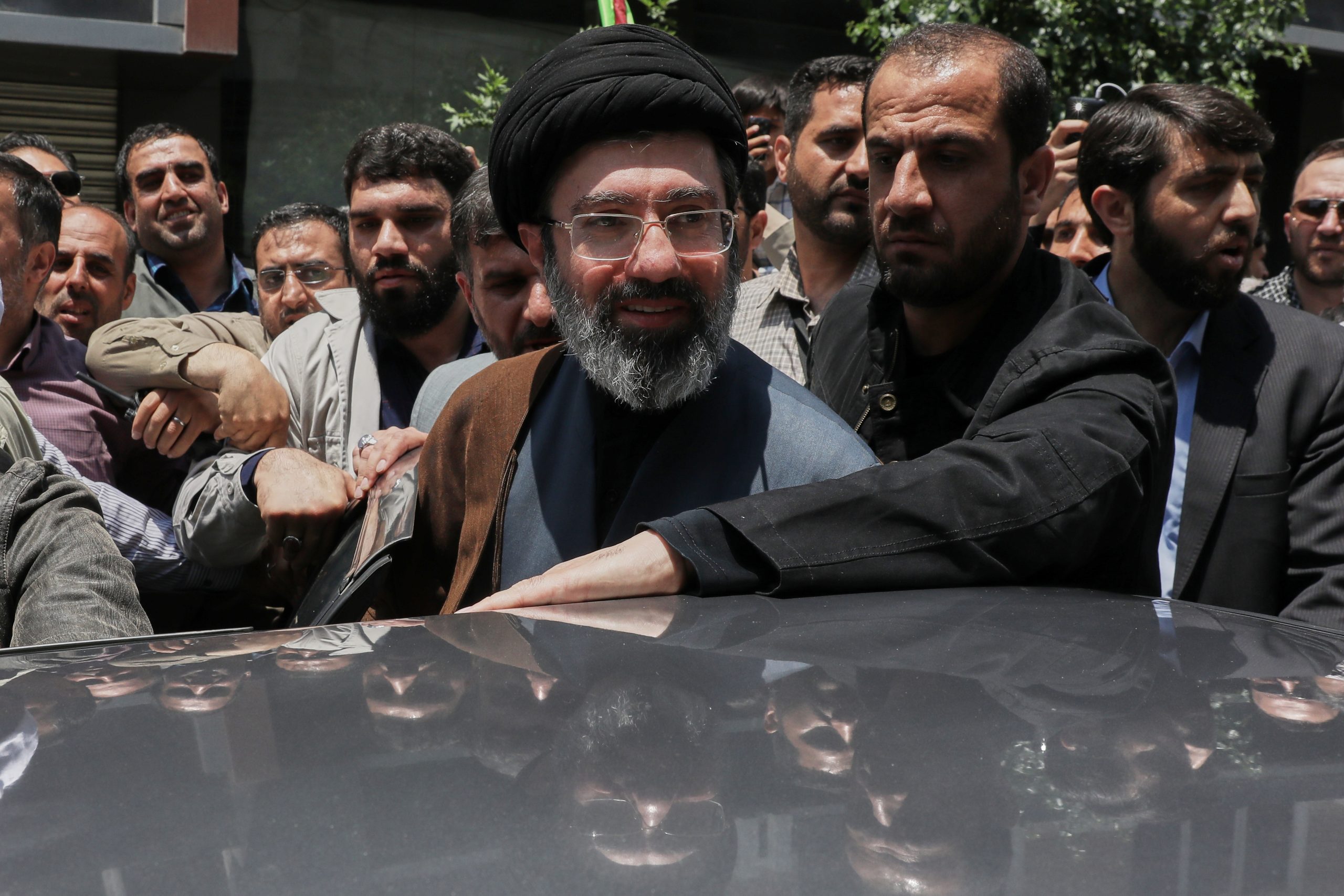
Mojtaba Khamenei’s appointment as Iran’s new Supreme Leader signals not a routine succession, but a deeper shift toward IRGC dominance and rule by coercion.

The death of Ayatollah Ali Khamenei has not launched a political transition in Iran. Instead, it has accelerated a deeper reconfiguration of the Islamic Republic, in which clerical legitimacy carries less weight, society remains outside the political contract, and the Islamic Revolutionary Guard Corps (IRGC) emerges as the core arbiter of power. In this context, the naming of Mojtaba Khamenei, the son of Ali Khamenei, as the new Supreme Leader is not simply about succession, but reflects a structural shift in the regime’s survival strategy.
The latest reshuffle of Iran’s top security institutions reinforces that reading. The appointment of former IRGC commander Mohammad Bagher Zolghadr to head the Supreme National Security Council after Ali Larijani’s killing suggests that the post-succession order is not merely preserving continuity. It is narrowing the regime’s decision-making core around harder security figures with fewer hybrid or mediating profiles.
The Logic Behind Mojtaba’s Rise
Mojtaba Khamenei’s emergence as Supreme Leader reveals much about the current state of the Iranian regime. Mojtaba’s appointment was reportedly pushed by the IRGC and hardline power centers that viewed him as a pliable and reliable figure capable of preserving internal cohesion while maintaining a hard external line. This balance matters. His succession did not project uncontested religious authority or broad revolutionary prestige, but rather continuity under pressure. It revealed a leadership arrangement designed to maintain command, prevent fragmentation, and preserve regime discipline during a period of war, severe internal stress, and strategic uncertainty. In that sense, the succession did not inaugurate a new political phase so much as formalize the regime’s ongoing re-entrenchment around its security apparatus.
This situation creates a profound irony at the heart of the Islamic Republic. A revolution that defined itself against monarchy and dynastic rule has drifted toward a quasi-hereditary logic concentrated at the top of the system, even as the rules of succession remain wrapped in clerical legality. Iran has not officially become a monarchy, but the symbolic damage is real. The transmission of supreme authority within the Khamenei family weakens one of the regime’s founding claims and highlights how narrow its internal mechanisms of renewal have become. The problem is not only Mojtaba’s surname, but the kind of authority he represents: one grounded more in the backing of Iran’s security establishment than in clerical standing. The office of the Supreme Leader survives, but the basis of its authority has shifted.
Control Without Consent
The growing reliance on the IRGC and the Iranian security apparatus becomes even clearer when viewed against Iran’s social landscape. The relative absence of sustained nationwide mobilization after the current conflict should not be mistaken for reconciliation between state and society. Protests that erupted in late December 2025 began amid a collapsing rial, inflation above 40 percent, and rapidly deteriorating living conditions. These conditions, combined with the government’s use of extreme force, transformed an economic outburst into a political revolt.
The social question has not been resolved; it has been contained. This distinction is critical. The relative calm on the street reflects fear, exhaustion, and the high cost of public dissent, not renewed consent. Human Rights Watch documented not only shootings and arbitrary detentions, but also internet blackouts, militarized urban control, and mass intimidation after the January uprising and subsequent killings. This points to a regime that no longer seeks to reintegrate society politically, but instead manages it through force and fear.
Prior to the latest revolt and subsequent U.S.-Israeli strikes, the regime had demonstrated a degree of tactical flexibility in the social sphere. Many Iranians experienced a form of “dual reality”: some easing in the day-to-day enforcement of social restrictions, particularly around dress codes, alongside deepening political repression, intensified pressure on activists, and a surge in executions. The regime appears to have learned that limited social permissiveness can function as a pressure valve, so long as it does not translate into autonomous political organization.
The IRGC Ascendant
The succession of Mojtaba Khamenei underscores the IRGC’s central role in the post-Ali Khamenei era. The IRGC have long been more than a military institution; they are political actors, an intelligence network, an economic force, and a core pillar of regime preservation. The current reality pushes their role even further. After Ali Khamenei’s death, the IRGC tightened its grip over wartime decision-making, taking the lead on all major strategic decisions while reinforcing the group’s role in internal security and repression. The IRGC’s command structure had been adapted to absorb leadership losses and maintain continuity under a decapitation scenario. For the Guards, the domestic and external fronts are no longer separate theaters. They are part of the same survival logic.
For Tehran, succession, society, and power now converge in a single institution. The IRGC is not simply protecting the system; it is increasingly organizing it. It acts as the guarantor of leadership continuity, a deterrent against a popular uprising, and the main purveyor of Iran’s hardline doctrine and external projection. Iran is not becoming a classic military dictatorship. Clerical authority, constitutional procedure, and religious symbolism still matter, but their function is changing. The “republic” component of the Islamic Republic still exists formally, but its practical role as a channel of mediation is nonexistent. The presidency and parliament remain in place, yet the strategic red lines of the system are more clearly defined by actors who are neither elected nor accountable to society. This is the central political shift in the post-Ali Khamenei moment.
Despite these changes, the regime does not yet appear on the verge of collapse. Multiple reports indicate that even Israeli officials privately acknowledged there is no certainty the war would bring down the Iranian regime, nor clear evidence of a mass uprising under sustained pressure. This assessment aligns with the broader picture. The Islamic Republic may be weaker in legitimacy, narrower in its support base, and less capable of meaningful political incorporation than before, but the regime retains command, discipline, coercive reach, and a leadership structure capable of enforcing continuity under severe strain.
The problem facing Tehran is therefore not immediate survival, but the long-term cost of surviving through hardening alone. A regime can endure without legitimacy for a long time if it possesses sufficient coercive capacity. Yet each step in that direction makes future reintegration more difficult and future crises more severe. The biggest winner of this new phase is not Mojtaba Khamenei, but the IRGC—the institution without which the current order becomes untenable.
The views and opinions expressed in this article are those of the authors and do not necessarily reflect the views of Gulf International Forum.
Issue: Politics & Governance
Country: Iran
Dr. Luciano Zaccara is a Senior Non-Resident Fellow at Gulf International Forum. He is Principal Researcher at New Ground Research, Qatar. Also, a Visiting Associate Professor at the Georgetown University in Qatar, and Director of the Observatory on Politics and Elections in the Arab and Muslim World, Spain. Previously, he has been Research Associate Professor in Gulf Politics at the Qatar University, Gulf Studies Center (2014-25). He has also been Visiting Researcher at Princeton University, Center for Iran and Persian Gulf Studies (2018); Visiting Assistant Professor at Georgetown University in Qatar (2013-14); post-doctoral fellow at Autonoma University of Barcelona (2010-12); and Visiting Researcher at Exeter University, Institute for Arab and Islamic Studies (2008-09). He obtained a BA in Political Science from National University of Rosario, Argentina, and a PhD in Arab and Islamic Studies from Autonoma University of Madrid, Spain. His research interests are Iranian Politics and Foreign Policy; Gulf Politics; International Relations in the Persian Gulf; and Electoral Systems in MENA region. His latest publications are: “China’s Economic and Political Presence in the Middle East and South Asia”, Haghirian, M. & Zaccara, L. (Eds.), Routledge, 2023. “Foreign Policy of Iran under President Hassan Rouhani’s First Term (2013–2017)”, Zaccara, L. (Ed.), Palgrave Macmillan, 2020.
Why Iran Never Knows When to Stop
July 27, 2026At first glance, Iran’s negotiating difficulties appear to stem from disagreements between pragmatists seeking sanctions relief and hardliners determined to resist compromise. Yet that explanation…
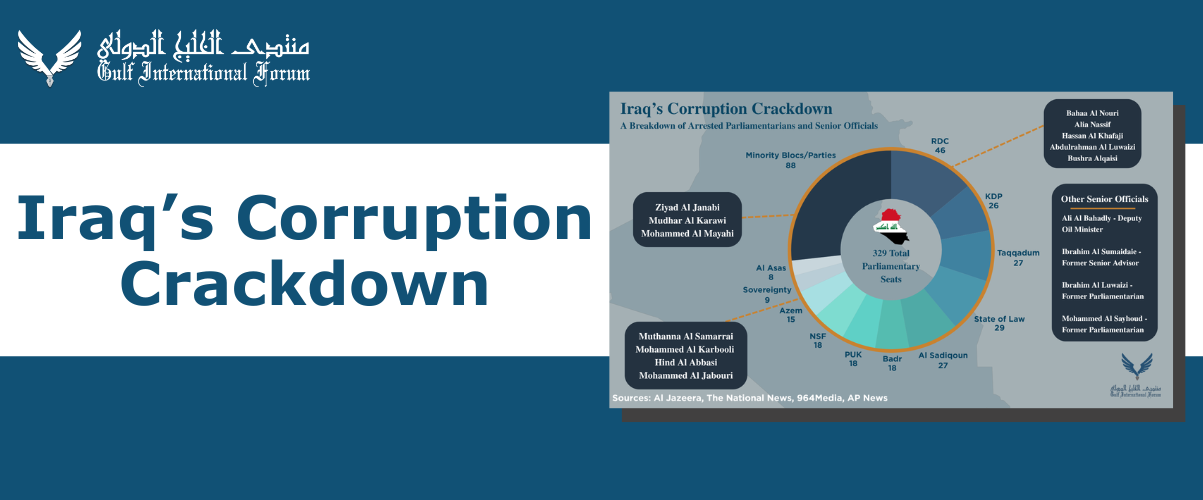
Iraq’s Corruption Crackdown
July 22, 2026*A breakdown of arrested parliamentarians and senior officials as of June 28, 2026.
Sheikh Hamad and the Making of Modern Qatar
July 15, 2026There is a question that haunts every small state: how does a nation survive and stay relevant in a region built for giants? For most…