Operation Epic Fury and the Collapse of Iran’s Layered Naval Defense
U.S. strikes in Operation Epic Fury have crippled Iran’s naval fleet, disrupted command networks, degraded deterrence, and reshaped the Gulf maritime balance while pushing Tehran toward asymmetric warfare strategies.

This is the first of a two-part series examining Iran’s naval power during Operation Epic Fury and what it reveals about Tehran’s layered defense architecture. Read the second article here.
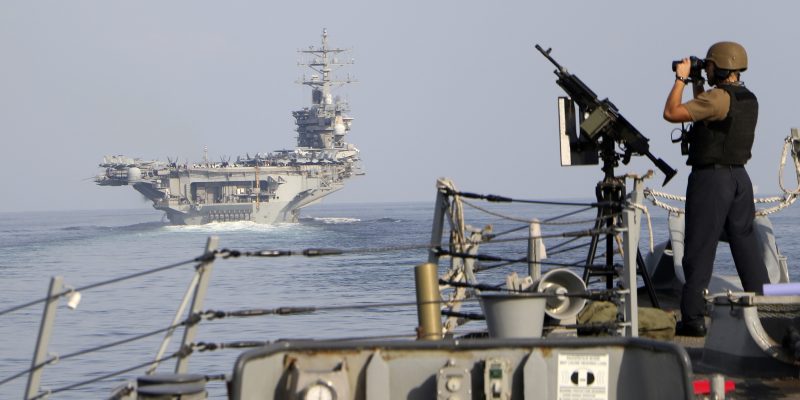
Since the beginning of Operation Epic Fury, U.S. forces have destroyed or incapacitated more than 120 Iranian naval vessels across both the Islamic Republic of Iran Navy (IRIN) and the Islamic Revolutionary Guard Corps Navy (IRGCN). These losses mark a significant blow to Tehran’s naval capabilities and underscore the scale and precision of U.S. strike capabilities in the opening phases of the campaign.
A Layered Naval Posture
Geography, historical experience, and threat perceptions of Iran’s political and military leadership shape Tehran’s naval doctrine in the Gulf. Traditionally, Tehran has regarded its southern coastline as a strategic vulnerability due to its accessibility to potentially hostile external powers. For Iranian strategists, this semi-enclosed body of water functions simultaneously as a maritime shield intended to keep adversaries at a distance and as a potential battleground where conflict could be contained to avoid a ground invasion of Iranian territory.
At the same time, Iran’s status as a major regional actor drives a more assertive approach. For Tehran, the Gulf is a natural sphere of influence: a maritime space where it can assert regional leadership, build political power, and project military might. As a result, Iran’s strategic perception of the Gulf combines caution with opportunism, reflected in its layered naval defense posture.
The Gulf’s geography, characterized by narrow waterways, small islands, and limited navigable passages, creates a complex operating environment for large conventional naval forces. This setting shapes the division of labor within Iran’s anti-access and area-denial (A2/AD) strategy. The IRIN and IRGCN share responsibility for securing maritime approaches to the Gulf, while the IRGCN assumes primary responsibility for operations west of the Strait of Hormuz.
In the Gulf of Oman, the IRIN leverages large surface combatants and long-range assets to focus on anti-access functions in open waters. While the IRGCN also retains significant long-range strike capabilities, its core mission centers on asymmetric maritime warfare and area-denial operations in the Gulf. The IRGCN’s approach combines conventional missile capabilities with a guerrilla-style mode of fighting and swarm tactics, employing fast-attack craft, one-way attack drones, and sea mines.
Neutralizing Iran’s Blue Water Fleet
Since the beginning of Operation Epic Fury, the IRIN and the IRGCN have suffered decisive blows. Major naval facilities, including Bandar Abbas at the entrance to the Strait of Hormuz as well as military installations at Chabahar and Konarak in the Gulf of Oman, were targeted within the first hours of the conflict. These precision strikes were carried out using Tomahawk land-attack cruise missiles launched from U.S. Naval destroyers. Although Iranian naval forces have rarely featured in negotiations with the United States, their logistical neutralization has become a central military objective of Operation Epic Fury, alongside degrading Iran’s ballistic missile capabilities and constraining Tehran’s nuclear ambitions.
Throughout the campaign, a significant number of Iranian surface combatants, submarines, and guided-missile patrol boats were struck while still moored at their piers. The decision to neutralize these naval facilities in the opening phase of the campaign reflects a number of strategic considerations. First, these bases host the bulk of Iran’s blue-water naval platforms. Among the principal surface combatants targeted were the Moudge-class light frigates, the most capable Iranian-built surface combatant currently in use. The Moudge-class is designed for multi-mission roles, incorporating air-defense capabilities, anti-ship cruise missiles, and anti-submarine warfare capabilities supported by lightweight torpedo tubes.
Several older surface combatants were also targeted. Pre-dating the 1979 Revolution, Bayandor-class corvettes and Alvand-class frigates retained anti-ship and anti-submarine capabilities and constituted a substantial portion of Iran’s remaining blue-water fleet. Their neutralization removed much of Iran’s already limited capacity for sustained naval operations beyond coastal waters. Tehran’s submarine force, long viewed as a relative tactical advantage over its Gulf neighbors, also sustained heavy losses. One Kilo-class submarine was reportedly severely damaged, while several Ghadir-class midget submarines were incapacitated.
Disabling these assets at the outset of hostilities was likely to prevent Tehran from leveraging the geographic positioning of these bases to support defensive naval operations or retaliatory strikes. Given the asymmetry with U.S. naval forces deployed in the Arabian Sea, Iranian surface combatants would have been unlikely to directly challenge U.S. vessels. However, if deployed in time, these combatants could have contributed to maritime anti-access and denial operations in the Gulf and the Strait of Hormuz, including missile attacks, harassment operations, and support to Iranian-allied coastal defense networks.
High Value Targets and Network Disruption
Beyond hosting key naval platforms, these marine assets function as more than simple naval bases; they are integrated nodes within Iran’s broader surveillance and air-defense architecture that oversee maritime routes in the Gulf. This infrastructure includes coastal radar installations, anti-ship missile batteries, and drone operating bases, all of which contribute to maritime domain awareness and targeting across the Gulf of Oman and the Strait of Hormuz. Disrupting this network likely aimed to degrade Iran’s ability to monitor maritime traffic and coordinate naval or missile responses in the early stages of the conflict.
Among the Iranian naval assets that U.S. CENTCOM acknowledged to have struck was the drone-carrier warship Shahid Bagheri operated by the IRGCN. The vessel featured a 180-meter flight deck equipped with a ski-jump ramp at the bow, reflecting the IRGCN’s growing emphasis on long-range drone operations at sea. Commissioned roughly a year before the conflict, the ship reportedly sustained multiple strikes, with confirmed impacts on the flight deck and quarterdeck. Although the vessel does not appear to have sunk, the damage to critical operating areas likely renders it inoperable for the foreseeable future.
On March 4, a U.S. nuclear-powered submarine carried out a torpedo attack against an Moudge-class frigate off the southern coast of Sri Lanka. The Iranian vessel was transiting the Indian Ocean after participating in the MILAN 2026 naval exercise, an India-hosted multinational naval exercise held days earlier. The attack, which resulted in 84 confirmed deaths, marked the first known instance since World War II of a U.S. submarine sinking a surface combatant with a torpedo. Following the attack, the Iranian replenishment vessel Bushehr and its crew of approximately 200 sailors sought refuge in Sri Lanka. Similarly, the auxiliary ship Lavan, also cruising in the Indian Ocean, found shelter in India.
The same day, U.S. forces reportedly struck one of the IRGCN’s most advanced surface combatants: the Shahid Sayyad Shirazi. Commissioned roughly two years earlier, the vessel belongs to the Shahid Soleimani-class corvette missile catamaran class, combining anti-ship strike capabilities, air defense systems, and advanced radar sensors with a high-speed, semi-stealth platform. On March 11, 2026, U.S. CENTCOM confirmed that all four ships of the Shahed Soleimani-class had been taken out of the fight. The targeting of these platforms has not only removed critical assets but also disrupted the systems that enable Iran to monitor, coordinate, and project power across maritime channels.
Damage Assessment
The opening phases of Operation Epic Fury have achieved significant success in disabling much of Iran’s blue-water naval fleet, underscoring the limited ability of Tehran’s naval forces to confront the U.S. Navy in conventional terms. By targeting both major surface combatants and the infrastructure that sustains them, U.S. strikes have not only reduced Iran’s naval capacity but also interrupted the networks that sustain maritime coordination and domain awareness.
These losses, however, do not fully capture the broader structure of Iran’s maritime power, which extends beyond conventional platforms to more adaptive, operational approaches. While Tehran retains the capacity to compete in the Gulf, the scale and precision of these early strikes have already reshaped the immediate naval balance in the region.
The views and opinions expressed in this article are those of the authors and do not necessarily reflect the views of Gulf International Forum.
Issue: Defense & Security
Country: Iran

Leonardo Jacopo Maria Mazzucco is a PhD candidate in Institutions and Policies at the Catholic University of Milan, Italy. His research interests revolve around the foreign policy and security affairs of the Gulf region. He tweets at @mazz_Leonardo.
Confirmed Houthi Attacks on Saudi Arabia: July 13 to October 26
October 28, 2026
Toward a New Order in MENA Regional Geopolitics
September 2, 2026This report is a byproduct of the workshop “Toward a New Order in MENA Regional Geopolitics: What’s Next for the Region’s Geopolitical Equilibrium?,” hosted in…
Yemen’s Emerging Role in the Red Sea
August 27, 2026On August 4, 2026, the Yemeni Coast Guard (YCG) rescued the 14-member crew of the Indian-flagged commercial vessel Faize Noore Oliya. Transiting the Red Sea…