Pragmatic Investment: Possibilities for Saudi-Iranian Cooperation Amid the Gaza War
As the Gaza war intensifies, Saudi Arabia has leaned strongly on Iran to avoid escalating the conflict elsewhere in the Gulf—dangling tantalizing economic incentives if Tehran agrees.

In the months since Iran and Saudi Arabia agreed to their Chinese-mediated normalization deal, the two sides have fostered growing diplomatic ties, marking a welcome change from years of violent confrontation in the Gulf region and across the Middle East. Iranian President Ebrahim Raisi paid an official visit to Saudi Arabia for the first time, meeting Crown Prince Mohammad bin Salman (MbS) on the sidelines of the Organization of Islamic Cooperation (OIC) leaders’ summit on November 11, 2023. A few weeks later, on November 30, the Saudi defense minister held his first direct talk with the Iranian Chief of Staff since the beginning of the normalization process.
Under the March 10 normalization agreement reached between the two regional rivals in Beijing. As such, Iran and Saudi Arabia agreed to de-escalate tensions in the Gulf region, given the former’s influence over the Houthi rebels in neighboring Yemen. For its part, Saudi Arabia has softened its criticisms of the Islamic Republic.
Gaza War Complicates Rapprochement
While the air of rapprochement appears to be favorable for both parties, diplomatic reconciliation may be threatened by the onset of the Gaza war. Iran and Saudi Arabia found themselves on different sides of yet another regional conflict, one that has inflamed passions around the world and could potentially trigger a new round of violence between Tehran and Riyadh. On October 7, Hamas launched an unprecedented attack on Israel, provoking a large-scale Israeli ground operation that has inflicted heavy casualties on both Hamas militants but mostly Palestinian civilians. Unsurprisingly, in the wake of the attack, Israel claimed that Iran had masterminded the operation as a part of its proxy hybrid warfare strategy against Tel Aviv, and vowed to respond.
The Gulf monarchies did not directly accuse Iran of providing planning and material assistance to Hamas ahead of the October 7 attack. Nevertheless, the successful implementation of the operation—bursting through the Israel Defense Forces’ (IDF) perimeter around Gaza with astonishing ease before indiscriminately targeting civilians in the surrounding areas—has likely in Saudi Arabia that Iran continues to harbor hegemonic aspirations through and the so-called Axis of Resistance in the Middle East region.
This time, however, Saudi Arabia attempted to tackle the issue more diplomatically without igniting the situation. In the aftermath of the Hamas attack and Israel’s retaliation in Gaza, media sources claimed that Saudi Arabia had proposed cooperation and investment in Iran if it prevented its militias from initiating a wider regional war. Shortly after signing the normalization agreement in March, Riyadh signaled that it would begin investing directly in the Iranian economy, but the outbreak of war in Gaza underlines the importance of bilateral economic cooperation as a means of resolving conflict and avoiding further escalation. From Riyadh’s perspective, a cooperative attitude toward Iran would appear rational, as the economic dividends of bilateral investment would require sustainable peace and regional stability to maintain. Since the beginning of the war, the Gulf region has witnessed a series of violent standoffs, particularly between Iranian-backed Houthi rebels in Yemen and Saudi-led Arab coalition forces, highlighting the need to secure Iranian cooperation in de-escalation efforts as quickly as possible.
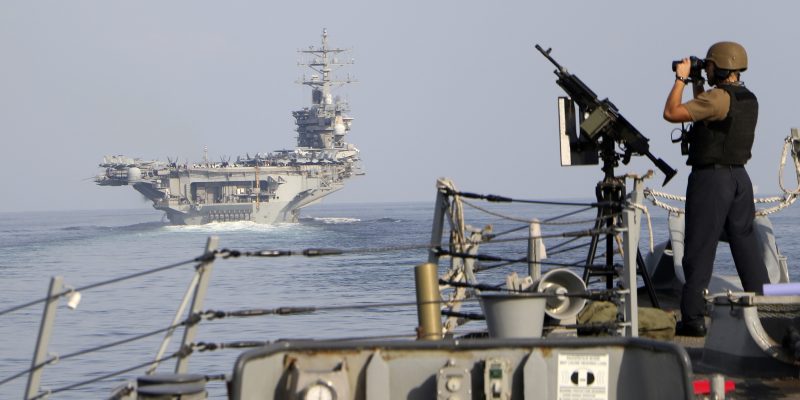
Riyadh’s decision to proffer economic assistance to its rival should not be viewed as charity, however, but a calculated effort to neutralize Iranian ambitions in the Middle East. Even with renewed dialogue between Riyadh and Tehran, a substantial long-term partnership between the two powers is not on the horizon. Iran has not exactly inspired trust in Saudi Arabia. It has leveraged the Gaza conflict to strengthen ties with its proxies in Lebanon, the West Bank, Iraq, Syria, and Yemen. To further hedge against Iranian designs, Saudi Arabia has also collaborated with its international partners, namely the United States. The United States has made its intention to prevent regional escalation. In the weeks after violence erupted, Washington moved two aircraft carrier groups into the region in the hope that the show of force would persuade Iran’s foreign allies to stay out of the conflict. This strategy seems to have worked so far; while Hezbollah has occasionally launched rockets at targets in northern Israel, there has not been widespread fighting along the Israel-Lebanon border, nor a regional eruption of violence in countries like Syria and Iraq.
Economics Plays an Important Internal Role
Riyadh’s designs to build closer economic ties with Iran also help the Kingdom achieve its domestic security interests. Saudi Arabia’s ambitious Vision 2030 economic diversification program requires domestic stability and regional peace for successful implementation; every riyal spent on defense, after all, cannot be used toward developing the new Saudi economy. Therefore, through partnering with Iran, Riyadh seeks to sideline the Houthi threat, decrease illegal arms smuggling in the Persian Gulf, and establish a pragmatic partnership that diminishes the need for spending on its own defense.
It remains unclear how Saudi Arabia plans to invest in the Iranian economy without violating international sanctions. Until now, Riyadh has not pressured its Western partners to ease economic sanctions on the Islamic Republic. At the same time, Saudi Arabia’s fundamental disagreements with Iran remain unresolved, complicating efforts to extend the rapprochement into the realm of trade and investment. For Iran, it is of utmost importance to keep the pulse on regional affairs, even if it agrees not to escalate the situation in Gaza. Officials in Tehran have expressed skepticism that their country will see a sudden inflow of Gulf investment.
In this context, Iran will likely continue to see its hybrid warfare strategy as the only viable deterrent to outside powers that seek to shrink its sphere of influence. However, considering the limitations of Iran’s proxy strategy, the Iranian regime should instead demonstrate its commitment to maintaining high-level dialogue with Saudi Arabia as cemented in the China-brokered agreement. If both sides can prove their good intentions to the other, Iran may limit its support for its regional proxy forces. Given the complicated relationship between the Gulf’s two major powers, however, such a scenario is far from certain.
The views and opinions expressed in this article are those of the authors and do not necessarily reflect the views of Gulf International Forum.
Issue: Geopolitics
Country: Iran, KSA

Fuad Shahbazov is an independent policy analyst specializing in regional security, energy diplomacy, and defense affairs across Eurasia and the Middle East. He holds an MA in Political Science from Vytautas Magnus University, a Professional Master’s degree in Terrorism and Religious Extremism from the University of Bergamo, and an MSc in Defense and Diplomacy from Durham University. He shares insights on Twitter at @fuadshahbazov.

Beyond Hormuz: Why Balochistan Matters to Gulf Energy Security
October 21, 2026A conflict long treated as peripheral to Gulf security is becoming harder to ignore as the war with Iran puts pressure on the region’s maritime…
Should Syria and Qatar Join the Mecca Pact?
October 9, 2026Three years of cascading conflict have fundamentally transformed the Middle East’s security outlook. American weapons, military deployments, and security guarantees remain central to the region….

China’s Technology Development Push Meets Gulf Diversification
October 6, 2026China’s “new quality productive forces” (NQPF) are often understood as a domestic effort to revive growth, upgrade industry, and reduce dependence on Western technology. Yet…