Saudi Arabia’s F-35 Deal Is Taking Shape
U.S. approval of a potential F-35 sale moves Riyadh’s longstanding ambitions closer to reality, while deepening its relations with Washington and complicating its defense ties with Beijing.

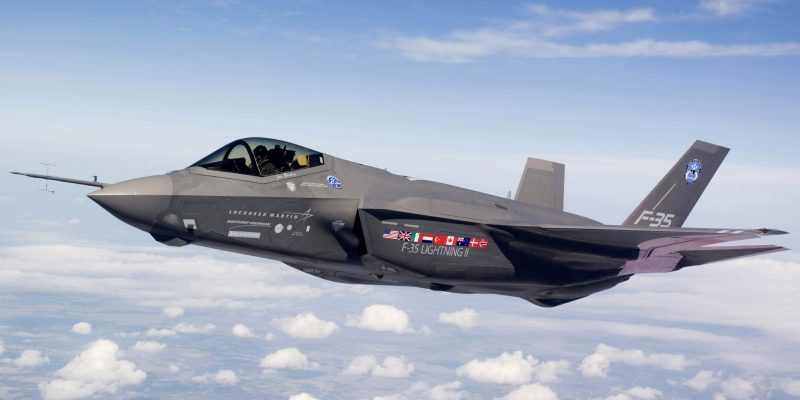
Less than a year after U.S. President Donald Trump publicly backed the sale of F-35 fighter jets to Saudi Arabia, the kingdom’s long-running effort to acquire the most advanced combat aircraft has moved from a political commitment toward a concrete procurement process. On September 17, the U.S. State Department approved the potential $24.3 billion sale of 48 F-35 Lightning IIs and 49 F135 engines to Saudi Arabia and formally notified Congress of the proposed transaction. The package also includes secure communications equipment, electronic warfare database support, classified and unclassified software, training, spare parts, and sustainment.
The notification marks a significant step from the commitment made during Crown Prince Mohammed bin Salman’s visit to Washington in 2025, when Trump announced that future F-35 deliveries would form part of a broader U.S.–Saudi defense package. At the time, Washington provided no official details, leaving much of the discussion surrounding the sale speculative. Riyadh had reportedly submitted its request earlier that year; twelve months later, the Saudi request has a price, a proposed fleet size, and a formal place in the U.S. Foreign Military Sales process.
The deal remains far from complete, but its progress brings into sharper focus three questions that have followed Saudi F-35 ambitions from the beginning: what the 48 stealth fighters would actually add to an already sophisticated Royal Saudi Air Force (RSAF), how Washington can protect sensitive technology as Riyadh expands its relationship with China, and how the sale can be reconciled with Israel’s qualitative military edge (QME).
From Political Promise to Procurement
While the Saudi F-35 gained State Department approval, the proposed sale must still move through the congressional review process, while the final value and number of aircraft could change during negotiations. The current notification does not include an accompanying weapons package, an important omission given that the aircraft’s eventual capabilities will depend partly on which U.S. munitions Riyadh is authorized to integrate. Beyond the 48 aircraft, the package includes an additional engine, training, software, logistics, and electronic warfare support.
The strategic significance of the prospective sale lies partly in how deeply it would embed Riyadh in U.S. defense networks. The F-35 relies on a continuous relationship with the United States for software, mission data, upgrades, maintenance, and sustainment, meaning that acquiring the aircraft would create a long-term technological connection even as Saudi Arabia continues to diversify its defense relationships.
The State Department has framed the proposed sale in similar strategic terms, arguing that it would strengthen Saudi deterrence and territorial defense while improving interoperability with U.S. and partner forces. It further insists that the transaction would not alter the military balance in the region. The latter claim will be particularly important as Washington evaluates how a Saudi F-35 fleet would interact with its longstanding commitment to Israel’s qualitative military edge.
The F-35’s Role in the Saudi Air Force
For the RSAF, 48 F-35s would add a capability largely absent from an air force that is already one of the largest and most heavily equipped in the Middle East. The RSAF has historically favored large twin-engine aircraft with considerable range and payload, combining American and European platforms. The Saudi Air Force has a combat inventory of 350 fighter jets, including 150 F-15S and F-15SA strike aircraft, older F-15C/D Eagles, around 71 Eurofighter Typhoons, and a remaining Tornado fleet.
What this force lacks is a low-observable aircraft designed to operate in heavily contested airspace, a capability that proved valuable during the war with Iran as fifth-generation aircraft played an important role in U.S. and Israeli operations against Iranian air defenses. Saudi F-15s and Typhoons can perform air superiority and long-range strike missions, but against a functioning modern air-defense network, they face risks that a stealth aircraft is specifically designed to reduce.
The F-35 would therefore sit at the apex of the Saudi fleet rather than become its numerical backbone. Its low observability, sensors, electronic warfare capabilities, and ability to fuse and distribute information could allow a small number of aircraft to identify threats inside contested environments while passing information to the kingdom’s larger fleet of fourth-generation aircraft. F-15SAs could continue to provide range and weapons payload, while Typhoons perform air-defense and multirole missions. F-35s could take on tasks in which survivability and information dominance matter more than weapons capacity. In practical terms, this would make the F-35 a force multiplier for investments Riyadh has already made rather than a replacement for them.
The China Problem
The most immediate political complication may come not from the composition of the Saudi fleet but from the kingdom’s relationship with China. U.S. officials and lawmakers have repeatedly expressed concern that Saudi-Chinese defense and technology cooperation could create opportunities for Beijing to obtain sensitive information about F-35 systems. According to recent reporting, a U.S. intelligence assessment again raised the possibility of Chinese access to F-35 technology, with potential safeguards including restrictions on Chinese personnel entering bases where the aircraft would be stationed. The issue is familiar from the United Arab Emirates, whose planned purchase of up to 50 F-35s stalled amid disagreements with Washington that included concerns about Chinese technology and activities in the country.
The Saudi case presents a particular concern because Riyadh’s defense relationship with Beijing is no longer peripheral. China has supplied the kingdom with ballistic missiles and armed drones, while the two sides have expanded exercises and industrial cooperation. Saudi Arabia is also pursuing local production and technology transfer in areas where Chinese companies offer fewer political restrictions than their Western competitors. Cooperation with Beijing can broaden Riyadh’s supplier base and support domestic capabilities, but it can simultaneously complicate access to the most sensitive U.S. technologies.
An incident involving an Australian F-35 this year provides a useful counterpoint. A cockpit canopy and weapons-bay door from an Australian aircraft were inadvertently diverted to Hong Kong while being shipped to the United States for inspection, possible repair, or disposal. Both contained radar-absorbing material, and Chinese authorities subsequently took possession of them. The Pentagon is seeking their return, while congressional committees are examining how the components ended up in Chinese hands. Lockheed Martin has described the parts as unserviceable and at “low risk for exploitation.”
The episode does not invalidate Washington’s concerns about operating F-35s in a country with extensive Chinese ties, but it illustrates the difference between exposure to individual components and access to the aircraft as a complete weapons system. The F-35’s low observability depends on the interaction of its shaping, radar-absorbing structures, sensors, and electronic warfare architecture. The Australian components could provide Chinese engineers with useful information about materials and construction techniques, but not access to the aircraft’s software, electronic warfare suite, mission data, or sensor-fusion architecture. For Washington, the Saudi question likely revolves around how much risk can be mitigated through restrictions on personnel, facilities, networks, and Chinese technology rather than whether every element of the aircraft can be kept beyond Beijing’s reach.
Israel and a Widening Fifth-Generation Club
Technology protection is only one part of Washington’s calculation. The other is Israel, which remains, so far, the only operator of the F-35 in the Middle East. It flies a customized F-35I Adir that incorporates Israeli systems and provides Israel with greater national autonomy than other foreign operators receive. U.S. law requires Washington to consider Israel’s QME when transferring advanced weapons to other regional states, and that requirement has historically been a principal barrier to Saudi access to the F-35. A Saudi fleet of F-35s would not erase Israel’s advantages in training, weapons, operational experience, or its customized fleet, but it would end Israel’s exclusive access to the platform in the Middle East and establish a precedent for other U.S. partners seeking the same capability.
Saudi Arabia would not, however, become the first Arab country to operate a fifth-generation aircraft. Algeria became the first foreign customer for Russia’s Su-57E, with evidence emerging that deliveries have already begun. The distinction matters because the Algerian acquisition has generated far less public concern in Israel than the possibility of Riyadh receiving F-35s, suggesting that the issue is not simply the diffusion of fifth-generation aircraft. Access by another Arab state to the F-35 itself, and therefore to an American defense ecosystem, has different implications for Israel’s QME than Algeria’s acquisition of a Russian platform.
Türkiye adds another dimension. Ankara is developing the indigenous KAAN fifth-generation fighter and seeking a pathway back into the F-35 program after its removal over the acquisition of Russia’s S-400 air-defense system. Saudi Arabia has explored cooperation on KAAN as its defense relationship with Türkiye expands. If the U.S. sale proceeds, the F-35 would provide a mature operational fifth-generation capability integrated into the American defense ecosystem, while KAAN could still offer industrial participation, technology transfer, and localization opportunities that Washington is less likely to provide. Türkiye’s renewed effort to return to the F-35 program further complicates the picture, pointing toward a regional fifth-generation landscape involving American, Turkish, and Russian aircraft programs.
The Saudi sale therefore captures both the progress and the limits of Riyadh’s defense diversification. The kingdom has spent years expanding military ties with Türkiye, China, South Korea, and European suppliers, and those relationships are unlikely to disappear if the F-35 deal proceeds. Yet its pursuit of the most advanced combat aircraft available continues to run through Washington, as operating the F-35 requires decades of cooperation and interoperability. Bringing the aircraft into Saudi service could deepen the kingdom’s relationship with Washington even as Riyadh continues to diversify its defense portfolio.
The views and opinions expressed in this article are those of the authors and do not necessarily reflect the views of Gulf International Forum.
Issue: U.S. – Gulf Policy
Country: KSA

Francesco Salesio Schiavi is an independent Middle East analyst and consultant specializing in the international relations and security architecture of the Levant and the Gulf. His expertise includes military and diplomatic interventions by international actors in the Middle East and North Africa and the military technologies of some of the leading Middle Eastern actors in this sector. He is a non-resident fellow at the Middle East Institute of Switzerland (MEIS), and advisor to the Rome Office of TRENDS, Research & Advisory, and a contributor to several international outlets, including Al- Monitor, Amwaj, The New Arab, and the NATO Defense College Foundation. Previously, he was a researcher at the Middle East and North Africa Centre of the Italian Institute for International Political Studies and a coordinator of the scientific team for “Rome MED – Mediterranean Dialogues” for five years. From 2023-24, he also served as an advisor to the Steering Committee for the Euromesco Annual Conference, organized by the European Institute of the Mediterranean in partnership with the Spanish Ministry of Foreign Affairs.

The Midterms Might Change Washington’s Gulf Debate, But Not the Relationship
October 27, 2026The ongoing U.S.–Iran war comes at a pivotal moment for U.S. foreign policy. With the increasingly unpopular and drawn-out conflict taking place amid the campaign…

Trump’s War on Iran Runs Through Baghdad
October 8, 2026Seven months into the war with Iran, the Strait of Hormuz remains a major point of contention. Goldman Sachs estimates that Gulf oil flows have…

Toward a New Order in MENA Regional Geopolitics
September 2, 2026This report is a byproduct of the workshop “Toward a New Order in MENA Regional Geopolitics: What’s Next for the Region’s Geopolitical Equilibrium?,” hosted in…