Sovereignty Without Control: Iraq’s Dual Power Crisis in a Regional War
As Iraq is pulled deeper into a regional war it did not choose, the limits of the government’s ability to control Iran-aligned PMF factions have become increasingly clear.

Since the outbreak of the Iran-U.S.-Israel war in late February 2026, Iraq has found itself at the center of a regional conflict it did not choose to enter. The war has clarified a longstanding feature of Iraq’s political order: the government projects sovereignty, but a parallel force within the state decides when and how it is exercised.
Iraq does not operate through a single center of power, but two. The government holds the diplomatic authority, international recognition, and the institutional framework of a sovereign state. The Iran-backed militias, organized under the Popular Mobilization Forces (PMF) and operating through the umbrella of the Islamic Resistance in Iraq, determine when the state is drawn into conflict. This leaves a fundamental question: where does authority in Iraq actually reside?
The Architecture of Dual Power
Through decades of deliberate infiltration, Iran has played a central role in the emergence of armed structures within Iraq’s political order. This strategy, tested in Lebanon and attempted to a lesser extent in Yemen, has contributed to the formation of forces that operate with significant autonomy alongside the Iraqi state’s formal security institutions. Iraq’s political system preserves the architecture of democratic governance: elections are held, coalitions are negotiated, and governments are formed. Yet this institutional performance also serves a legitimizing function for a system in which the most important decisions are increasingly made outside state institutions.
The parliament that votes, and the prime minister it appoints, operate within boundaries set in Tehran. Groups formally embedded within Iraq’s national security structure, drawing salaries from the state budget and nominally reporting to the prime minister, have in practice operated as an extension of Iranian strategic priorities. The result is a paradox of state sovereignty: armed groups that answer to Tehran are simultaneously funded by Baghdad.
From Fatwa to Parallel State
Following the fall of Mosul to the Islamic State in June 2014, Grand Ayatollah Ali al-Sistani issued his fatwa calling on Iraqi Shia Muslims to defend the country. After many Shia militias formed independently of one another, the PMF was formally established on June 15 as the institutional mechanism for that mobilization. The fatwa was issued during a national emergency, and it was framed around civic defense through existing state institutions; it called for Iraqis to join the army, not to create independent armed structures operating outside state authority.
What followed was a gradual restructuring of that mobilization. Qasem Soleimani, the head of the Islamic Revolutionary Guard Corps’ “Quds Force” external operations wing, personally oversaw the PMF’s formation, deepening Iran’s institutional grip on the Iraqi state and entrenching pro-Tehran Shia factions. The Iraqi militias that today launch drones at Gulf states and the Kurdistan Region of Iraq represent a specific ideological faction whose primary loyalty is to the Iranian revolutionary project, not to the Iraqi community from which they recruit.
Over time, these factions moved from the battlefield into formal politics. By 2016, parliament formally recognized the PMF as part of Iraq’s national security architecture, allowing its members to secure ministerial portfolios, giving them access to state resources. PMF-aligned factions later moved into the electoral arena, finishing second in the 2018 elections. The result is a force holding legitimacy across religious, military, parliamentary, and budgetary domains while taking its marching orders from Tehran.
How Iraq Was Dragged into War
Much like Lebanon, Iraq has been drawn into the war by forces it could not control. Outgoing Iraqi Prime Minister Mohammed Shia al-Sudani directed Iraqi security forces and militias to prevent any escalation that could pull the country into the conflict. To say that these instructions were not followed would be an understatement. Since late February, more than 500 attacks have been recorded either inside Iraq or launched from its territory, almost always as a result of Iran-aligned militia activity. Saudi intelligence has linked nearly half of the 1,000-plus drone strikes against its territory to launch points inside Iraq. In response, Riyadh summoned Iraq’s ambassador to formally protest, while Bahrain warned it reserved the right to defend its own security. Baghdad’s response oscillated between two incompatible positions: condemning militia strikes as terrorism while denouncing retaliatory U.S.-Israeli strikes as aggression. The contradiction peaked on March 24, when Baghdad “formally authorized” the PMF to respond to attacks on its positions, effectively making Iraq a belligerent in the conflict and erasing what remained of the boundary between state conduct and militia action.
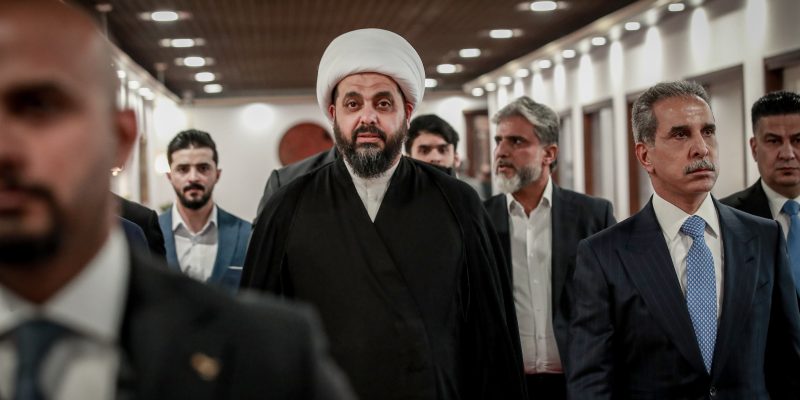
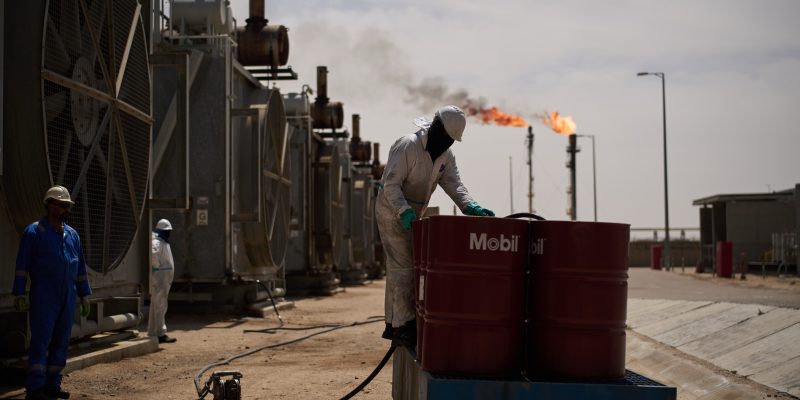
These developments reflect the structure of the PMF within Iraq. The PMF exercises influence over financial institutions, key ministries, the legislature, and the judiciary, operating with impunity that no elected institution can match. These groups have become transnational actors, sustaining Iran’s sanctions-evasion networks through oil smuggling and illicit financial channels. As Hezbollah and Hamas have been degraded under sustained military pressure, the Iraqi militia ecosystem has absorbed much of their former strategic weight. The most ideologically committed factions—Kata’ib Hezbollah, Harakat al-Nujaba, and Kataib Sayyid al-Shuhada—show no interest in accommodation, having accumulated enough capital to operate beyond the reach of the Iraqi state.
A Government in Crisis
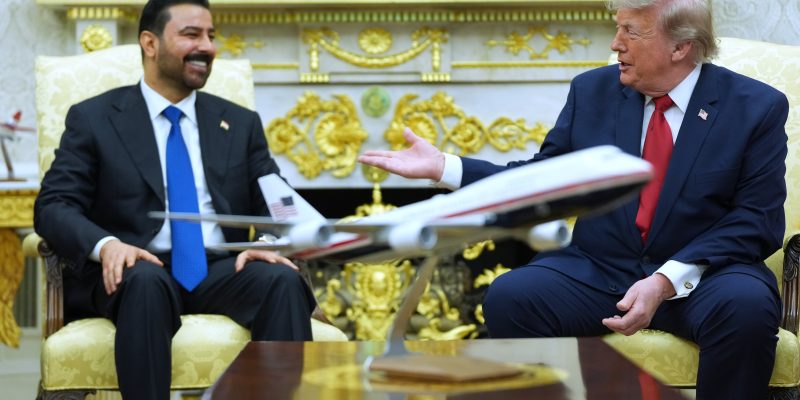
The war arrived at the worst possible moment. The country entered the conflict without a functioning executive, led by a prime minister whose authority was constitutionally constrained. The deadlock within the Shia Coordination Framework left Baghdad structurally unable to confront militia escalation. The recent nomination of Ali al-Zaidi as prime minister further underscored this dynamic, revealing the extent to which Iraq’s leadership selection remains shaped by internal fragmentation as well as competing pressures from Washington and Tehran. Tehran pushed to install an ideologically aligned prime minister to consolidate Iraq within Iran’s regional network. Washington responded by halting dollar shipments, tightening financial access, and scaling back security cooperation. Iraq’s most consequential sovereign political decision is not being made in Baghdad, but in a tug-of-war between Washington and Tehran.
These dynamics point to a broader issue of how authority is exercised within Iraq. Iraq has all the formal attributes of a state—a flag, a constitution, a parliament, a prime minister, and foreign embassies—but it lacks the most crucial element of all: a monopoly on the use of force within its own territory.
This problem lies upstream of Iraq’s broader problems. Decisions taken by the Iraqi government can be undermined by PMF actions if officials in Iran determine that it does not suit their interests. The state-within-a-state can thwart political appointments, upend decisions on oil and gas issues, and undermine Iraq’s foreign relations at a moment’s notice. On orders from Tehran, the PMF is currently doing so in the Gulf; militia attacks on Gulf states have triggered joint condemnations and risk reversing years of regional re-engagement, while strikes on energy infrastructure threaten Iraq’s investment relationships. Internally, strikes on the Kurdistan Region have killed civilians and Peshmerga fighters alike, deepening tension between Erbil and the central government.
Baghdad’s political class remains too fragmented and too constrained to mount a genuine confrontation with the forces undermining it. What is needed is not merely political will, but a structural reconfiguration of the Iraqi state that ends the institutionalized duality that has made this crisis possible.
The views and opinions expressed in this article are those of the authors and do not necessarily reflect the views of Gulf International Forum.
Issue: Politics & Governance
Country: Iraq

Hiba Abdulwahhab is an Iraqi researcher and analyst focused on Iraq’s governance, armed factions, Iranian influence in the region, and questions of Iraqi national identity, alongside broader themes in Middle East politics and security. She has collaborated with the Gulf International Forum, the Wilson Center’s Middle East Program, and the Washington Center for Human Rights. She holds a master’s degree in public and international Affairs from Virginia Tech and another in Arabic Language and Linguistics from PennWest University, as well as a bachelor’s degree in law from Baghdad University.
Why Iran Never Knows When to Stop
July 27, 2026At first glance, Iran’s negotiating difficulties appear to stem from disagreements between pragmatists seeking sanctions relief and hardliners determined to resist compromise. Yet that explanation…
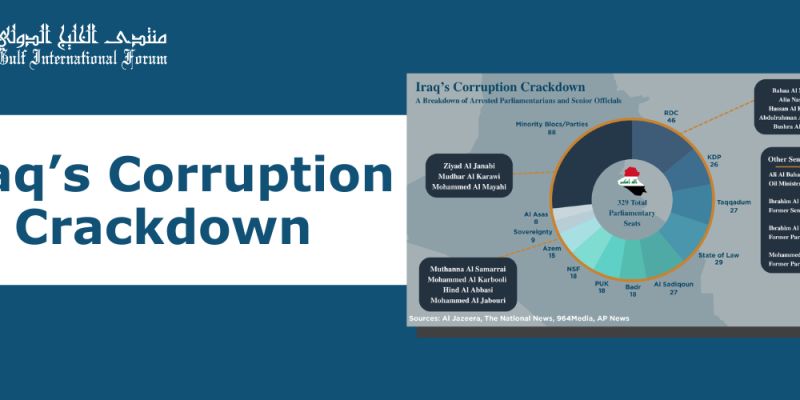
Iraq’s Corruption Crackdown
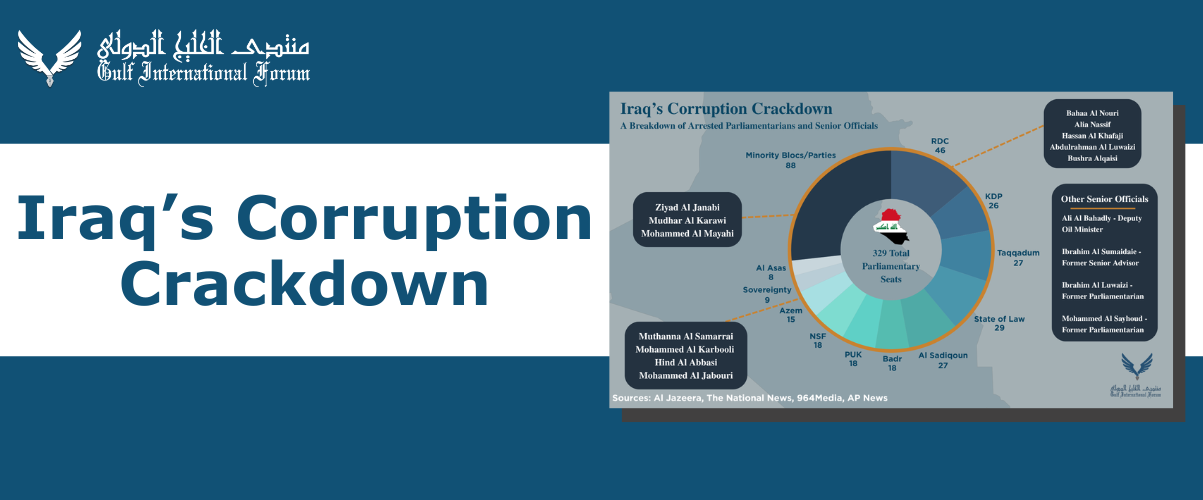
July 22, 2026*A breakdown of arrested parliamentarians and senior officials as of June 28, 2026.
Sheikh Hamad and the Making of Modern Qatar
July 15, 2026There is a question that haunts every small state: how does a nation survive and stay relevant in a region built for giants? For most…