Strategic Crossroads: Navigating the UAE’s Security Dilemma in Somalia
The UAE’s persistent military involvement in Somalia, despite the evident dangers posed by groups like al-Shabaab, underscores a strategic commitment to deepen its security ties with Mogadishu and extend its influence in the Horn of Africa.

On February 10, Al-Shabaab claimed responsibility for an attack on the General Gordon military base in Somalia’s capital, Mogadishu. According to the Emirati Defense Ministry, the raid killed four Emirati soldiers and one Bahraini, all of whom were deployed on a mission to train soldiers from the Somali Armed Forces. Reports indicate that the gunman, who had defected from al-Shabaab before being recruited by Somalia and the UAE, had opened fire on the forces as they had started to pray.
While rare, al-Shabaab attacks on Emirati troops are not unheard of. Back in 2015, the group detonated a vehicle-borne improvised explosive device (VBIED) on a car carrying Emirati officials in Mogadishu. While the attack killed 12 people, the Emirati officials survived. And in 2019, al Shabaab claimed responsibility for killing a Maltese man who worked for Dubai’s P&O Ports—a Dubai government-owned port operator—in Somalia’s semi-autonomous Puntland region.
The latest attack illustrates the risk of the Emirates’ deepening security relationship with the internationally recognized Somali government, which, though it pales in comparison to the support provided by the United States, the African Union, and Turkey, appears poised to play a larger role.
A Complicated Relationship
The UAE’s presence in Somalia stretches as far back as the early 1990s, when Abu Dhabi contributed 640 men to the U.S.-led Unified Task Force (UNITAF) peacekeeping mission in the country. After waning over the following three decades, Emirati influence in Somalia was revived in 2022 with the election of Somali President Hassan Sheikh Mohamud. Only three days after the election, the government in Mogadishu released $9.6 million that had been seized by Somali forces in 2018 from an Emirati plane in Mogadishu after the former Somali government claimed that the money was intended to disrupt the country’s security. Relations had struggled for some time before the seizure, with the Somali government banning UAE state-owned ports operator, DP World, from the country and Mogadishu remaining neutral during the 2017 Qatar diplomatic crisis. However, the 2018 seizure provoked a stronger response from the UAE, which terminated its military training mission in Somalia—programs that had developed thousands of Somali troops, built training centers, and paid over 2,000 soldiers’ salaries since they were established in 2014. The severance of Emirati engagement also caused the Sheikh Zayed Hospital in Mogadishu to close.
By February 2023, the bilateral relationship had improved dramatically. Mogadishu and Abu Dhabi entered an official security cooperation agreement. A month later, the UAE began construction on a new Emirati-owned and -operated military base in Somalia’s southern Jubaland region. And in June, the UAE carried out its first public kinetic operation in Somalia—an airstrike targeting an al-Shabaab-controlled village in the Galguduud region with Turkish-made Bayraktar TB2 drones. The strike underscored Abu Dhabi’s commitment to the war against al-Shabaab to thwart the group’s expansion, while solidifying its influence with the Somali government. Emirati forces remain actively involved in military operations across the Horn of Africa, including those to intercept Iranian weapons smuggling in Puntland.
Warning Signs
While Emirati troops have long fallen low on al Shabaab’s priority list, the UAE’s expanded military presence in Somalia appears to have attracted significant attention from the terrorist group. After all, when the group claimed responsibility for the attack on the General Gordon military base, it described the UAE as an “enemy” of Islamic law for its backing of the internationally recognized Somali government, a diatribe that mirrored its depiction of the Emirates as a tyrannical regime seeking to exploit Somalia.
The February 10 attack is a stark reminder of the risk posed by al-Shabaab to the UAE’s involvement in Somalia. Although other foreign forces make up a larger portion of foreign troops across Somalia, anti-UAE sentiment has been rising in the country in recent years. Much of this ill will can be put down to realpolitik. In recent years, Abu Dhabi has normalized relations with Israel through the Abraham Accords and supported closer relations with Ethiopia, which recently recognized Somaliland as a sovereign state in return for access to a Red Sea port. Al-Shabaab released a statement condemning the port deal and implying that the militant group would look to stymie the agreement, in an effort to garner support among Somalis opposed to foreign intervention.
The attack on General Gordon also highlights that al Shabaab operatives have successfully infiltrated the Somali military, giving the group access to intelligence on foreign forces and access to military facilities. Equipped with these insights and capabilities, the risk of future al Shabaab attacks on UAE forces, the UAE’s new military base in Jubaland, or even high-ranking Emirati officials visiting Somalia will reach all-time highs.
Though some may posit that the attack could prompt the UAE to reconsider its support to Somalia, it is unlikely that Abu Dhabi’s presence in the country will be affected. In fact, shortly after the attack, Anwar Gargash, a senior Emirati diplomat, wrote that “no treacherous act will prevent [the UAE] from continuing [its] message of security and safety and combating extremism and terrorism in all its forms.”
Abu Dhabi’s determination to maintain its military footprint in Somalia, despite recent attacks, underscores a strategic commitment to increase its influence and role at crucial maritime corridors. The assault by al-Shabaab not only exposes the challenges and risks associated with the UAE’s military endeavors in the region but also casts a spotlight on the intricate interplay of international forces in Somalia. In the face of escalating threats, including piracy, terrorism, and regional maritime security breaches, the UAE’s resolve to uphold its strategic interests in the Horn of Africa is clear. This steadfast approach indicates a deep-seated intention to bolster Somalia’s stability and safeguard regional security, affirming the UAE’s ongoing investment in the country’s future.
The views and opinions expressed in this article are those of the authors and do not necessarily reflect the views of Gulf International Forum.
Issue: Defense & Security, Geopolitics
Country: UAE

Emily Milliken is the Senior Vice President & Lead Analyst at Askari Defense & Intelligence, LLC, an Arlington, Virginia-based program management and consulting company.
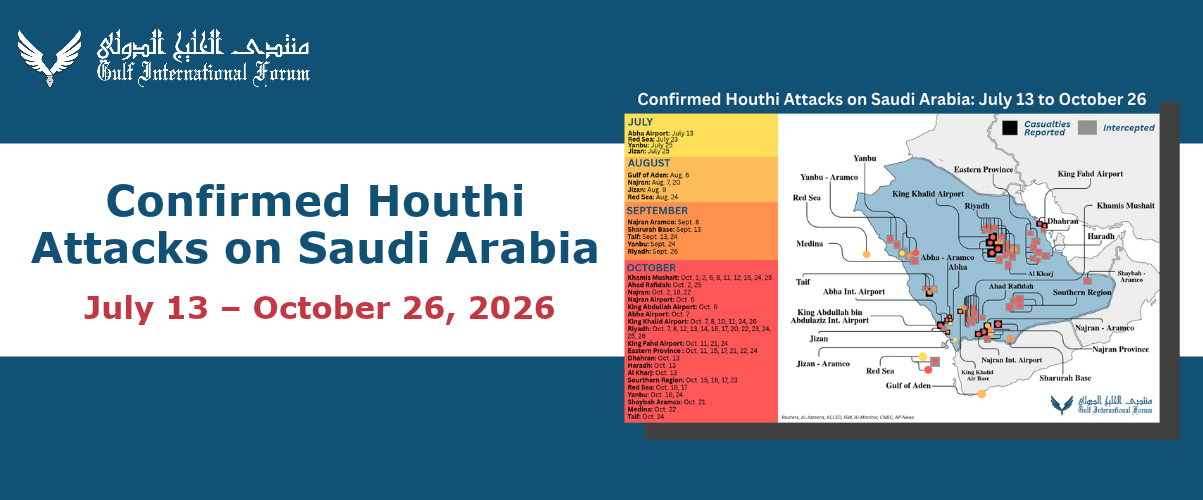
Confirmed Houthi Attacks on Saudi Arabia: July 13 to October 26
October 28, 2026
Toward a New Order in MENA Regional Geopolitics
September 2, 2026This report is a byproduct of the workshop “Toward a New Order in MENA Regional Geopolitics: What’s Next for the Region’s Geopolitical Equilibrium?,” hosted in…
Yemen’s Emerging Role in the Red Sea
August 27, 2026On August 4, 2026, the Yemeni Coast Guard (YCG) rescued the 14-member crew of the Indian-flagged commercial vessel Faize Noore Oliya. Transiting the Red Sea…