Succession and Legitimacy Struggles: Assessing Iran’s Post-Raisi Political Landscape
The unexpected passing of Iranian President Raisi underscores the intricate challenges concerning succession, stability, and the overall legitimacy of the Islamic Republic.

On May 19, the helicopter carrying Iran’s hardline president, Ebrahim Raisi, disappeared in the mountains of the country’s East Azerbaijan province following his visit to a joint Iran-Azerbaijan dam along the northern border. After a day of searching, crews located the crashed helicopter and recovered Raisi’s body, along with those of Foreign Minister Hossein Amirabdollahian, two local officials, and the flight crew.
Prior to the crash, Raisi’s upward political trajectory seemed certain. After overwhelmingly winning the presidency in 2021 as the only viable, pre-approved candidate, the former head of the judiciary was widely seen within Iran as the obvious choice to succeed the octogenarian supreme leader, Ayatollah Ali Khamenei. Instead, Raisi’s abrupt death has upended Iranian politics and thrown the country’s future trajectory into serious question.
Next in Line
Raisi’s untimely death has sparked a renewed crisis of legitimacy within the Islamic Republic. Raisi was the first Iranian leader in its post-1979 era to die in office, and according to the country’s constitution, a new presidential election must be held to choose his successor within 50 days. However, in addition to electing the president, the Islamic Republic’s political apparatus must also consider whether the winner would also be a suitable successor to Khamenei, as the new president would immediately enter the running to ascend to the supreme leadership upon the supreme leader’s passing—just as then-President Khamenei succeeded the late Ayatollah Ruhollah Khomeini in 1989. However, given the existing tensions and widespread anti-government discontent in Iran, questions surrounding the election of Raisi’s successor remain. Will the situation end in a crisis? Will the election of the president and the next leader be challenged by an opposition force, or a mass uprising by the people akin to the Mahsa Amini protests? The short answer is that the Islamic Republic’s political operatives will move relatively quickly to name viable successors, without allowing reformist politicians near the presidency.
The supreme leader is nearly all-powerful within Iran. He is the sole determiner of the country’s domestic and foreign policy, while other institutions, such as the presidency, are simply its implementers. The organs of government may create and implement their own tactics, but the supreme leader determines the overall strategy. The supreme leader maintains the support of the Islamic Revolutionary Guard Corps (IRGC) and Iran’s other military forces—the most decisive influences in the country’s succession process. Whoever seeks to assume the presidency and replace Khamenei must ensure the support of these actors.
Some Iranian experts have observed that with Raisi’s death and the election of a successor, Iran’s elites will prioritize securing the new leader’s domestic position. This means that the Islamic Republic will most likely reduce its foreign expenditures, reining in its foreign proxies and attempting to alleviate tensions with the West. Many Iranians oppose the Islamic Republic’s Gaza and anti-Western policies and consider them harmful to Iran’s interests. Though the Iranian regime clearly has no interest in changing those policies, Tehran may de-emphasize them in a bid to improve the livelihood of the people and keep the atmosphere calm.
A New Dynasty?
Another way to ensure stability would be to choose Raisi’s successor—and thus Khamenei’s likely successor—from within Iran’s political establishment, guaranteeing elite support for the candidate in question and helping to head off potential contenders. Although this selection will be managed by the so-called “Assembly of Experts” well away from the public eye, one name has been the subject of widespread discussion and controversy: Mojtaba Khamenei, the 55-year-old son of the current supreme leader. However, there are two major reasons to suspect that his candidacy might be met with doubts.
First, Iranians overall—both within the clerical system and outside of it—have deep suspicions of hereditary government, owing to Iran’s history of authoritarian rule under the Pahlavi family. Iran’s 1979 revolution was expressly anti-monarchical and anti-dynastic, and the creation of a Khamenei dynasty in its place would necessarily raise questions about the Islamic Republic’s legitimacy.
There is some evidence that Khamenei himself is sensitive to this issue; Mahmoud Mohammadi Araghi, a member of the Assembly of Experts, stated in an interview with the Iranian Labor News Agency that the supreme leader had voiced his disapproval of the committee’s earlier suggestion to appoint his son to succeed him. According to Araghi, Khamenei told the group, “What you are doing raises doubts about the hereditary issue of leadership.”
Second, Mojtaba Khamenei’s appointment would raise suspicions within the clerical regime that nepotism had infiltrated the revolution, potentially causing a major rift in the Islamic Republic’s governing structure at a time when the system can least afford it. Over the past half-decade, Iran has confronted economic depression, crippling inflation, a wave of devastating natural disasters, and the largest anti-government protests since the regime’s founding in 1979. One major reason for the failure of the 2022-2023 Mahsa Amini protests was the degree of unity within the ruling coalition, but an unpopular hereditary appointment would threaten to split the establishment and create an opening for further protests.
Mojtaba Khamenei is far from the only option available to Khamenei’s inner circle. Other high-profile clerics and political leaders are more religiously moderate and could help keep the masses in check, but are equally “revolutionary” and thus trusted by the regime. Ayatollah Alireza Arafi, a high-profile cleric and a member of both the Guardian Council and the Assembly of Experts, has been mentioned as one of the most promising options. His ascent through Iranian politics began in 2001, after being appointed by Khamenei to lead the World Center for Islamic Sciences (now called Al-Mustafa International University). In 2016, he was elected as one of the seven members of the Supreme Council of Qom Seminary and was later elected to the position of the director general of seminaries across the country—one of the most powerful religious positions in Iran. Khamenei’s high regard for Arafi is clear—he had previously praised the cleric as an “original, intellectual and resourceful jurist,” and said at the time of his appointment, “The right sat in its place.” Other potential options exist as well, such as Mohammed Bagher Ghalibaf, a former IRGC commander and longtime mayor of Tehran, who currently serves as the speaker of Iran’s parliament.
In short, Raisi’s death has left uncertainty swirling around the selection of a successor. If the succession battle goes poorly or divides societal opinion, there is little doubt that it could cause a deeper political crisis and reinforce popular perceptions that the regime is illegitimate. However, at the present, Khamenei’s leadership over Iran remains unquestioned, and the institutions he controls will likely select a different successor in due course. There is little chance, however, that Iran’s new president will repair the crisis of legitimacy affecting the Islamic Republic or address the concerns of millions of its resentful and disaffected citizens.
The views and opinions expressed in this article are those of the authors and do not necessarily reflect the views of Gulf International Forum.
Issue: Politics & Governance
Country: Iran

Dr. Mohammad Salami holds a Ph.D. in International Relations. He is a specialist in Middle Eastern policy, particularly in Syria, Iran, Yemen, and the Persian Gulf region. His areas of expertise include politics and governance, security, and counterterrorism. He writes as an analyst and columnist in various media outlets. Follow him on Twitter: @moh_salami
Why Iran Never Knows When to Stop
July 27, 2026At first glance, Iran’s negotiating difficulties appear to stem from disagreements between pragmatists seeking sanctions relief and hardliners determined to resist compromise. Yet that explanation…
Iraq’s Corruption Crackdown
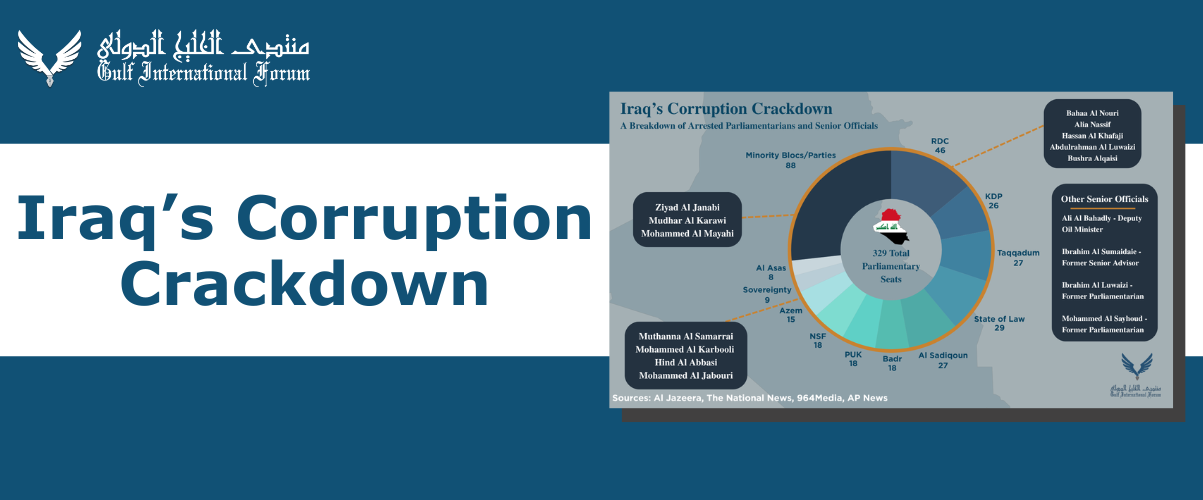
July 22, 2026*A breakdown of arrested parliamentarians and senior officials as of June 28, 2026.
Sheikh Hamad and the Making of Modern Qatar
July 15, 2026There is a question that haunts every small state: how does a nation survive and stay relevant in a region built for giants? For most…