The GCC States Flex Their Diplomatic Muscles over Ukraine
In a sign of the region’s growing diplomatic clout, the Gulf states have developed into major power players in negotiations to end the war in Ukraine.

Since President Donald Trump’s return to the White House, Saudi Arabia has emerged as the United States’ preferred mediator to end the war in Ukraine. On February 18th, a U.S. delegation led by Secretary of State Marco Rubio met a Russian delegation led by Foreign Minister Sergey Lavrov in Riyadh for talks. This historic meeting, which did not include Ukrainian officials, preceded Rubio’s March 11 talks with Andriy Yermak, the Head of the Office of the President of Ukraine, in Jeddah. Saudi Arabia is slated to host future negotiations between U.S., Ukrainian, and Russian officials as Washington presses for peace.
While Saudi Arabia’s role as host for these talks has dominated the headlines, other GCC countries have also contributed to initiatives aimed at de-escalating the war. The UAE has secured several rounds of prisoner exchanges between Russian and Ukrainian forces, most recently in January 2025. Qatar has spearheaded efforts to repatriate Ukrainian children abducted by Russian forces, and Oman has facilitated lower-profile dialogue efforts between Iran and Ukraine, which seek to address tensions caused by Tehran’s export of armed drones to Russia. As Trump’s push to end the Ukraine war intensifies, these parallel initiatives further bolster the standing of GCC countries as helpful mediators.
Saudi Arabia at the Center of Peace Talks
Although Saudi Arabia has mediated in conflicts, from the 1975-90 Lebanese Civil War to Sudan’s ongoing intra-military civil war, it initially assumed a lower profile than its GCC counterparts regarding the Ukraine war. From April to September 2022, Saudi Crown Prince Mohammed bin Salman (MBS) worked with Turkish President Recep Tayyip Erdogan and Russian oligarch Roman Abramovich to broker the release of ten foreign national prisoners of war (POWs) in Russian custody. In December 2022, Saudi Arabia coordinated with the UAE to win the release of U.S. WNBA basketball player Brittney Griner from Russian prison. Saudi Foreign Minister Faisal bin Farhan claimed that MBS personally intervened on Griner’s behalf, but U.S. officials have disputed the extent of his involvement.
Saudi Arabia’s next foray into Ukraine War mediation was more polarizing. In August 2023, Ukrainian President Volodymyr Zelensky presented his ten-point plan for peace in Jeddah. Perhaps because the talks took place in a non-Western country and China was in attendance, Zelensky saw the forum as an opportunity to encourage solidarity with Ukraine among countries of the Global South. Russia’s exclusion from the negotiations and Ukraine’s insistence on a complete withdrawal of Russian forces from its territory hardened the Kremlin’s resistance to a diplomatic solution.
In light of these controversies, Saudi Arabia lowered its profile as a conflict mediator in Ukraine. However, Trump’s return to power has changed the calculus for Saudi leaders. MBS clearly sees an opportunity to use crisis diplomacy to rid himself of the reputational stains that have lingered since the grizzly 2018 assassination of Jamal Khashoggi by Saudi agents in Istanbul. By demonstrating his utility to President Trump and his foreign policy priorities, MBS hopes that Saudi Arabia can become a trusted interlocutor for the U.S. and ensconce its seat at the table in future negotiations over Iran’s nuclear program. In a sign of its newfound influence over the discussions, Saudi commentator Salman al-Ansari claimed that European diplomats are considering visiting Riyadh—not Washington—to register their disagreements with U.S. policy towards Ukraine.
Riyadh’s emergence as a major diplomatic power player in the Ukraine war should not come as a surprise, as Saudi Arabia’s calculated, independent foreign policy has made it an amenable mediator for both Russia and Ukraine. After the 2023 U.S.-Ukraine talks in Jeddah, Putin reportedly consulted with Mohammed bin Salman on how to best resolve the conflict. Support for Saudi Arabia’s mediative role is widespread among Putin’s negotiating team. Russia Direct Investment Fund chief Kirill Dmitriev is one of Putin’s main interlocutors with Trump and is a long-standing supporter of cooperation with Saudi Arabia; In October 2019, Dmitriev became the second Russian national—after Putin himself—to receive the Order of King Abdulaziz.
The Kremlin also sees holding talks in Saudi Arabia as a triumph for its vision of a multipolar international order. Kirill Semenov, a prominent Moscow-based expert on Middle East affairs, highlighted to the author the symbolic significance of holding U.S.-Russia talks in “the heart of the Islamic world in Riyadh, not in Europe.” Semenov argued that “thanks to the Russian special military operation, the role of the leaders of the Global South has increased and they naturally recognize Russia’s contribution.”
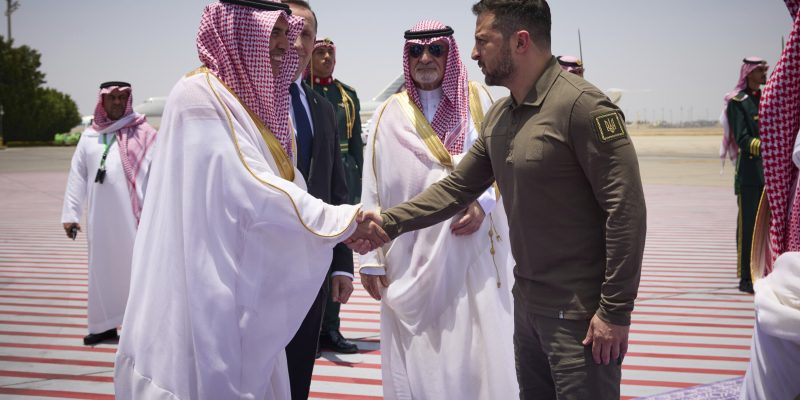
For its part, Ukraine sees Saudi Arabia as a valuable potential investor in its post-war reconstruction and is courting it as a partner with which it can develop an indigenous defence industry. Ukraine also wants to extend MBS’ diplomatic ambitions to the prisoner exchange and child repatriation spheres, which are particularly important for Kyiv. These plans were officially announced by the Ukrainian presidential administration after Zelensky’s trip to Riyadh last week.
Parallel GCC Efforts
While the UAE has publicly endorsed Saudi Arabia’s arbitration efforts, it has also offered its mediation services to U.S. officials. The UAE has established its credibility as a diplomatic interlocutor through its efforts to broker prisoner exchanges between the warring parties. Since the start of Russia’s full-scale invasion of Ukraine, the UAE has brokered 11 separate prisoner exchanges and helped free a total of 2,583 POWs. The UAE has tried to tie these prisoner exchanges to other issues, such as the resumption of Russian ammonia exports (a key base chemical used for fertilizers), but has struggled to find success. Nonetheless, the UAE has continued to maintain close relations with the warring parties to advance its interests and bolster its diplomatic efficacy.
During Zelensky’s February 2025 visit to Abu Dhabi, the UAE signed a Comprehensive Economic Partnership Agreement (CEPA) with Ukraine. The CEPA amounts to a UAE-Ukraine free trade pact and will also allow both countries to coordinate on facilitating Ukrainian grain exports to the Global South. The coincidental timing between this CEPA and the UAE’s double taxation agreement with Russia underscores the delicacy of Abu Dhabi’s balancing strategy.
Since July 2023, Qatar’s diplomatic role has focused chiefly on the repatriation of Russian and Ukrainian children. These efforts have resulted in the return of 95 Ukrainian children and 15 Russian children to their families. Although Ukraine protests Russia’s depiction of this initiative as a “child exchange” and the number of children released is dwarfed by the 19,000 that Russia allegedly abducted from the territories it occupies in eastern Ukraine, Qatar’s mediation is the most durable framework to address this issue.
Similar to the UAE, Qatar has tried to broaden its diplomatic efforts to issues beyond the repatriation of children. Before Ukraine’s surprise August 2024 incursion into Russia’s Kursk region, Qatar attempted to broker an energy facility ceasefire. While Russia denied the potential resumption of talks in October 2024, Yermak expressed an openness to Qatar hosting energy ceasefire negotiations days later. Qatar’s more limited initiatives could gain renewed momentum if Trump fails to convince Putin to adopt the U.S.-Ukraine thirty-day Jeddah ceasefire plan.
Oman’s diplomatic role in the Ukraine War has been more peripheral and mirrors the dialogue facilitation efforts it advanced in other Middle East theatres, such as the March 2023 Saudi-Iran normalization agreement, discussions over the future of Yemen, and ongoing U.S.-Iran talks. In February 2023, Oman hosted negotiations between Iranian and Ukrainian officials. Ukraine, along with the United States, has accused Iran of arming Russia with armed drones, while Iran has dubiously insisted that its drone deliveries to Russia predated the war. Though these talks did not produce any diplomatic breakthroughs, Oman’s reputation for neutrality could allow it to play a role in the Ukraine war’s resolution.
Saudi Arabia’s emergence as mediator-in-chief in the Ukraine War is a watershed moment for the GCC’s conflict arbitration ambitions. It complements successes in other theatres like Qatar’s brokering of talks between the Democratic Republic of the Congo and Rwanda, and the UAE’s dialogue facilitation between the U.S. and Iran. As protracted conflicts continue to destabilize the post-Soviet space, Middle East and Africa, GCC countries will have many opportunities to leverage their diplomatic experience and contribute to the de-escalation of hostilities.
The views and opinions expressed in this article are those of the authors and do not necessarily reflect the views of Gulf International Forum.
Issue: Geopolitics
Country: GCC

Dr. Samuel Ramani is an Associate Fellow at the Royal United Services Institute (RUSI) in London, Non-Resident Fellow at Gulf International Forum and the CEO of Pangea Geopolitical Risk. Samuel is the author of two recent books on Russian foreign policy “Russia in Africa: Resurgent Great Power or Bellicose Pretender” and “Putin’s War on Ukraine: Russia’s Campaign for Global Counter-Revolution.” Both books were published by Oxford University Press and Hurst in 2023,. Samuel is a regular contributor to major broadcast networks, such as CNN, Al Jazeera, BBC, Sky News and France-24, and to Foreign Policy magazine. Samuel has advised the U.S. Department of State, U.S. Department of Defence, UK Foreign and Commonwealth Office, France’s Ministry of Defence and NATO Headquarters on international security issues.

Beyond Hormuz: Why Balochistan Matters to Gulf Energy Security
October 21, 2026A conflict long treated as peripheral to Gulf security is becoming harder to ignore as the war with Iran puts pressure on the region’s maritime…
Should Syria and Qatar Join the Mecca Pact?
October 9, 2026Three years of cascading conflict have fundamentally transformed the Middle East’s security outlook. American weapons, military deployments, and security guarantees remain central to the region….

China’s Technology Development Push Meets Gulf Diversification
October 6, 2026China’s “new quality productive forces” (NQPF) are often understood as a domestic effort to revive growth, upgrade industry, and reduce dependence on Western technology. Yet…