The Impact of Leadership Loss in Iran
Leadership decapitation has failed to force the Iranian regime to surrender, revealing resilience and an attempt to shape negotiations on its own terms.

The most recent round of military strikes by Israel and the United States has targeted thousands of sites across Iran, killing scores of senior Iranian leaders and commanders. However, the strikes have failed to achieve their primary objective: compelling Iran’s leadership to surrender. Tehran has rejected President Donald Trump’s 15-point peace plan, calling it “extremely maximalist and unreasonable,” and dismissed subsequent calls to relinquish its missile and nuclear programs. Iran reiterated that it would decide when to end the war on its own terms, potentially including new demands for greater control over navigation in the Strait of Hormuz, war reparations, and the preservation of its defensive and offensive capabilities. A fragile two-week ceasefire, mediated by Pakistan, is now in effect, but the fundamental problems of the war remain unsolved: Iran is unwilling to concede to Trump’s demands, and Trump is unwilling to back down on them.
The failure of negotiations raises another question: after the killing of Supreme Leader Ayatollah Ali Khamenei on the first day of the war, who now speaks for Tehran?
A New Supreme Leader
After Iran’s 12-day war with the United States and Israel in June 2025, Tehran rapidly revised its military strategy in anticipation of a larger conflict. The regime expanded military capabilities, reinforced wartime supply lines, and designated multiple successors for every key leadership position. The plan preserved centralized authority while dispersing operational control, ensuring both regime resilience and continuity under wartime conditions.
The new Supreme Leader, Mojtaba Khamenei, serves as a figurehead who has not appeared publicly since his family compound was struck on February 28. Credible reports indicate that the younger Khamenei was injured in the strikes, and may not even be inside Iran. As commander-in-chief, Khamenei is charged with keeping Iran’s multiple pillars of power unified, but his prolonged absence has raised doubts about his condition and current ability to lead.
In a statement issued on March 12, Khamenei unveiled his leadership roadmap. The plan underscored the need for a proactive deterrence strategy and for strengthening human capital through a new people-centered national security policy. Khamenei further declared the year ahead as one of “Resistance Economy in light of National Unity and National Security,” focused on building local economic capacity through indigenous growth, particularly in the military-industrial sector and science-based foundations driving innovation.
Resilient Political System
Khamenei’s roadmap now guides the key pillars of Iran’s wartime power:
Executive Branch: President Masoud Pezeshkian leads Iran’s wartime diplomacy, calling for “serious and genuine” engagement with regional states even as Tehran continues strikes on U.S. bases and energy infrastructures in the Gulf. These operations are designed not only to punish U.S. interests but also to deter further involvement by other states.
Judicial Branch: Chief Justice Gholam-Hossein Mohseni-Ejei reinforces regime control through a top-down structure targeting domestic dissent. Throughout the war, the judiciary has expanded its use of arrests, public shaming, executions, and property confiscation against Iranians accused of espionage or cooperation with foreign news networks. Controlled internet access across the country enables the government to trace sources of dissent and suppress opposition.
Supreme National Security Council: Mohammad Baqer Zulqadr, a veteran commander of the Islamic Revolutionary Guards Corps (IRGC) who has held key positions in the judiciary, security, and disciplinary forces, leads the National Security Council and coordinates across Iran’s political and security institutions. His central role is to ensure cohesion among Iran’s different pillars of power, while issuing directives to secure regime survival. He also oversees the operations of the Supreme Defense Council, which centralizes military decision-making during wartime.
Conventional Armed Forces (Artesh) and the IRGC: The possibility of regime collapse following the killing of senior military commanders was always extremely unlikely. Western expectations of a coup, premised on Western-based political perspectives of the armed forces fracturing or abandoning their ranks, were never realistic. The Iranian regime is built on ideologically rigid, top-down command structures, reinforced by a robust counterintelligence apparatus operating alongside the army and IRGC to prevent internal dissent. Combined with the Basij paramilitary, this structure enables the Supreme Leader to command two to three million personnel in the armed forces, supported by decentralized operational networks designed to ensure continuity even if senior officials are eliminated.
Iran’s armed forces also monitor enemy movements along borders, conduct joint operations against multiple targets in the war, and implement new strategies to control shipping in the Strait of Hormuz. Iranian forces have further warned that any foreign troop presence on Iranian soil could trigger an expansion of the conflict into other international waterways.
Clerical Networks: Clerical networks, led by influential ayatollahs with large followings, play a critical role in mobilizing support during the war. Through religious rulings, ayatollahs can translate ideological guidance into mass participation, providing Tehran with a useful source of foot soldiers in the conflict and helping to shore up public support. Recent wartime verdicts, including those issued by Ayatollah Abdullah Javadi Amoli, frame the conflict in religious terms and reinforce calls to confront the United States and Israel.
Societal Networks: The Islamic Republic utilizes societal mobilization as a tool to reinforce its wartime strategy, projecting the appearance of a domestic base united behind the regime. In reality, large-scale rallies are mainly orchestrated by the regime, which may retain a base of several million Iranians in sufficient numbers to help protect against regime collapse. This managed mobilization is also intended to deter dissent, legitimize Iran’s wartime actions, and reinforce the impression of internal backing. Moreover, the absence of almost all anti-regime protests reflects both a level of wartime national solidarity and the government’s strict censorship and security enforcement measures, particularly after demonstrations in the month before the war were met with deadly force.
Iran’s leadership losses may have weakened regime control, but it also reinforced its resilience. With the centralized authority working to reclaim its position amid stalled but likely continuing negotiations in Islamabad, Tehran will try to sustain the conflict on its own terms, ensuring that leadership decapitation alone will not alter its strategic trajectory. Yet, with the decapitation strategy failing to produce surrender or sufficient concessions from Iran, it remains to be seen whether Trump will develop a new modality for temporary coexistence with Tehran or instead be tempted to escalate militarily to reinforce his preferred end to the war.
The views and opinions expressed in this article are those of the authors and do not necessarily reflect the views of Gulf International Forum.
Issue: Politics & Governance
Country: Iran

Banafsheh Keynoush is the co-author of the book The Abraham Accords: National Security, Regional Order and Popular Representation (Rowman and Littlefield, 2025) and a chapter therein entitled “Iran and Israel: A Distorted Connection”. She is also the author of the The World Powers and Iran: Before, During and After the Nuclear Deal (Palgrave, 2022). She can be followed @banafshkeynoush.
Why Iran Never Knows When to Stop
July 27, 2026At first glance, Iran’s negotiating difficulties appear to stem from disagreements between pragmatists seeking sanctions relief and hardliners determined to resist compromise. Yet that explanation…
Iraq’s Corruption Crackdown
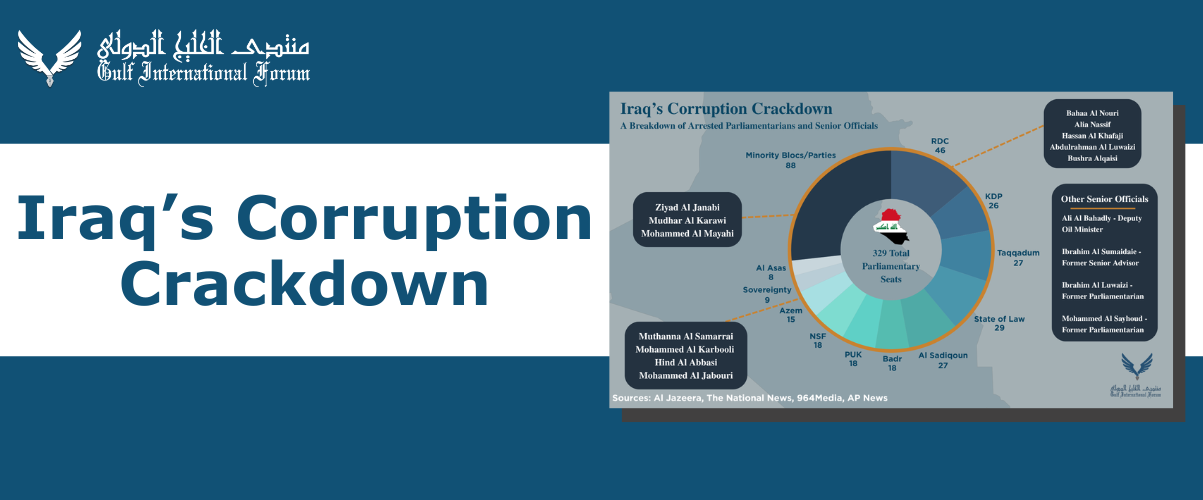
July 22, 2026*A breakdown of arrested parliamentarians and senior officials as of June 28, 2026.
Sheikh Hamad and the Making of Modern Qatar
July 15, 2026There is a question that haunts every small state: how does a nation survive and stay relevant in a region built for giants? For most…