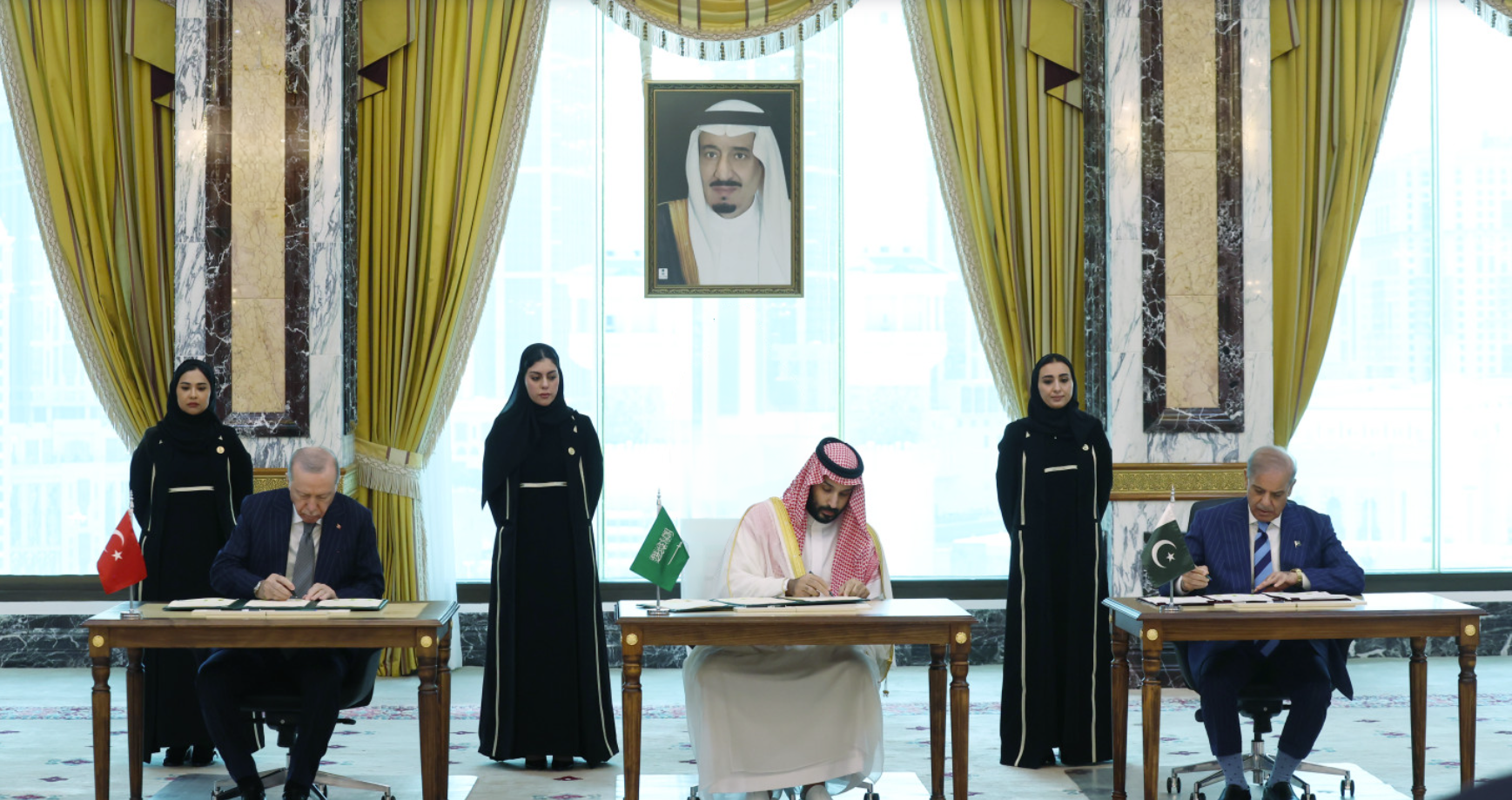
The Mecca Agreement: Seeds of a New Regional Security Architecture
By bringing together Turkey’s defense capabilities, Saudi Arabia’s resources, and Pakistan’s military power, the new trilateral defense pact could lay the groundwork for greater regional security cooperation.

The Middle East is entering a new phase in the evolution of its security order, as conflict and instability continue to reshape the region. At the same time, uncertainty surrounding the durability of external security guarantees has encouraged regional states to reconsider how they protect their territory, populations, critical infrastructure, and economic interests. The result is a growing desire to invest in security partnerships that provide greater regional agency and draw upon complementary capabilities.
These concerns have been reinforced by the region’s growing instability since 2023, marked by conflict, the increasing role of non-state actors, and intensifying competition between Iran, Israel, the United States, and their regional partners. The war that began with the October 2023 attacks and the subsequent conflict in Gaza has gradually expanded into a broader regional confrontation, while the current war in the Gulf has heightened fears of further Iranian attacks against regional states and critical infrastructure. At the same time, renewed Houthi activity has underscored the growing risks to regional maritime security. Disruptions to the Strait of Hormuz, through which roughly 20 million barrels of oil and petroleum products flowed daily before the start of the war, have been particularly consequential for the region and global economy. These developments have heightened the urgency of reconsidering existing security arrangements and seeking greater control over the regional strategic environment.
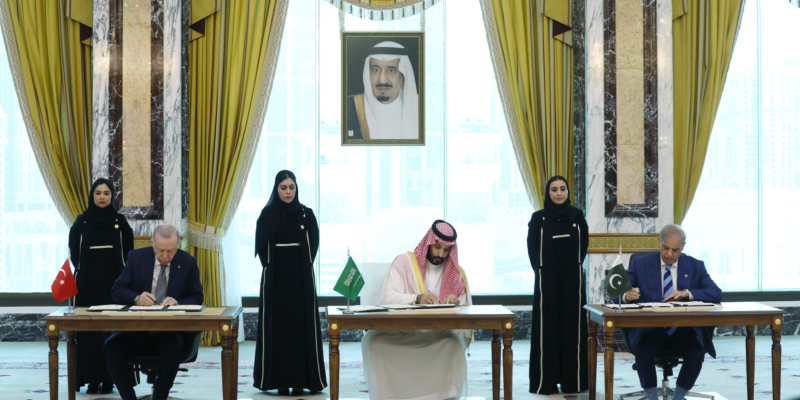
It is within this changing environment that Turkey, Saudi Arabia, and Pakistan signed a new security deal, the Mecca Joint Defense Agreement. At face value, the agreement brings together three states with markedly different strategic profiles but highly complementary capabilities. Yet its importance should not be measured solely by the capabilities that the three states possess today. Its greater significance may lie in the institutional space it creates for future cooperation.
The Architecture of a New Partnership
Signed on August 7 in Mecca, the agreement brings together three states with significant military, economic, and geostrategic capabilities. Turkey is a NATO member with one of the region’s most capable and growing defense industries, as well as substantial conventional military capabilities. Saudi Arabia brings its position as a leader of the Arab world, along with significant financial and energy resources. Pakistan, meanwhile, has a large population, is the only nuclear power in the Muslim world, and brings a large standing military force with extensive experience. Together, these capabilities create a partnership that combines military reach, economic power, geostrategic importance, and nuclear deterrence.
Importantly, the signatories have stressed that the agreement is defensive and is not directed against any specific country, including Iran. Nevertheless, its creation represents a significant development in the emergence of more autonomous regional security arrangements as Middle Eastern states seek greater control over their own strategic environment. The agreement establishes a collective-defense framework under which an armed attack against one of the three countries is to be considered an attack against all three. Turkish Foreign Minister Hakan Fidan subsequently described the mechanism as technically comparable to NATO’s Article 5, although the agreement does not prescribe an automatic military response and leaves the nature and extent of assistance to be determined through consultation. In this light, the agreement is better understood as a framework for strategic coordination and deterrence than as a fully integrated military alliance.
The timing of the agreement is particularly significant. Threats at different levels have exposed the vulnerability of regional states and raised questions about the reliability and sustainability of existing security arrangements. For Saudi Arabia, the pact reflects an accelerated diversification of its defense relationships as it seeks additional partners rather than a replacement for Washington. For Turkey, the agreement provides an opportunity to expand its partnership across the Gulf while creating new opportunities for its growing defense industry through deeper defense-industrial cooperation with Riyadh and Islamabad. For Pakistan, it reinforces longstanding defense ties with Riyadh while providing an avenue to strengthen its regional standing and bolster its efforts to play a more prominent political and diplomatic role beyond South Asia.
The Future Potential
While it is too early to describe the partnership between Turkey, Saudi Arabia, and Pakistan as a fully developed military alliance, it could represent the seeds of a game-changing regional security framework. Its significance lies less in the assumption that the three states will share identical strategic objectives than in the possibility that the agreement creates an institutional basis for cooperation where their interests overlap. Additionally, the agreement could complement other economic integration plans, such as the Four Seas Initiative.
The three countries will inevitably retain different foreign-policy priorities, threat perceptions, and relationships with other powers. The agreement should therefore not be interpreted as evidence of complete strategic alignment or a common foreign policy. Its longer-term importance could instead emerge through practical military cooperation. The three countries could gradually develop mechanisms for joint defense planning, intelligence sharing, military exercises, logistics, and coordinated responses to threats against their territory or critical infrastructure. Regular exercises could provide an opportunity to establish common procedures and improve the ability of their armed forces to operate alongside one another during defensive operations.
This could become particularly important as regional states confront threats that transcend national borders, including missile and drone attacks, maritime insecurity, attacks on energy infrastructure, cyber threats, and disruptions to critical trade routes. Cooperation in these areas would not require the three governments to share identical political objectives; it would simply require them to recognize common security vulnerabilities and create space for greater cooperation.
Over time, repeated military cooperation could create a degree of strategic familiarity and institutional trust, allowing the agreement to develop into more sophisticated forms of joint planning and operational coordination. Its real potential, therefore, lies not in what the alliance is today, but in what it could become. If sustained, it could provide the foundation for a new model of regional security cooperation.
The views and opinions expressed in this article are those of the authors and do not necessarily reflect the views of Gulf International Forum.
Issue: Geopolitics
Country: KSA

Dr. Massaab Al-Aloosy is a researcher focusing on Iraq, Iran, and Shia non-state armed groups. He holds a PhD from the Fletcher School-Tufts University and is the author of The Changing Ideology of Hezbollah, Palgrave 2020.

Themistoklis Asthenidis is a lawyer and seasoned political strategist with more than 15 years of experience working in the intersection of international politics, press and media, think tanks, and the not-for-profit sector. Having worked in senior roles in European politics, in Brussels, and across Europe, Themistoklis has a unique insight into the European Institutions’ ecosystem and an excellent contextual and geopolitical understanding of the European multilateral policy landscape. He has advised national governments, political parties, and other public and private stakeholders, and has led electoral and issue campaigns providing strategic counsel and leadership support. He holds a Master’s Degree in International Relations from the Fletcher School of Law and Diplomacy at Tufts University, as well as an LLM and LLB from the Aristotle University of Thessaloniki.

Beyond Hormuz: Why Balochistan Matters to Gulf Energy Security
October 21, 2026A conflict long treated as peripheral to Gulf security is becoming harder to ignore as the war with Iran puts pressure on the region’s maritime…
Should Syria and Qatar Join the Mecca Pact?
October 9, 2026Three years of cascading conflict have fundamentally transformed the Middle East’s security outlook. American weapons, military deployments, and security guarantees remain central to the region….

China’s Technology Development Push Meets Gulf Diversification
October 6, 2026China’s “new quality productive forces” (NQPF) are often understood as a domestic effort to revive growth, upgrade industry, and reduce dependence on Western technology. Yet…