UAE–South Korea Defense Cooperation: The KF-21 Factor
After four years of stalled F-35 talks with Washington, the UAE is weighing a partnership with South Korea to co-produce a multirole fighter, seeking a strategic hedge amid intensifying Gulf military competition.

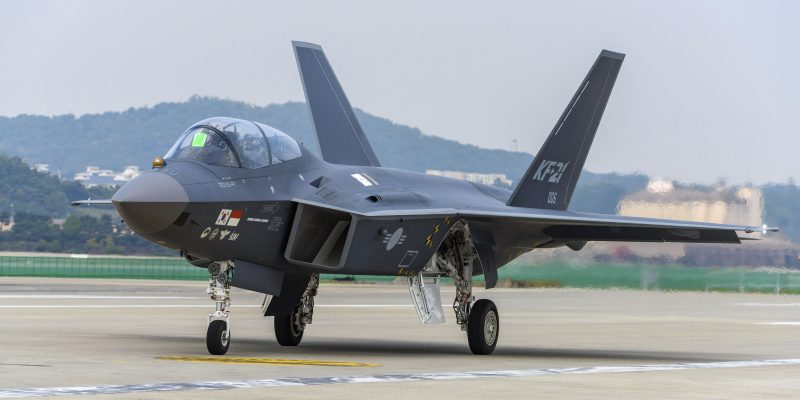
This past summer, UAE Defense Undersecretary Ibrahim Nasser Mohammed Al Alawi climbed into the rear seat of a South Korean KF-21 Boramae prototype for a symbolic “friendship flight” over Sacheon Air Base in South Korea. A few months later, during President Lee Jae-myung’s visit to Abu Dhabi, Seoul followed up with a far more consequential signal: a reported full value-chain partnership built around joint development, local assembly, and the co-export of future KF-21 variants. According to Lee’s staff, the model could generate more than $15 billion in long-term contracts for Korean firms. Following an April 2025 letter of intent committing both countries to “comprehensive cooperation” on the KF-21, the pitch marks the most ambitious step yet in a rapidly deepening partnership.
While negotiations remain preliminary, the sequence of events highlighted the emergence of a new phase in UAE–South Korea defense relations, one centered not on off-the-shelf procurement, but on industrial participation and long-term capacity building.
South Korea’s Export Ambitions
From Seoul’s perspective, a potential UAE partnership represents both opportunity and necessity. The KF-21 sits at the core of South Korea’s effort to move beyond its role as a competitive supplier of mid-tier systems and establish itself as a credible co-developer of advanced aerospace programs.
This ambition is underpinned by a remarkable surge in South Korea’s defense-industrial output. According to the Stockholm International Peace Research Institute (SIPRI), South Korea’s arms export volumes more than doubled over the last 15 years, elevating the country to the world’s 10th-largest exporter of major arms in 2020–24 and expanding its global market share from 0.9 percent to 2.2 percent. Over the same period, four South Korean companies—including Korea Aerospace Industries—featured in the SIPRI Top 100 arms producers for 2024, with their combined arms revenues rising by roughly 30 percent in 2023–24.
The Middle East, and the Gulf in particular, has emerged as a key driver of this expansion. South Korea has positioned itself as one of the region’s fastest-rising defense suppliers by combining rapid delivery schedules, competitive pricing, and a strong emphasis on industrial localization. Between 2021 and 2025, Seoul secured major contracts across the region, including K9 self-propelled howitzers for Egypt; Cheongung-II (KM-SAM) air defense systems for the UAE, Saudi Arabia, and Iraq; K239 Chunmoo rocket launchers for the UAE and Saudi Arabia; and T-50 advanced trainers for Iraq.
Within this context, securing a Gulf anchor partner on the KF-21 would elevate the jet from a domestically-focused fighter into a platform with genuine global reach—particularly in the airpower domain, which remains a politically and symbolically charged area of defense cooperation in the Middle East.
The UAE’s Objectives: Procurement Strategy and Political Signaling
The KF-21 is a 4.5-generation multirole fighter featuring stealth shaping, advanced fly-by-wire controls, and an Active Electronically Scanned Array (AESA) radar. With future variants (such as Block III or KF-21EX) slated to introduce enhanced stealth, sensor fusion, and Manned-Unmanned Teaming (MUM-T), the platform falls between the F-16 and F-35 in terms of capability and cost.
Industrial participation is central to this calculus. The April 2025 UAE–South Korea letter of intent on the KF-21 laid the groundwork for Emirati access to testing, training, and operational integration. If talks progress, Abu Dhabi could seek a role that extends beyond procurement into areas such as final assembly, subsystem production, sustainment, or co-export, mirroring South Korea’s localization practices in other markets.
According to SIPRI, the UAE was the world’s 11th-largest importer of major arms between 2020 and 2024, accounting for roughly 2.6 percent of global imports. Its sourcing pattern, dominated by the United States (42 percent), France (17 percent), and Turkey (11 percent), reflects a deliberate strategy of supplier diversification calibrated to the army’s operational needs and Abu Dhabi’s political relationships.
What has changed in recent years is the role that procurement plays within the UAE’s broader defense strategy. Major acquisitions are no longer viewed solely through the lens of platform performance; they are increasingly treated as vehicles for industrial participation, technology access, and sovereign upgrade pathways. This shift is closely aligned with Abu Dhabi’s longer-term objective of building a more autonomous and resilient defense-industrial base.
For Abu Dhabi, the appeal of the KF-21 is thus not about filling an urgent capability gap. The UAE already operates one of the most advanced air forces in the region, built around almost 80 F-16E/F Block 60 Desert Falcons and reinforced by an order of 80 Dassault Rafale F4 fighters from France. In this context, the KF-21 could occupy a specific niche within the UAE’s future airpower mix. Rather than competing directly with the Rafale or serving as a substitute for a fifth-generation platform, the Boramae would complement existing platforms by offering a stealth-leaning, multirole aircraft capable of carrying a diverse weapons load and operating with reduced dependence on U.S. systems. It could also evolve through successive blocks toward more advanced sensor fusion and survivability features, particularly in later variants.
The Potential of KF-21 Procurement
What makes South Korea an attractive partner for the UAE is not simply the aircraft itself, but the partnership model it enables. For Abu Dhabi, the most plausible value of a KF-21 arrangement lies less in large-scale fleet expansion and more in structured industrial participation. After committing to a $19 billion Rafale deal, it would be both strategically and economically improbable for the UAE to acquire another large tranche of fighters in the same performance tier. The greater prize lies in entering a modern combat aviation program at a stage where governance, upgrades, and future variants remain negotiable.
This matters because manned combat aviation has historically been one of the most difficult domains for Gulf states to industrialize. While Emirati firms have made significant advances in missiles, autonomous systems, and land platforms, participation in the design and evolution of a frontline fighter would mark a qualitative leap in ambition. A KF-21 partnership could serve as a bridge into that space, building on existing UAE–South Korea industrial ties rather than starting from scratch.
South Korea, in turn, has strong incentives to accommodate such a model. Unlike traditional Western suppliers—whose programs are often tightly controlled and politically encumbered—Seoul has demonstrated greater flexibility on governance, workshare, and localization. As the KF-21 progresses through its blocks and planned variants, a flagship partner like the UAE could be treated as a program stakeholder rather than a downstream customer.
Long-term vision is a key part of this equation. Emirati planners are looking beyond immediate fleet requirements toward a 15–20 year horizon shaped by manned–unmanned teaming, autonomous adjuncts, and rapid capability spirals. A KF-21 partnership might offer a pragmatic pathway into that spectrum, as a means to embed Emirati industry into an aerospace ecosystem where future concepts of operations can be co-shaped rather than simply acquired.
The F-35 Factor
Any discussion of the KF-21 inevitably intersects with the unresolved question of purchasing Lockheed Martin’s F-35 Lightning II. Once envisioned as the capstone of U.S.–UAE defense ties, the deal has remained frozen since 2021 over technical requirements, operational restrictions, and political concerns in Washington. Recent signals that the United States might consider F-35 sales to Saudi Arabia—and renewed debate over Turkey’s potential pathway back toward the program—underscore a structural reality: the F-35 is as much a political instrument as a military one.
For the UAE, this volatility reinforces the logic of diversification. Exploring alternatives does not signal abandonment of the F-35—which is likely to remain Abu Dhabi’s preferred long-term option, but rather an effort to hedge against uncertainty and improve negotiating leverage.
In case of a potential UAE–KF-21 arrangement, the broader impact on the Gulf’s overall defense architecture would be limited. Qatar and Saudi Arabia already operate fleets of advanced 4.5-generation fighters, and the regional balance would not shift dramatically as a result of a similar acquisition.
In this context, the KF-21 should be understood as a strategic hedge rather than a substitute. Interim engagement with the program—alongside the Rafale—can help narrow capability gaps and sustain industrial momentum until conditions become more favorable for resuming F-35 negotiations with the United States. Crucially, this approach allows Abu Dhabi to expand cooperation with Seoul in ways that remain carefully calibrated not to jeopardize its core defense relationship with Washington.
Challenges Ahead
Despite strong strategic alignment, significant hurdles remain. The KF-21’s reliance on U.S.-origin components—most notably its General Electric F414 turbofan engines—means that exports and technology transfer are subject to Washington’s approval. The depth of access to software, mission systems, and upgrade authority may therefore be bounded by export-control realities, and the UAE’s constant flirting with China in the defense space will surely cause hesitance in Washington.
Program maturity is another constraint. While production of initial Block I aircraft has begun, weapons certification, complex mission-software integration, and environmental testing remain ongoing. These phases are precisely where timelines can slip and costs escalate. Seoul’s earlier experience with Indonesia, whose wavering participation forced a reduction in its equity stake, has sharpened Emirati scrutiny over program governance and long-term stability.
For the UAE, timing is the central question: whether the KF-21’s development roadmap aligns with its own modernization cycle and whether deeper involvement in future stealth variants is politically and technically feasible. Yet even with these uncertainties, the strategic signal is already clear. The UAE now has an opportunity rarely offered to Gulf buyers—not only to procure a modern fighter aircraft, but to help shape, build, and export its next iteration.
Whether or not a full partnership materializes in the near term, the KF-21 case reflects a deeper shift in Gulf defense thinking: away from one-track dependence and toward negotiated autonomy, built through partnerships that deliver not just platforms, but industrial leverage and opportunity.
The views and opinions expressed in this article are those of the authors and do not necessarily reflect the views of Gulf International Forum.
Issue: Defense & Security, Geopolitics
Country: UAE

Francesco Salesio Schiavi is an independent Middle East analyst and consultant specializing in the international relations and security architecture of the Levant and the Gulf. His expertise includes military and diplomatic interventions by international actors in the Middle East and North Africa and the military technologies of some of the leading Middle Eastern actors in this sector. He is a non-resident fellow at the Middle East Institute of Switzerland (MEIS), and advisor to the Rome Office of TRENDS, Research & Advisory, and a contributor to several international outlets, including Al- Monitor, Amwaj, The New Arab, and the NATO Defense College Foundation. Previously, he was a researcher at the Middle East and North Africa Centre of the Italian Institute for International Political Studies and a coordinator of the scientific team for “Rome MED – Mediterranean Dialogues” for five years. From 2023-24, he also served as an advisor to the Steering Committee for the Euromesco Annual Conference, organized by the European Institute of the Mediterranean in partnership with the Spanish Ministry of Foreign Affairs.

Toward a New Order in MENA Regional Geopolitics
September 2, 2026This report is a byproduct of the workshop “Toward a New Order in MENA Regional Geopolitics: What’s Next for the Region’s Geopolitical Equilibrium?,” hosted in…
Yemen’s Emerging Role in the Red Sea
August 27, 2026On August 4, 2026, the Yemeni Coast Guard (YCG) rescued the 14-member crew of the Indian-flagged commercial vessel Faize Noore Oliya. Transiting the Red Sea…
The Iran War Is Rewriting Kuwait’s Defense Architecture
July 14, 2026Since the outbreak of the Iran war in February 2026, Kuwait has announced a series of major defense acquisitions, including a $1 billion contract for…