Ukraine’s Drone War is Reshaping Gulf Defense
Faced with sustained drone attacks, Gulf states are looking to Ukraine not just for technology, but for a new model of air defense.

The war unfolding between Iran and its adversaries is exposing a reality Gulf states can no longer ignore: even the world’s most advanced air-defense systems can struggle against sustained waves of relatively cheap drones and missiles. In recent weeks, attacks across the region have placed growing pressure on interceptor stockpiles and defensive coordination, highlighting the limits of relying primarily on high-end missile defense in a prolonged campaign.
For Gulf governments, this is not an entirely new problem. Since Russia’s full-scale invasion of Ukraine, Kyiv has faced repeated mass attacks involving Iranian-designed Shahed drones, missiles, and evolving strike tactics aimed at saturating defenses and imposing unfavorable cost exchanges. That experience is now becoming directly relevant to the Gulf, where Ukraine is emerging not only as a source of lessons learned, but increasingly as a partner in countering drone-centric warfare.
Iran’s Drone Campaign Meets Gulf Air Defenses
Iran’s campaign against Gulf targets is being shaped less by individual strikes than by the cumulative pressure of sustained, large-scale attacks. Since the start of the escalation, nearly 4,200 projectiles have been recorded across the Gulf as of March 22, with drones accounting for roughly three-quarters of all systems employed. This imbalance is not incidental. It reflects a deliberate shift toward a form of warfare built around volume, persistence, and cost-efficiency.
The geographic distribution of these attacks further highlights their operational logic. The United Arab Emirates (UAE) has emerged as the most exposed theater, absorbing nearly half of all recorded incidents as of March 26. Emirati territory alone has reportedly faced around 1,825 drones compared to just over 387 missiles, making it the most drone-saturated environment of the conflict so far. Saudi Arabia has also been targeted overwhelmingly by drone attacks, especially in the later phases of the conflict, while Bahrain has experienced a similar pattern. Qatar stands out as a partial exception, where ballistic missiles have played a more prominent role, likely reflecting the presence of high-value military targets such as the Al Udeid Air Base, the main U.S. base in the region.
This distribution suggests a calibrated approach rather than indiscriminate use of available systems. Drones appear to be employed primarily to exert sustained pressure: targeting infrastructure, logistics, and economic nodes, while gradually straining defensive systems. Missiles, by contrast, are used more selectively against symbolically significant targets where speed, precision, and penetration are critical.
For the Gulf states, this distinction matters. Air defense is no longer challenged solely by the need to intercept advanced threats, but by the requirement to sustain continuous defensive operations against large volumes of lower-cost systems. Existing architectures built around high-end interceptors remain technically effective, but are increasingly being tasked with roles they were not designed to perform at scale.
The resulting challenge is one of sustainability. Using expensive interceptors against mass-produced drones creates an unfavorable cost dynamic that, over time, places increasing pressure on stockpiles, operational tempo, and command structures. Even high interception rates do not necessarily translate into long-term resilience if the defensive systems are forced into repeated, resource-intensive engagements. In this sense, the current campaign is not simply testing the performance of Gulf air defenses, but their endurance. Iran’s use of drones is not replacing missile strikes altogether; instead, it is making the campaign more sustainable, turning relatively inexpensive systems into tools of attrition designed to impose continuous pressure. This mirrors the operational environment seen in Ukraine.
The Feedback Loop
If the Gulf is beginning to resemble Ukraine in the pressures it faces, the threat itself is also evolving along similar lines. Since 2022, Russian forces have used Iranian-designed Shahed drones at scale in Ukraine, turning them into one of the most intensively tested strike systems in its war machine. Over time, this has enabled continuous, battlefield-driven adaptation.
In Ukraine, recent waves of drone attacks have included hundreds of Shahed-type drones launched in a single night, designed not only to strike targets but to exhaust air defenses, force costly interceptions, and expose gaps in coverage. This model, based on volume, repetition, and cost asymmetry, has become a defining feature of the conflict.
These systems have not remained static. Since localizing production in 2023, Russian forces have introduced a series of incremental modifications, including lower-altitude flight profiles, decoy drones to trigger defensive responses, and navigation upgrades to improve survivability. The underlying logic has been iterative: test in combat, assess outcomes, and rapidly integrate changes at scale.
There are growing indications that elements of this operational experience are informing Iran’s approach in the Gulf. Western military officials have noted that drones used in recent attacks are increasingly flown at lower altitudes, making them harder to detect and intercept, consistent with patterns observed in Ukraine. More broadly, the structure of recent strike waves suggests a shift toward the coordinated use of drones and missiles designed to stretch defensive systems over time.
This dynamic reflects more than parallel evolution. Justin Bronk, Senior Research Fellow at RUSI, notes that this evolution is taking place within a broader framework of deepening Russia–Iran cooperation on drone development. “Iranian engineers are almost certainly well aware of the major changes that Russia has made to the Geran variants of the Shahed-136,” he explains, pointing to modifications such as mesh-network antennae, first-person-view camera modules, and low-cost sensors designed to detect approaching interceptors.
These adaptations, however, are not simply transferred wholesale. As Bronk cautions, “Iran operates in a different environment, facing different air-defense architectures and operational constraints than those encountered by Russian forces in Ukraine.” This suggests that while the feedback loop is real, it is filtered through Iran’s own strategic and operational requirements.
The Gulf’s Pivot to Ukraine
As the persistence of Iranian drone attacks increases, Gulf states are actively searching for models that have already been tested under similar conditions. In this context, Ukraine has emerged as the most relevant reference point. At the core of this shift is a growing imbalance between the cost of interceptors and the price of incoming threats. Umair Aslam, Founder and CEO of Global Defense Insight, notes that this imbalance reflects a structural gap in current Gulf air-defense architectures. “Traditional systems in the region were primarily designed to counter high-end threats such as ballistic missiles,” he explains. “The proliferation of low-cost, low-altitude drones has created a detection and interception gap, especially against small radar cross-section targets.”
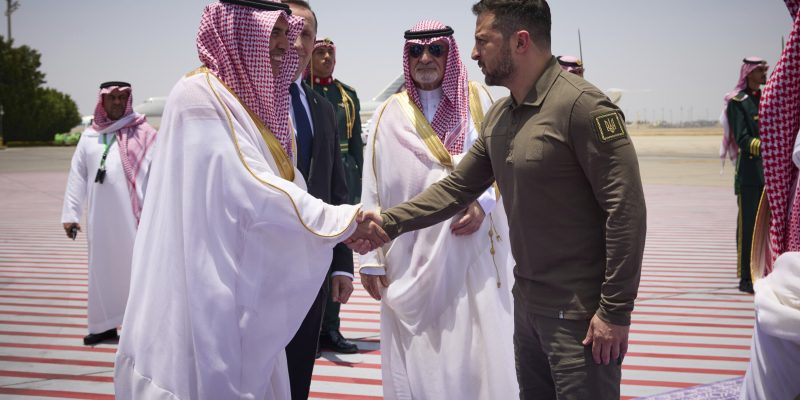
Ukraine’s experience offers a clear precedent. Over the past three years, Kyiv has defended against repeated large-scale drone attacks, forcing it to develop a layered, increasingly scalable counter-drone architecture. This is precisely the model that Gulf states are now seeking to study and replicate, and early signs suggest that this shift is already translating into concrete engagement. On March 27, President Volodymyr Zelenskyy announced that Ukraine had signed a defense agreement with Saudi Arabia to share its drone defense expertise and technology. This announcment follows earlier reports that Saudi Arabia is negotiating what has been described as a “huge deal” for Ukrainian-made air-defense and counter-drone systems, with initial contracts already signed through local intermediaries. At the same time, countries such as the UAE, Qatar, and Kuwait have expressed interest in Ukrainian interceptor drones developed by firms such as TAF Industries.
Demand appears to be significant. The UAE alone has reportedly requested up to 5,000 interceptor drones, while Qatar has expressed interest in approximately 2,000 units, with Kuwait also entering discussions. These systems are designed specifically to counter low-cost aerial threats, offering a more sustainable complement to high-end missile defenses.
From Procurement to Practice
The shift toward Ukrainian defense measures is driven largely by cost. As Aslam notes, “using high-cost interceptors against inexpensive drones creates an unfavorable cost exchange ratio,” reinforcing the need to reserve systems such as Patriot and THAAD for higher-value targets. Ukrainian interceptor drones can be produced for as little as $1,000–$2,000 per unit, compared to tens of thousands of dollars for a Shahed drone and several million for a Patriot PAC-3 interceptor. In comparison, Ukrainian interceptors cost between $800 and $3,000 per unit, according to Kyiv. More importantly, they can be manufactured at scale. Ukrainian producers have indicated output levels of more than 10,000 units per month for certain systems, while Zelenskyy stated in March 2026 that Ukraine could supply up to 1,000 interceptor drones per day to international partners. Recent reports also noted that Ukraine is seeking to use Qatar’s old fleet of nine single-seat Mirage 2000-5EDA fighter jets in exchange for help with interceptor drones.
Gulf interest in Ukraine goes beyond procurement. On the operational side, Zelenskyy confirmed that 201 Ukrainian military specialists are already deployed across the UAE, Saudi Arabia, and Qatar, with additional teams en route to Kuwait. These personnel are tasked with sharing battlefield experience gained in countering Russian drone attacks.
This reflects a broader shift in how Gulf states are approaching the problem, which is no longer simply technological but also operational. “Layered air defense systems require highly trained operators and integrated command structures,” Aslam notes. “Effective performance depends on coordination between sensors, interceptors, and electronic warfare systems in real time.”
Ukraine’s experience demonstrates that such an ecosystem cannot be improvised quickly. It requires training, coordination, and sustained adaptation. Training drone interceptor operators alone can take weeks, even for personnel already familiar with first-person-view systems, while effective deployment depends on integration with radar networks and digital situational awareness tools. As a result, cooperation between Kyiv and Gulf capitals is increasingly focused not only on equipment, but on transferring the underlying model of how to fight and sustain a drone war over time.
The views and opinions expressed in this article are those of the authors and do not necessarily reflect the views of Gulf International Forum.
Issue: Defense & Security
Country: GCC

Francesco Salesio Schiavi is an independent Middle East analyst and consultant specializing in the international relations and security architecture of the Levant and the Gulf. His expertise includes military and diplomatic interventions by international actors in the Middle East and North Africa and the military technologies of some of the leading Middle Eastern actors in this sector. He is a non-resident fellow at the Middle East Institute of Switzerland (MEIS), and advisor to the Rome Office of TRENDS, Research & Advisory, and a contributor to several international outlets, including Al- Monitor, Amwaj, The New Arab, and the NATO Defense College Foundation. Previously, he was a researcher at the Middle East and North Africa Centre of the Italian Institute for International Political Studies and a coordinator of the scientific team for “Rome MED – Mediterranean Dialogues” for five years. From 2023-24, he also served as an advisor to the Steering Committee for the Euromesco Annual Conference, organized by the European Institute of the Mediterranean in partnership with the Spanish Ministry of Foreign Affairs.

Toward a New Order in MENA Regional Geopolitics
September 2, 2026This report is a byproduct of the workshop “Toward a New Order in MENA Regional Geopolitics: What’s Next for the Region’s Geopolitical Equilibrium?,” hosted in…
Yemen’s Emerging Role in the Red Sea
August 27, 2026On August 4, 2026, the Yemeni Coast Guard (YCG) rescued the 14-member crew of the Indian-flagged commercial vessel Faize Noore Oliya. Transiting the Red Sea…
The Iran War Is Rewriting Kuwait’s Defense Architecture
July 14, 2026Since the outbreak of the Iran war in February 2026, Kuwait has announced a series of major defense acquisitions, including a $1 billion contract for…