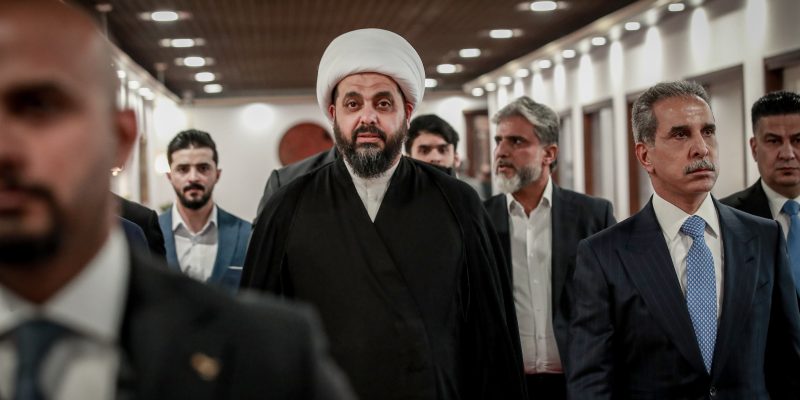
What Ali al-Zaidi Won’t Bring to Iraq
The nomination of Ali al-Zaidi for the Iraqi premiership highlights how the country’s political elite continue to prioritize the preservation of the status quo over genuine political reform.

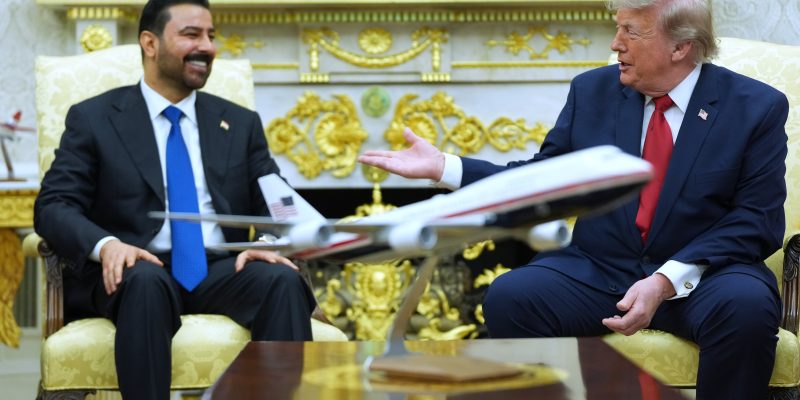
After an American veto brought down the nomination of Nouri Al-Maliki to the Iraqi premiership, Iraq has a new nominee for prime minister. After months of political deadlock following parliamentary elections in November 2025, President Nizar Amidi tasked Iraqi businessman Ali al-Zaidi with forming a government. U.S. President Donald Trump, along with many other leaders, congratulated al-Zaidi on his nomination, which may appear as a breakthrough to outsiders. For Iraqis, however, the new nominee represents another cog in a dysfunctional political system.
Iraq is facing chronic corruption, unruly non-state armed groups, and grave repercussions from the war in the Gulf. It urgently needs a reformer. Instead, in al-Zaidi, it will receive a manager. Al-Zaidi, who lacks a political party, political base in Iraqi society, or a genuine agenda of his own, is the quintessential compromise candidate; his nomination reflects the continued decay of Iraq’s tenuous political order. If he fails to form a government, he will buy the Shia Coordination Framework more time. If he succeeds, he will introduce a new phenomenon of apolitical businessmen taking the helm.
Who Is Ali al-Zaidi?
Al-Zaidi, aged around 40, is the youngest nominee for the position of prime minister in Iraq’s modern history. A Shia Muslim, he comes from a family originally from Dhi Qar province in southern Iraq and holds a bachelor’s degree in law and a master’s degree in finance and banking. In contrast to his predecessors, he has no political experience, either in elected office or government administration. His dark horse nomination came as a surprise, as his name had not circulated among the obvious candidates.
Although some of al-Zaidi’s supporters describe him as a technocrat, the reality is very different. Al-Zaidi is part of a nexus of favored businessmen that secure state contracts through political connections. It is access, not political astuteness or popularity, that propelled him to the nomination.
As a businessman, al-Zaidi is the head of the National Holding Company, which was established in 2017 and has stakes in agriculture, real-estate, logistics, and banking. He is also the chairman of the board of the Shaab University and Ishtar Medical Institute, as well as the owner of Dijlah TV. Al-Zaidi also served as chairman of Al-Janoob Bank, notorious as one of eight banks that the Iraqi government barred from conducting transactions in U.S. dollars in 2024 in order to tackle fraud, money laundering, and other illicit uses of foreign currency on behalf of Iran. Yet being a successful businessman in Iraq invariably means strong political connectivity. Some reports maintain that al-Zaidi had ongoing contractual engagements with companies linked to the Popular Mobilization Forces (PMF) and a ministry under militia control.
The System and the Situation
As in previous government formations, the candidate for prime minister—always a Shia Muslim under Iraq’s muhasaha sectarian political system—is picked by the Coordination Framework, an umbrella of Shia political parties. The Framework, like many other sectarian coalitions, is subject to disagreements and competing interests, even among co-religionists. The potential return of Nouri al-Maliki created sharp divisions within the coalition until Washington threatened sweeping sanctions on Iraq due to al-Maliki’s close ties to Iran. Government formation in Iraq also entails dividing ministries among the different political parties, including Sunni and Kurdish factions. Al-Zaidi must therefore spend the next 30 days negotiating among Iraq’s various parties, using lucrative cabinet positions as bargaining tools to secure support. In practice, the political parties generally dominate ministry operations, particularly the tendering of contracts, which ministers steer towards their political allies as a means of patronage. Al-Zaidi is likely to continue in the same policy direction, given that he is supported by the same coalition that brought outgoing Prime Minister Mohammed Shia al-Sudani to power.
If successful in forming a government, al-Zaidi will be subject to pressure from both the United States and Iran. As the U.S.-Israel war with Iran has reached a boiling point, Iraq has borne the brunt of the consequences. Washington has pressured Baghdad to rein in Iran-aligned armed groups who have continuously launched attacks on the Gulf states, Jordan, and the Kurdistan region of Iraq throughout the war. Conversely, Tehran has used those same militias to raise the costs of the war for the United States and its Gulf partners, while urging Baghdad not to interfere. The Iraqi government has remained largely inert toward these groups for several reasons, including fear of inter-Shia conflict and elite interest in preserving the status quo. Given his background, al-Zaidi is unlikely to alter this dynamic.
At the same time, al-Zaidi is inheriting a country facing significant economic challenges. Iraq’s oil-dependent economy has suffered significantly from the current war. Oil production, the backbone of the Iraqi economy, has decreased from 4.3 million to only 1.3 million barrels per day since the start of the war due to the government’s lack of a viable contingency plan.
Race to the Abyss
Whether al-Zaidi will be able to form a government or not is not the crux of the matter. Most of the Shia elite have concluded after the Maliki years that a strong prime minister could threaten their interests and that they would therefore be better served with an inconsequential figure as the country’s nominal leader. Over time, the office of the prime minister has been transformed from a genuine leadership role into a managerial post designed to preserve elite interests through inaction. In essence, Iraq is experiencing governance without participation: the country’s major decisions almost entirely originate outside of state institutions, which react when necessary but have little power to shape them. By rejecting change and embracing sclerosis, the Iraqi elites have succeeded in tightening their grip on the country by blocking any possibility of reform.
Time, however, may be running out for the elites’ comfortable arrangement. Iraq’s position in the Middle East today is strategically untenable. It is consistently facing pressure from the United States to curb Iranian influence in the country; while some of the armed groups have been absorbed into the governing system and share the spoils with the rest, others have refused to participate and are dedicated to Tehran’s orders. Another contradiction is the country’s overreliance on oil revenue. Oil constitutes 88 percent of the Iraqi budget and remains the Achilles’ heel of the Iraqi economy. As the population grows and oil revenue continues to decrease, the Iraqi government will face an enormous crisis.
These are two contradictions out of many. The solution to such problems is structural and is not in the hands of al-Zaidi to solve, nor in any future Iraqi prime minister. It is in the hands of an elite that has put its own interests before the interests of the state, with disastrous results.
The views and opinions expressed in this article are those of the authors and do not necessarily reflect the views of Gulf International Forum.
Issue: Politics & Governance
Country: Iraq

Dr. Massaab Al-Aloosy is a researcher focusing on Iraq, Iran, and Shia non-state armed groups. He holds a PhD from the Fletcher School-Tufts University and is the author of The Changing Ideology of Hezbollah, Palgrave 2020.
Why Iran Never Knows When to Stop
July 27, 2026At first glance, Iran’s negotiating difficulties appear to stem from disagreements between pragmatists seeking sanctions relief and hardliners determined to resist compromise. Yet that explanation…
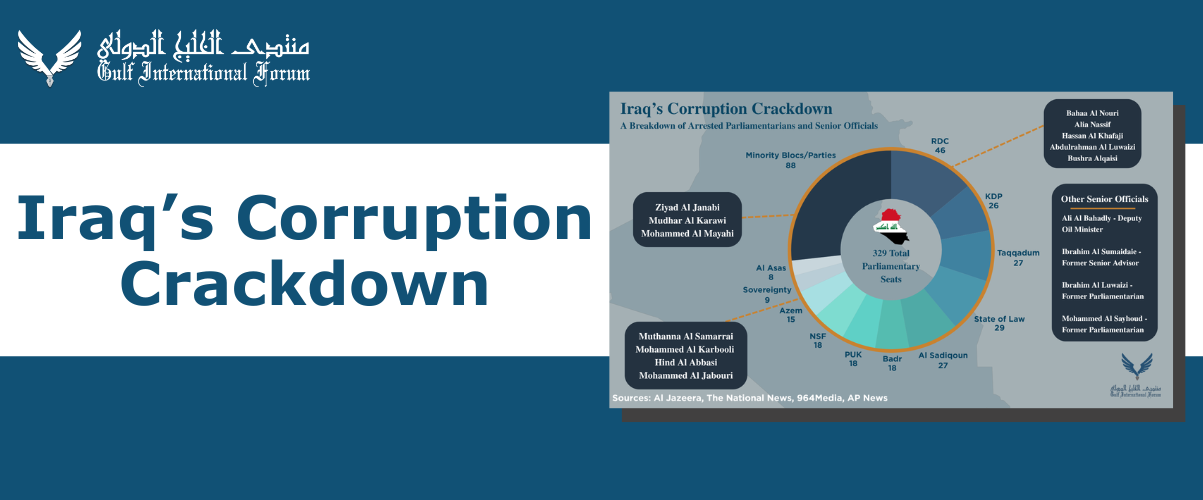
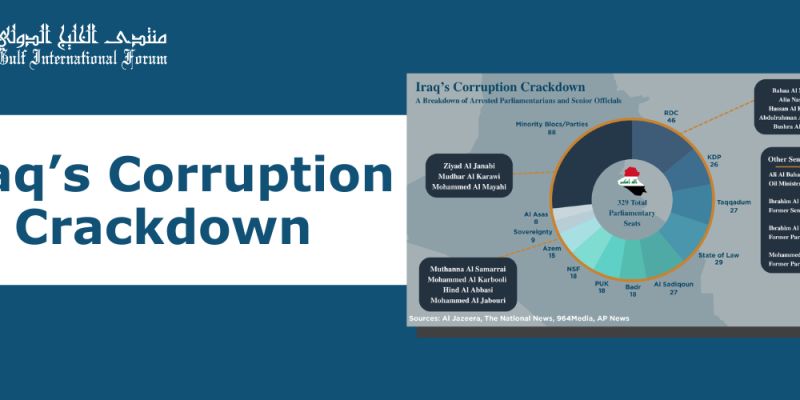
Iraq’s Corruption Crackdown
July 22, 2026*A breakdown of arrested parliamentarians and senior officials as of June 28, 2026.
Sheikh Hamad and the Making of Modern Qatar
July 15, 2026There is a question that haunts every small state: how does a nation survive and stay relevant in a region built for giants? For most…