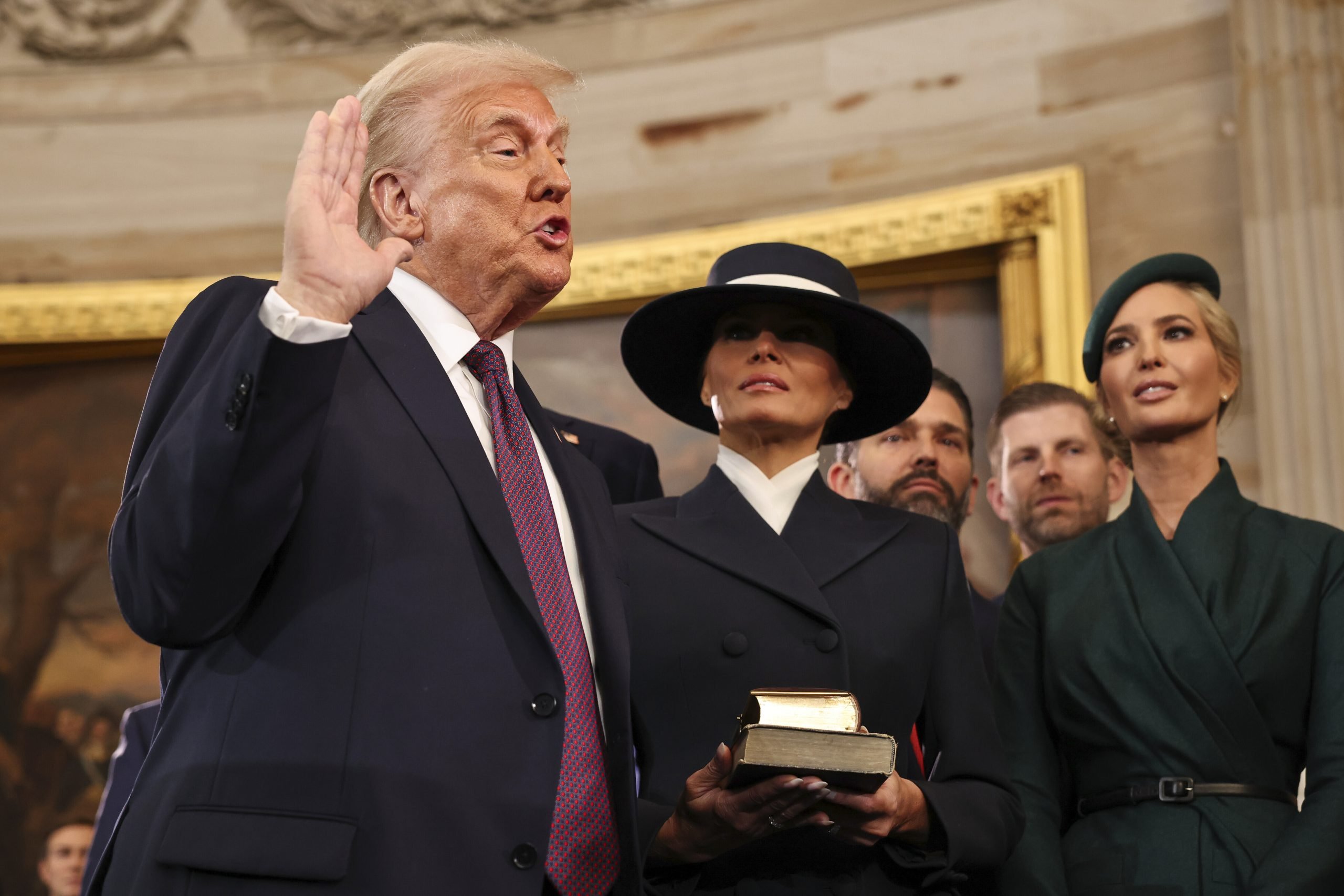
President-elect Donald Trump takes the oath of office as he is sworn in as president during the 60th Presidential Inauguration in the Rotunda of the U.S. Capitol in Washington, Monday, Jan. 20, 2025. (Chip Somodevilla/Pool Photo via AP)
100 Days of Trump: Gulf Experts’ Perspectives
Iran, Yemen, Economy & Innovation, Energy & Environment, Geopolitics, U.S. – Gulf Policy, Commentary
< 1 minute read
Iran, Yemen, Economy & Innovation, Energy & Environment, Geopolitics, U.S. – Gulf Policy, Commentary

One hundred days into President Trump’s second term, Gulf International Forum’s experts assess his early impact on the Gulf—examining shifts in diplomacy, security, and economic ties. They analyze how the Gulf states have adjusted their policies and offer insights into what the rest of the year may hold.
Diplomacy in Motion: Gaza, Iran, and the Gulf’s Role – Patrick Theros
Riyadh’s Balancing Act – Dr. Kristian Coates Ulrichsen
Striking Back: Trump’s War on the Houthis – David Des Roches
Trump’s Trade Wars and the Gulf’s Fiscal Recalibration – Rachel Ziemba
Power Vacuums and Pivot Points in Syria – Anas Alqaed
Energy, Power, and the Price of Influence – Gawdat Bahgat
Cautious Optimism: Resetting U.S.-Turkiye Ties? – Dr. Sinem Cengiz
From Brink to Breakthrough: A New Iran Deal? – Dr. Arman Mahmoudian

Diplomacy in Motion: Gaza, Iran, and the Gulf’s Role
Ambassador Patrick Theros, Strategic Advisor at Gulf International Forum
From the outset, Donald Trump viewed the Gaza war and the Palestinian issue as background noise—an irritating distraction from his real mission: tearing down and rebuilding American governance. But even distractions can become dangerous. When Qatar- and Egypt-led ceasefire talks faltered, Trump sent his envoy, Steve Witkoff, to lean on Netanyahu to accept a truce.
That held for a time. Then Netanyahu, sensing Trump’s attention shift to Ukraine, resumed the war. Trump let it go — until Israeli leaks hinted at dragging the U.S. into a strike on Iran. That was a bridge too far. In classic fashion, Trump made an example of him. He hauled Netanyahu into a press conference and announced his own talks with Iran. The message was unmistakable: “You don’t run this show.” Netanyahu, for once, had nothing to say. And that silence may prove useful.
The real story, however, is in the Gulf. While Israel overplayed its hand, America’s Arab partners acted with restraint and purpose. They supported the original ceasefire push, avoided public friction with Washington over the resumption of hostilities, and — most importantly — backed renewed U.S. diplomacy with Iran. That isn’t passivity. It’s strategy. The Gulf states remember what regional escalation looks like. They prefer to keep their economies growing, not burning. Their message is clear: talk first, bomb last — or better yet, not at all.

Riyadh’s Balancing Act
Dr. Kristian Coates Ulrichsen, Fellow for the Middle East at Baker Institute for Public Policy, Rice University; Senior Non-Resident Fellow, Gulf International Forum
The opening months of President Trump’s second term in office have not moved the needle significantly on the security and defense-related issues in U.S.-Saudi relations, at least in a strict bilateral sense. More broadly, though, talks between the United States and Iran over the latter’s nuclear program and an intensifying U.S. bombing campaign against the Houthis hold serious implications for Washington’s ties to Saudi Arabia. There is a risk that the White House may box itself into a corner should the talks with Iran break down or the strikes on the Houthis provoke an escalatory cycle. Through their diplomatic outreach to Iran and their comments on Yemen, Saudi officials continue to stress that they do not wish to see any such escalation, which would put in jeopardy the Kingdom’s “de-risking” strategy of the past several years.
As such, the first 100 days of the second Trump presidency have set a more uncertain tone for the Kingdom, despite Trump’s choice of Saudi Arabia as the destination for his first foreign visit. Whereas Trump’s 2017 trip was followed within weeks by the most severe falling-out among Gulf Cooperation Council states in decades, as Saudi Arabia, Bahrain, and the United Arab Emirates joined with Egypt to isolate Qatar, in 2025 the dividing line is between the United States and its Gulf partners. Saudi Arabia remains focused on prioritizing economic growth and regional diplomacy, while the White House is seemingly bent on confronting allies and partners and upending what remains of the rules-based international order.

Striking Back: Trump’s War on the Houthis
David Des Roches, Professor at the National Defense University’s Near East South Asia Center for Strategic Studies; Senior Non-Resident Fellow, Gulf International Forum
Remarks do not reflect the views of any USG agency
The second Trump administration has entered office with an ambitious agenda and an unprecedented sense of urgency. One of the animating principles of the second Trump term seems to be an imperative to differentiate itself from the Biden Administration on almost every issue.
In Yemen, the Biden Administration’s response to the Houthi attacks on civilian shipping in the Red Sea were remarkably ineffective. In large part, this was due to internal Democratic party deliberations about whether to invoke the War Powers Act against the president. Of course, the Biden Administration did not want to provoke a Congressional vote on the Houthis, and thus limited its targeting to Houthi missiles and support facilities (such as radar sites) that were involved in attacks on U.S. ships.
It appears that Trump has taken advantage of relatively uniform views in Congress that support a more forceful approach to expand the Houthi target set significantly. Rather than limited strikes against Houthi missiles, Trump has authorized attacks against Houthi leadership, general weapons storage and training facilities, fuel and logistics sites, and command and control hubs.
Will these attacks achieve American aims and deter the Houthis from attacking civilian shipping? At this point, it’s still too early to say. Military campaigns can be likened to blowing up an air mattress—for a long time, it seems like nothing is happening. Then, suddenly, the final product takes shape. In other words, the results of most military campaigns seem uncertain until they are decisive, as was the case when the Taliban regime abruptly collapsed after the U.S.-led campaign in 2001.
Another complicating factor for analysts to consider is that there is a paucity of accurate information on how damaging the Trump administration’s strikes have actually been for the Houthis. U.S. government analysts have claimed that the Houthis are being put under pressure, but offer few details. It is safe to say that the Houthis are likely suffering serious damage. Indeed, Iran has reportedly withdrawn its Revolutionary Guard cadre from the country. There has been an almost unprecedented destruction of infrastructure in Houthi-controlled areas. But none of this may matter to the Houthis. Like other militant groups, their staying power, even in the face of overwhelming force, may surprise the Trump administration. So, observers would do well to keep a close eye on events and reserve judgement on its effectiveness.

Trump’s Trade Wars and the Gulf’s Fiscal Recalibration
Rachel Ziemba, Founder, Ziemba Insights; Adjunct Lecturer, Center for Global Affair New York University; Non-Resident Fellow, Gulf International Forum
President Trump’s tariff policies have not singled out the GCC states, which generally import more from the U.S. than they export, for punishment, but the indirect effects of U.S. trade policy remain meaningful. Global demand uncertainty has weighed on energy prices, including oil, which remains the region’s biggest export, source of liquidity, and government revenue. In particular, U.S. trade policy will likely exacerbate already weak Chinese fuel demand, as domestic demand stagnates and China’s growth becomes less oil-dependent.
Other challenges stem from the financial market adjustment that has taken place in response to the tariffs—in particular, the decline in value of the dollar and increasing uncertainty in U.S. bond markets. Rising U.S. Treasury yields naturally increase borrowing costs for the GCC (a particular concern for Saudi Arabia, Bahrain and Oman), which did not front-load their borrowing enough. Meanwhile, imports from other countries will become more expensive as their U.S. dollar-pegged currencies weaken. Some redirection of trade may slightly offset this trend
Going forward, GCC countries will try to leverage their sovereign balance sheets to support domestic demand and the non-oil sector. However, some member states are likely to suffer more than others. For instance, Saudi Arabia will likely run a larger deficit this year and need to borrow more. Domestic needs will keep PIF’s international investment more constrained and some mega projects, including the NEOM megacity, will be pulled back further. Saudi Arabia will almost certainly promise investments in the United States during President Trump’s upcoming tour of the region in May, but the Kingdom’s actions are likely to be more modest. Rather, instead of new infusions of cash, expect Saudi Arabia to shift the allocation of its U.S. assets away from Treasurys and equity toward some fixed investment. Other GCC states face similar dilemmas. Bahrain and Oman likely hope to leverage their free trade agreements with the United States to argue for exemptions to Trump’s tariffs, especially on aluminum, though they are unlikely to find much success.
The UAE, by comparison, is relatively well situated in the tariff standoff and could even stand to benefit from a slowing of its overheated property market. The UAE will leverage Comprehensive Economic Partnership Agreements with other countries, including India, to redirect trade away from the United States.
Gas-poor GCC countries continue to express interest in U.S. LNG investments, especially in projects close to final investment decision (FID) status, with Kuwait possibly following peers in investing in projects for financial returns and technology transfer. Nuclear projects too may be attractive even as the US is no longer open for renewable energy investment – GCC actors will look elsewhere, especially MENA and Asia. Total GCC investment in the United States will depend on the Trump administration’s plan to streamline inward investment, including the Committee on Foreign Investment in the United States (CFIUS) security concerns. Newer U.S. energy projects though will face challenges as tariffs increase U.S. energy production cost curves. The GCC hopes to take back some market share from price sensitive shale producers, which along with OPEC cohesion goals, likely accounts for some of the recent easing plans. U.S. LNG projects are rushing to FID status, which may put more pressure on Qatari production plans and force it to offer more flexible contracts. Still the region’s attractive costs, past savings, and trade links with Asia will leave it in a relatively strong position.

Power Vacuums and Pivot Points in Syria
Anas Alqaed, Director of Programs, Gulf International Forum
A little over 40 days separated the fall of the Assad regime and the inauguration of President Donald Trump—two major events that have significantly reshaped the GCC states’ regional policy calculations. The fall of the Assad regime accomplished what both the Trump and Biden administrations failed to achieve through sanctions and maximum pressure on Iran: a reduction in Iran’s malign regional activities. With the loss of its ally in Damascus, Tehran effectively lost control over Syria and its access to Lebanon, limiting its regional influence to Iraq and Yemen and reducing its presence in the Levant tremendously. The new regional landscape now favors Turkey and most GCC states who had long opposed Iran’s material support for the former Syrian regime, backing that contributed to the deaths of over half a million Syrians and the displacement of millions more.
In response to GCC pressure, Syria’s geopolitical importance, and the U.S. presence in the country, the Trump administration began in March low-level engagement with the new Syrian authorities. Despite initial hesitation due to the background of Syria’s new president Ahmed al-Sharaa, a former Al-Qaeda member, the U.S. engagement has remained limited, primarily consisting of message exchanges, preliminary trust-building steps, and the establishment of conditions for partial sanctions relief. Washington’s eight announced demands include the removal of foreign fighters from military leadership, permission for U.S. counterterrorism operations on Syrian territory, the destruction of chemical weapons stockpiles, and assistance with locating missing American citizens in Syria.
The GCC states, European countries, and Turkey remain constrained in their ability to support Syria’s economy and reconstruction, due to extensive U.S. sanctions dating back to 1979, but they remain interested in expanding their influence with the new government and facilitating development where they can. While they recognize that continued economic deterioration could lead to domestic sectarian clashes—as seen in the coastal regions in March and in Damascus suburbs in April—they are also aware that inaction risks Syria’s descent into renewed civil war or alignment with Russia and China—the only two major powers that can operate with less fear of U.S. sanctions. As such, Saudi Arabia and Qatar recently announced that they would pay Syria’s debt to the World Bank, a sum of $15 million, to enable the organization to restart operations there. The EU and the UK suspended some sanctions against Damascus in February and sought to facilitate reconstruction to accelerate the return of Syrian refugees. Trump’s visit to the Gulf this month may prompt renewed calls from Doha and Riyadh for greater latitude in engaging with Syria, including assurances against the risk of U.S. sanctions.

Energy, Power, and the Price of Influence
Gawdat Bahgat, Professor of National Security Affairs, the National Defense University’s Near East South Asia Center for Strategic Studies; Senior Non-Resident Fellow, Gulf International Forum
For decades, Washington’s relation with the GCC states was largely seen through the “oil for security” proposition—that the United States would guarantee regional security in return for uninterrupted oil and gas supplies. This explanation, however, is too simplistic. The relations between the two sides are multidimensional and cover several strategic and economic interests. Since the mid-1970s, the United States has grown less dependent on oil and gas supplies from the GCC states. Advances in horizontal drilling and hydraulic fracturing, or “fracking,” have made the United States the world’s leading oil producer and a major gas exporter. These developments, however, do not diminish the role energy plays in foreign policy under the second Trump administration.
On his first day back in office, President Trump withdrew the United States from the Paris Climate Agreement (again), further weakening the global consensus on the need to combat climate change. Second, the administration’s raft of tariffs, announced on April 2, has triggered trade tensions with adversaries and allies, alike. It is too early to adequately assess the economic impact of these import taxes, but they are likely to disrupt economic growth around the world and reduce demand for oil and gas. If oil prices drop significantly as a result, the GCC states could see their government revenues plummet. Third, the United States’ ongoing negotiations with Russia to end the war in Ukraine and with Iran to reach a new nuclear deal might ease sanctions on these two major oil and gas producers—further increasing global supply and depressing prices. Finally, observers should pay close attention to the activity of the GCC sovereign wealth funds, which all have substantial investments in the United States. Trump’s upcoming visit to Saudi Arabia, the UAE, and Qatar could boost the Gulf’s investments in the United States and smooth over the tensions caused by President Trump’s other economic policies.

Cautious Optimism: Resetting U.S.-Turkiye Ties?
Dr. Sinem Cengiz, Researcher, Qatar University’s Gulf Studies Center; Non-Resident Fellow, Gulf International Forum
Ties between Ankara and Washington, two NATO allies, are often framed by the most divisive issues in the bilateral relationship. Under past American administrations, these issues have remained unresolved, or in many cases worsened. In the first 100 days of the new Trump administration, Ankara appears to be approaching its relations with cautious optimism, while also expecting concrete steps from Washington as a signal of goodwill. For instance, Ankara expects the United States to lift sanctions and start technical talks on the Countering America’s Adversaries Through Sanctions Act and the F-35 program, which was suspended after Turkiye purchased advanced Russian air defense platforms in 2018. Ankara also expects the U.S. to stop its cooperation with the Kurdish militias in Syria, which Turkiye considers a serious national security threat. Should Washington acknowledge and seek to address these concerns, the Trump administration will demonstrate that it is committed to a pragmatic foreign policy.
If a new era in Turkish-American relations is to begin, it must be built on shared national and regional interests and backed up by demonstrations of commitment. Trump’s attitude seems to meet Turkish ruling elite’s expectations that Ankara stated that it positively views Trump’s attitude that “takes into account Turkiye’s sensitivities.” Turkish President Recep Tayyip Erdogan stated on Wednesday that he and Trump have a shared understanding on the Syria issue and two leaders will bring Turkish-American relations to a “very different momentum”. It is clear that the two leaders are keen on developing a mutually beneficial and cooperative agenda. Since Trump’s election in November, two leaders have spoken several times and their teams have rolled up their sleeves to prepare for their meeting.
There are also more commonalities than differences in how the two overconfident leaders approach international politics. However, the devil is in the details. The unpredictability of the Trump administration’s policies and the uncertain evolution of regional dynamics, most notably regarding regional flashpoints like Gaza and Syria, could see regional optimism evaporate. With three years and nine months still ahead, all eyes are fixed on Trump’s upcoming visit to the Gulf and on the first Erdoğan-Trump meeting. If such a meeting concludes on a positive note, with quantifiable progress on key sticking points in the bilateral relationship, it could pave the way for an improvement in Turkish-American relations.

From Brink to Breakthrough: A New Iran Deal?
Dr. Arman Mahmoudian, Lecturer of Russian and Middle Eastern Studies and Researcher at the Global and National Security Institutes, University of South Florida
In the first hundred days of President Trump’s new term, U.S.-Iran relations have taken an unexpected turn away from escalation and toward accelerated diplomacy. Rather than clashing militarily, both countries are engaging in negotiations at a pace not seen since the lead-up to the 2015 Joint Comprehensive Plan of Action (JCPOA). For Trump, the strategic logic is clear; with little progress in negotiating an end to the war in Ukraine and the crisis in Gaza, the president is likely seeking a more attainable foreign policy win—something a nuclear deal with Iran could provide.
The Islamic Republic, on the other hand, is operating under growing pressure. The collapse of the Assad regime and decimation of Hezbollah have weakened Iran’s regional influence significantly. At home, economic instability and fear of civil unrest are rising. Meanwhile, the two rounds of direct confrontation with Israel in late 2023 and April 2024 brought Iran dangerously close to war, which seems to have pushed Tehran to more seriously consider diplomacy.
On April 26, the United States and Iran concluded a third round of nuclear and sanctions talks. Recent deliberations mirror the final stages of the original JCPOA negotiations, suggesting that a shared political understanding is already in place. However, major obstacles remain: the United States has demanded assurances that Iran will not develop nuclear weapons, while Iran refuses to completely dismantle its uranium enrichment program and insists on meaningful and reliable sanctions relief as a prerequisite to a larger deal.
A possible compromise could allow Iran to continue low-level enrichment (around 3.6 percent) at a monitored site—allowing Tehran to preserve some symbolic capability without raising fears of weaponization, while the United States offers clear guarantees that sanctions relief will not be reversed arbitrarily. If the two parties agree to such a framework, a new deal may be possible. Though nothing is finalized, the current phase marks the closest the two sides have come in years to reaching a political solution to the nuclear issue.
The views and opinions expressed in this article are those of the authors and do not necessarily reflect the views of Gulf International Forum.
Issue: Defense & Security, Economy & Innovation, Energy & Environment, Geopolitics, U.S. – Gulf Policy
Country: GCC, Iran, Yemen
Yemen’s Emerging Role in the Red Sea
August 27, 2026On August 4, 2026, the Yemeni Coast Guard (YCG) rescued the 14-member crew of the Indian-flagged commercial vessel Faize Noore Oliya. Transiting the Red Sea…
The Iran War Is Rewriting Kuwait’s Defense Architecture
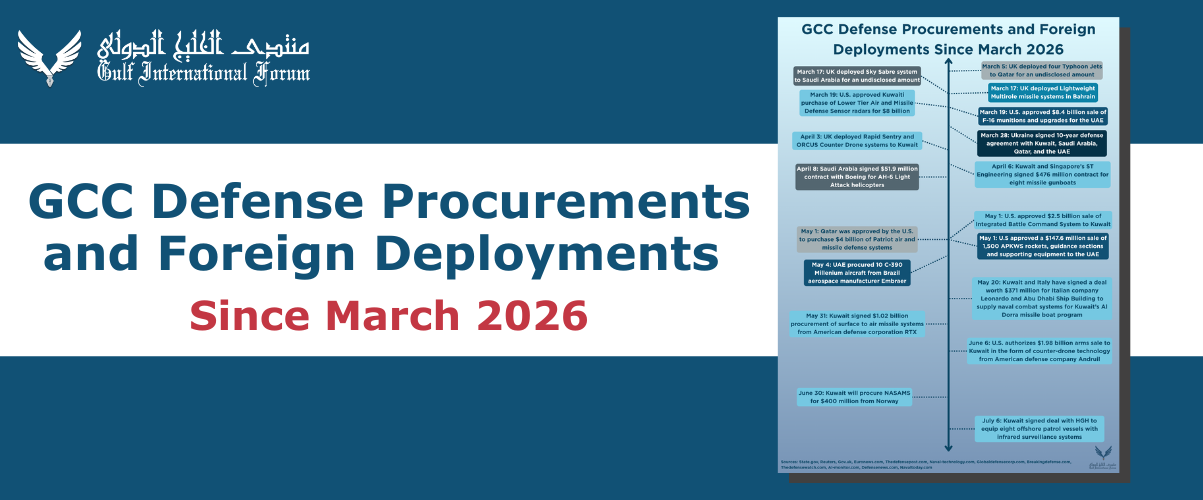
July 14, 2026Since the outbreak of the Iran war in February 2026, Kuwait has announced a series of major defense acquisitions, including a $1 billion contract for…
GCC
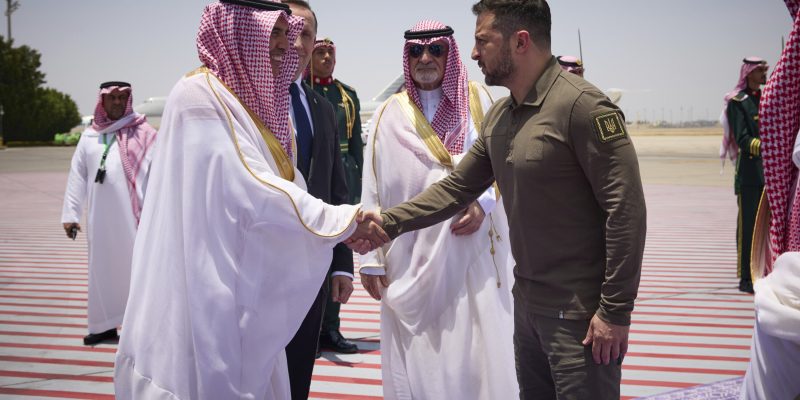
The Gulf Looks to Ukraine as Global Conflicts Converge
CommentaryThe war between the United States and Iran has entered another period of escalation, casting...
GCC
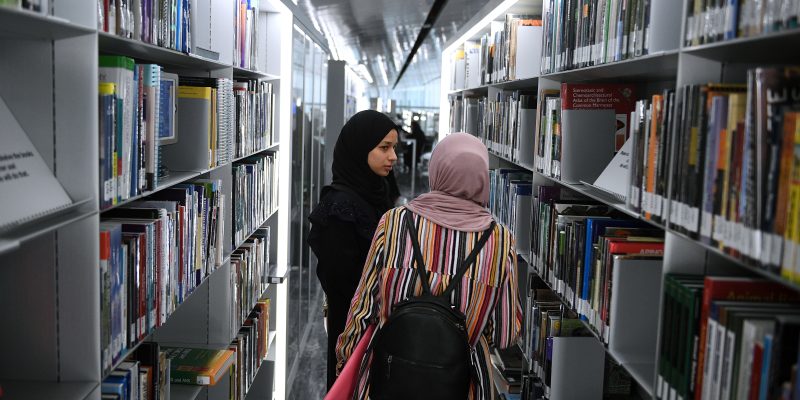
Who Leads Gulf Schools Through Crisis?
CommentaryRecent discussion has rightly drawn attention to how regional conflict can disrupt education in the...
GCC
Cartel at Dusk: OPEC’s Future After the Iran War
CommentarySomething more consequential than another oil market disruption is underway. The Iran war has exposed...
GCC
The Middle East’s Corridor Boom Meets Reality
CommentaryIn recent years, particularly since the outbreak of the recent conflicts in Gaza and Iran,...
GCC
The Gulf Needs a Strong Syria, Not Another Battleground
CommentaryThere are moments in international politics when a legal or administrative decision reveals a much...