


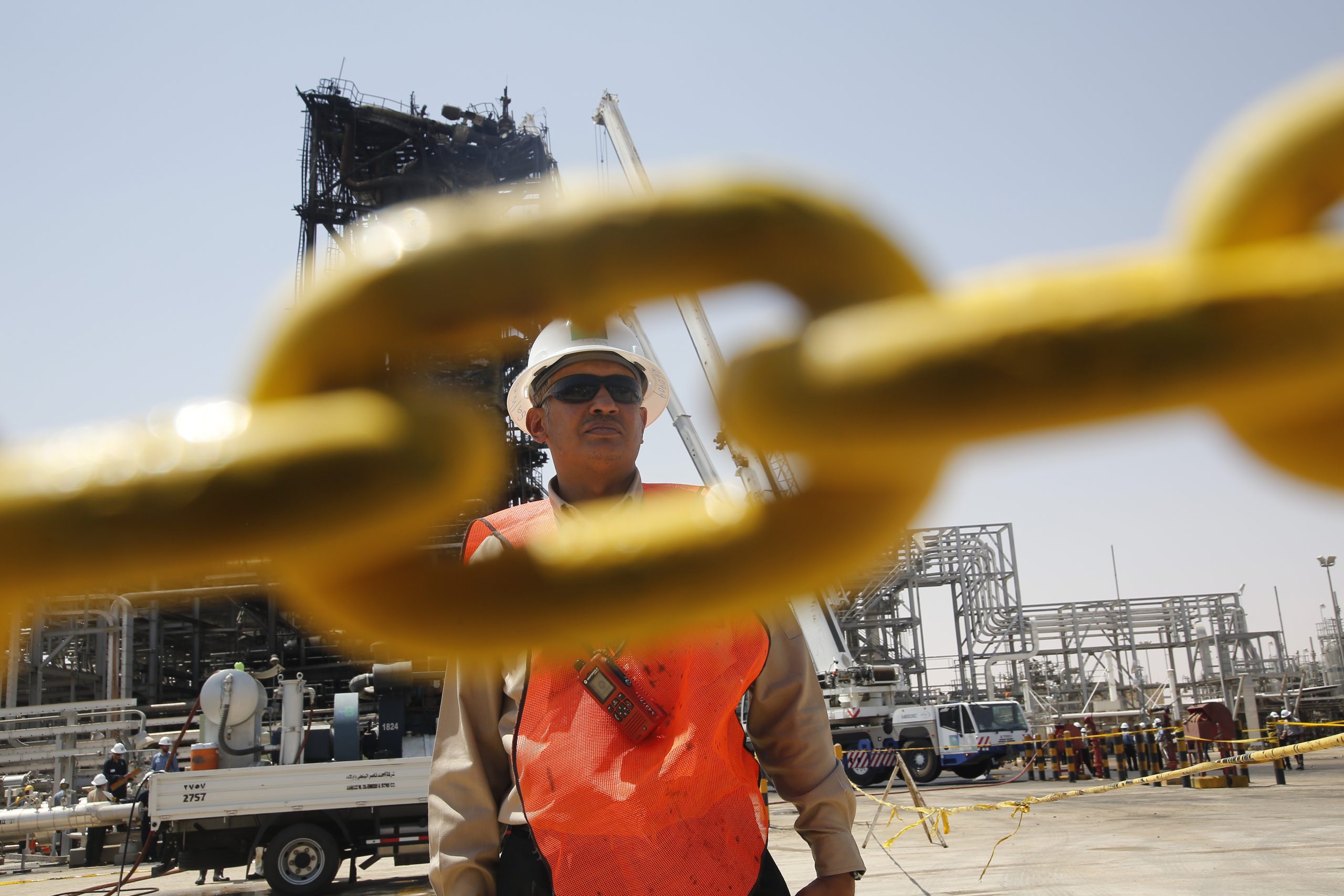
In the GCC, Today’s Fossil Fuel Workers are Tomorrow’s Green Engineers
Empowering the Gulf’s energy transition means retraining—not replacing—the region’s energy sector workforce, unlocking a just, cost-effective, and sustainable shift from hydrocarbons to renewables while preserving economic and social stability.

Migrant workers form the backbone of the Gulf Cooperation Council (GCC) states’ economies. Since the discovery of oil and natural gas, millions of people, mainly from south and southeast Asia, have flocked to the region to work in rapidly industrializing economies, sending remittances to their families at home. Their labor is indispensable to the region’s rapid economic growth and diversification initiatives, as too few citizens are willing to undertake grueling roles in the fossil fuel and construction industries. Now, however, the Gulf states are showcasing their commitment to green energy and a post-oil future, leading some to question the future of fossil fuel laborers throughout the region. However, Gulf policymakers should move to integrate the same workforce that currently powers its hydrocarbon extraction operations into the green energy workforce of the future—ensuring social stability, increasing productivity, and realizing economic diversification goals in the process.
Human capital development and green energy lie at the center of the region’s various economic diversification initiatives, including Saudi Arabia’s National Vision 2030, the UAE’s Energy Strategy 2050, and Qatar’s National Vision 2030. Beyond cutting-edge technologies, exploiting renewable resources requires a workforce equipped to operate complex systems. Because Gulf states suffer from shallow labor pools, policymakers should consider retaining and developing the workers that currently run oil and gas facilities, many of whom possess transferable skills, to participate in the renewables sector.
The Hazards of the Hydrocarbon Industry
Before redeploying fossil fuel workers into sustainable energy roles, it is important to acknowledge the challenges they currently face. Because they operate in hazardous environments amid rising temperatures, fossil fuel workers require continuous monitoring and assessment to ensure their well-being. For instance, workers on offshore oil rigs suffer from limited access to medical care, the potential for heat to damage safety equipment, and constrained intervention mechanisms, such as prompt emergency evacuations and delays in delivering urgent parts. To combat heat-related injuries, energy companies across the GCC have aligned their policies with international safety protocols and implemented mitigating practices, such as shaded rest areas and rotating shifts.
Hydrocarbon workers are often exposed to harmful chemicals, too. Although companies follow globally recognized guidelines for chemical safety, including the Globally Harmonized Standard of Classification and Labelling of Chemicals (GHS7), some studies reported that some firms prioritize production targets over safety standards. However, cultivating a safety-first culture is pragmatic from both a moral and financial standpoint; by ensuring safety standards are consistently applied, workers remain healthy and companies can avoid costly shutdowns.
Moreover, addressing workers’ concerns seriously can have some positive impact on their psychological well-being, which can improve productivity. Numerous studies and experts have stressed the prevalence of mental health issuesamong workers in the fossil fuel industry globally. GCC states should encourage companies to provide their workers with mental health resources—helping them navigate work-related stressors and promoting a more sustainable work culture more broadly.
GCC governments should also implement a third-party audit system to ensure that oil and gas companies comply with the latest safety standards and laws. Independent assessments would reinforce consistent application of regulations and promote accountability among employers, which bolsters economic efficiency. For instance, Impactt, an international consultancy firm that specializes in human rights, published several external compliance reports on worker welfare standards in Qatar ahead of the 2022 World Cup. The firm found that compliance rates improved significantly after an initial inspection process, leading to overall improved conditions for workers.
A Workforce for the Future
Though the GCC states continue to rely heavily on fossil fuel revenues to finance their economies, they have taken remarkable steps to embrace sustainable energy. In 2021, Saudi Arabia launched the Saudi Green Initiative, which seeks to achieve net-zero emissions by 2060 by reducing the Kingdom’s carbon output and planting over 10 billion trees, under its Vision 2030 initiative. The UAE aspires to the most ambitious green energy goals of its Gulf neighbors. Abu Dhabi has invested multi-billion-dollarsin solar and wind power technologies and projects, like Masdar City and Mohammed bin Rashid Al Maktoum Solar Park—the world’s largest solar installation. Qatar’s green energy production is anchored by Al Kharsaah Solar Park and the Ras Laffan carbon-capture hub, built to trap millions of tons of CO2 every year.
While these considerable projects are capturing local interest and creating new jobs in the market, they require a workforce equipped to perform the functions required by green energy generation facilities. Luckily for the Gulf states, they do not have to look far from home for workers; they have a deep pool of suitable candidates already in the workforce. A survey of 1,635 fossil-fuel blue-collar workers based in the United States found that their mechanical, electrical, and safety skills are highly transferable to green energy jobs, including in construction and maintenance. Across the GCC, the same employees that now work oil rigs and refineries can readily translate their pipeline fitting, scaffolding, and wiring skills to tasks required to install solar panels and assemble wind-tower parts. A 2023 report by the International Renewable Energy Agency (IRENA), confirms that oil and gas workers, including electricians and technicians, can qualify to work in renewable facilities with minimal re-training. Likewise, the International Energy Agency (IEA) proclaims that about half of fossil fuel workers can obtain sustainable energy jobs after undergoing only four weeks of training. Therefore, policymakers in the GCC should develop rigorous training programs that reskill the existing workforce for the green industries of the future.
Some GCC countries have begun testing the viability of these programs. In Oman, for example, many workers from the labor force participate in the SEI-Shams PV101 Program, qualifying as entry-level solar installers after following a practical curriculum. In Saudi Arabia, NEOM’s green-hydrogen project has teamed up with the Energy and Water Academy to introduce the country’s first operations and maintenance course aimed at refinery and process plants workers. In the UAE, Dubai Electricity and Water Authority’s Innovation Center introduced the Integrated Solar Photovoltaic (PV) System Designer course, which equips electricians and contractors with necessary skills for PV design, installation, testing, and maintaining in a few weeks. In addition to examining data from countries that have already introduced upskilling schemes, governments should incentivize private companies to invest in internal training programs by providing financial assistance to cover expenses, including equipment costs, curriculum design, and training materials.
Scaling these training programs to meet the labor market’s demand for green energy jobs will almost certainly run into obstacles. Other countries have faced challenges in their pilot training programs for several reasons, including mismatches in job placement and workers’ proximity to project sites. Attentively matching workers with specific skills to relevant projects near where they live is critical to programs’ success. Otherwise, workers may risk salary disruptions and undergo redundant or inapplicable training that might not improve or translate their existing skill set into green jobs.
The benefits of domestic worker training programs far outweigh the drawbacks, however. Employing new workers from overseas involves several burdensome expenses, such as medical screening, visa processing, and fees paid to recruitment agencies. Furthermore, workers new to the region will need time to adapt to the local culture, working environment, climate, and more, which may diminish their productivity. Additionally, by retaining and retraining fossil fuel workers, the GCC states will not only safeguard workers’ financial incomes, but also model a more just energy transition that other countries can follow.
The unparalleled contributions of high-risk workers in the fossil fuel industry, which have driven the GCC states’ rapid economic growth over the past decades, highlight the need to usher in a new era of sustainable development. Through effective retraining programs, Gulf governments can incentivize many workers to remain and become the bedrock of the region’s clean-energy transition. Targeted professional development programs would protect GCC companies from costly recruitment fees and shield workers against financial insecurity. The GCC can thus transition from simply benefiting from low-cost labor to setting global benchmarks for ethical labor practices and unlocking the demographic promises of their large expatriate populations. This transformation would not only safeguard the backbone of GCC economies, but also demonstrate these states’ commitment to sustainable human development.
The views and opinions expressed in this article are those of the authors and do not necessarily reflect the views of Gulf International Forum.
Issue: Energy & Environment
Country:

Dr. Hind Al Ansari is a Fellow at Gulf International Forum. She is a development and global education researcher based in Washington and recently completed a one-year fellowship at the Wilson Center. Dr. Al-Ansari has published multiple articles and has been recognized for her work as a recipient of the Middle East Policy Council 40 Under 40 Award. She holds a PhD in Education from Cambridge University and a Master in Middle Eastern Studies from Harvard.

Pipe Dreams and Pecking Orders: Who Gets Priority When Gulf Bypass Routes Are Tested?
September 17, 2026In June, Kuwait Petroleum Corporation CEO Sheikh Nawaf Al-Sabah told an Atlantic Council audience that Kuwait was in discussions with Saudi Arabia and the UAE…
Cartel at Dusk: OPEC’s Future After the Iran War
July 28, 2026Something more consequential than another oil market disruption is underway. The Iran war has exposed and accelerated an institutional weakness within OPEC that had been…
Saudi Arabia Needs an Overland Route to Global Energy Markets
July 2, 2026For years, Saudi Arabia has recognized the vulnerability created by its dependence on the Strait of Hormuz. To reduce risks from Iranian disruptions, the kingdom…