Bahrain’s Fiscal Reforms: A Stress Test for Gulf Diversification
Bahrain’s sweeping fiscal reforms are the Gulf’s boldest attempt yet to rein in debt, with outcomes that could redefine the region’s path to economic diversification.

Bahrain is implementing the Gulf’s most comprehensive fiscal reform package yet, combining market-linked fuel pricing, a 10 percent corporate tax, and 20 percent government spending cuts to address a debt burden that has reached 133 percent of the country’s GDP. While the UAE and Oman introduced market-based fuel pricing nearly a decade ago, Bahrain’s reforms are distinct in their scope and urgency, representing a complete restructuring of the kingdom’s revenue model rather than incremental adjustments. The key question is whether Bahrain’s crisis reflects a unique response to fiscal stress or an early warning of challenges other Gulf economies will inevitably face.
The Reform Package
In late December 2025, Bahrain’s government announced it would permanently link fuel prices to global markets through a new monthly pricing mechanism. This is not the kingdom’s first fuel price increase. Bahrain raised prices in 2016 and 2018 during oil market crashes, but those were temporary measures presented as emergency responses to revenue shortfalls. This time, it is fundamentally different. The new pricing mechanism is permanent and part of a broader reform package that includes electricity and water tariff increases for commercial users, a planned 10 percent corporate tax on larger companies, and 20 percent cuts to government administrative spending.
The package emerged from months of deliberate consensus-building between the government and parliament, reflecting careful political management of necessary but potentially unpopular measures. The reforms target an 11 percent fiscal deficit that the IMF flagged in its November 2025 Article IV consultation as requiring immediate structural adjustment. Rather than tactical adjustments to weather temporary oil price volatility, Bahrain is implementing structural changes to its revenue model and expenditure patterns that signal a fundamental shift in how the kingdom finances its operations.
The political sensitivity of these reforms cannot be understated. Bahrain experienced the Gulf’s most significant episode of public unrest during the 2011 Arab Spring, with protests centered on economic grievances and sectarian tensions between the Sunni-led government and the Shia majority population. The careful emphasis on protecting citizens’ primary residences from electricity and water tariff increases, maintaining diesel subsidies for Bahraini fishermen, and the extended parliamentary consultations before implementation all reflect an awareness that subsidy cuts could reignite social tensions. The government is attempting to thread a difficult needle: implementing painful fiscal adjustments necessary to avoid economic crisis while preventing these measures from triggering the kind of popular discontent that has historically challenged regime stability. How successfully Bahrain manages this balance over the coming months will determine not just the fiscal outcomes but the political viability of comprehensive economic reform across the Gulf.
The Need for Radical Change
Bahrain’s fiscal crisis is not a temporary cash flow problem but a structural mismatch between revenue capacity and expenditure commitments. The kingdom faces the GCC’s highest debt-to-GDP ratio, with borrowing costs now consuming an expanding share of government revenues even as credit rating agencies downgrade the country. S&P Global lowered Bahrain’s sovereign credit rating to “B” in November 2025, reflecting concerns that the debt trajectory had become unsustainable without fundamental policy changes. The IMF’s Article IV consultation the same month delivered a blunt assessment: immediate structural reforms were no longer optional but necessary to prevent a market-driven crisis that would force far more painful adjustments.
Bahrain produces oil from a single aging field with reserves that rank as the smallest among GCC states, yet it maintains government spending levels comparable to its much wealthier neighbors. While economic diversification has progressed in financial services, tourism, and logistics, this success has not translated into fiscal diversification. The economy has broadened, but the budget remains overwhelmingly dependent on oil income even though production capacity cannot expand and global prices cannot be controlled.
This creates an impossible equation. The kingdom has fixed commitments including public sector salaries for a substantial government workforce, subsidies that have historically kept living costs low, and debt service on accumulated borrowing. These expenditures cannot be eliminated without significant social and economic disruption, yet the revenue to fund them sustainably does not exist under realistic oil price projections. Unlike Saudi Arabia, which can modulate production to influence markets, or the UAE and Qatar, which maintain massive sovereign wealth funds as buffers, Bahrain has neither the production flexibility nor the financial reserves to weather prolonged price weakness. The temporary fuel price hikes in 2016 and 2018 were reversed when market conditions improved, reinforcing the pattern of crisis management rather than structural change. The comprehensive package announced in late 2025 signals an acknowledgment that tactical adjustments can no longer bridge the gap between what the kingdom earns and what it spends.
The Stakes of Structural Change
Bahrain’s comprehensive reforms will provide Gulf policymakers with their first real-world test of whether fiscal consolidation can coexist with economic growth in oil-dependent economies. While Bahrain’s fiscal position is more acute than that of its neighbors, the underlying challenge is shared across the GCC: hydrocarbon revenues that fund generous government spending and subsidized living costs are insufficient to sustain those commitments long-term.
The UAE introduced corporate taxation in 2023, signaling recognition that zero-tax models have limits. Saudi Arabia capped fuel prices in 2021 after earlier increases met resistance, demonstrating the political sensitivity of subsidy reform even in states with greater fiscal buffers. Kuwait’s parliament has blocked similar measures repeatedly, illustrating how political structures can prevent necessary adjustments. What makes Bahrain’s experience particularly instructive is the combination of permanent fuel pricing mechanisms, corporate taxation, and spending cuts implemented simultaneously rather than sequentially.
The real test, however, lies not in the design of the reforms but in their execution and economic impact. The outcomes over the next year or two will reveal whether comprehensive reform packages can achieve fiscal sustainability without triggering economic stagnation or social instability. For now, Bahrain’s reforms demonstrate what happens when a Gulf state runs out of fiscal runway and must implement the structural adjustments that wealthier neighbors can still afford to postpone.
The views and opinions expressed in this article are those of the authors and do not necessarily reflect the views of Gulf International Forum.
Issue: Politics & Governance
Country: Bahrain

Wasay Mir is a geopolitical risk analyst covering the Middle East and South Asia, focusing on economic and energy policy, regional security, and emerging technologies. He holds fellowships at the Pulitzer Center and Johns Hopkins SAIS, and his work has appeared in Al Jazeera, Gulf News, The National Interest, and Qatar Tribune. He is currently based between Washington D.C. and Doha. Connect with Wasay on X or Linkedin and find him at www.wasaymir.com.
Why Iran Never Knows When to Stop
July 27, 2026At first glance, Iran’s negotiating difficulties appear to stem from disagreements between pragmatists seeking sanctions relief and hardliners determined to resist compromise. Yet that explanation…
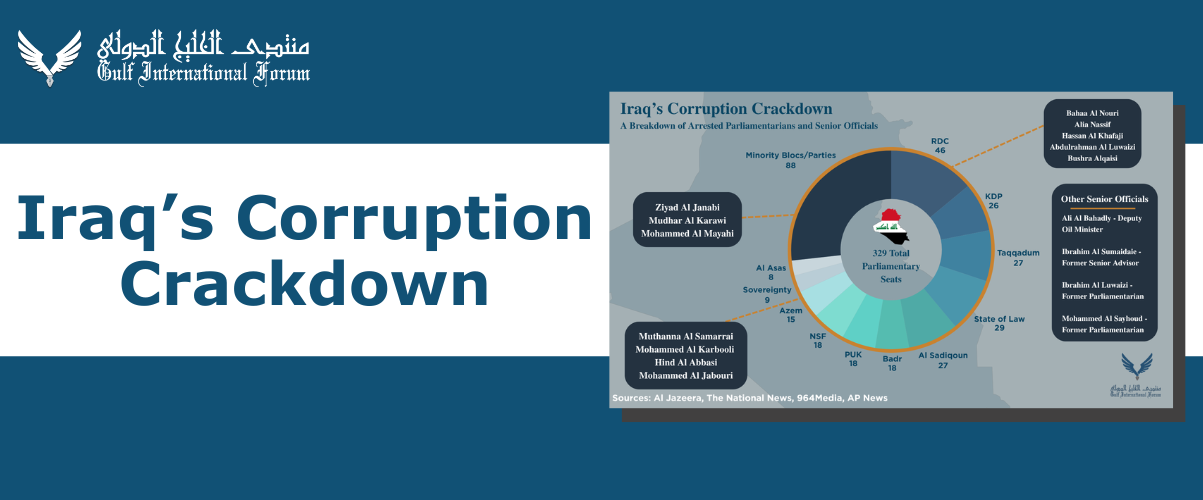
Iraq’s Corruption Crackdown
July 22, 2026*A breakdown of arrested parliamentarians and senior officials as of June 28, 2026.
Sheikh Hamad and the Making of Modern Qatar
July 15, 2026There is a question that haunts every small state: how does a nation survive and stay relevant in a region built for giants? For most…