The Winter Olympics and Deepening Italy–Qatar Defense Diplomacy
The Milano-Cortina 2026 Winter Olympics represent just one facet of a growing Italy–Qatar partnership shaping defense and security cooperation.

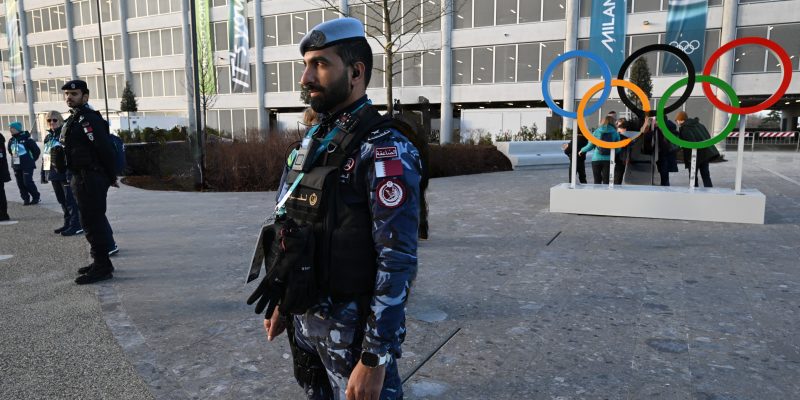
As the Milano-Cortina 2026 Winter Olympic Games commenced at the beginning of the month, Qatar’s visible contribution to the security framework of the Games has drawn attention far beyond the Alps. The deployment of Qatari security personnel to Italy is neither an isolated act of goodwill nor a mere symbolic gesture. Rather, it represents the latest manifestation of a mature, reciprocal security partnership between Doha and Rome, one that has evolved through defense procurement, operational cooperation, and mutual support during major global sporting events.
While athletic excellence and sport remain the centerpiece of the Games, the Olympics also reflect the growing role of international sporting events as platforms for defense diplomacy, understood as the peacetime cooperative use of security forces as a tool of foreign policy. Situated within the broader trajectory of Italy–Qatar relations in defense and internal security, and against the backdrop of Italy’s security role during the FIFA World Cup Qatar 2022, securing major sporting events has become an important vector of strategic cooperation between the two countries.
Operational Contribution, Not Symbolism
On January 25, Qatari armored vehicles conducted a high-visibility movement through central Milan, passing several of the city’s most recognizable landmarks. The maneuver was not part of a ceremonial display, but rather a preparatory security activity linked to the upcoming Winter Olympics.
A few days earlier, a Qatari Air Force C-17 Globemaster III aircraft transported a contingent of Qatari security personnel to Milan Malpensa airport, marking the start of Qatar’s on-the-ground contribution to the security architecture of the Games. The deployments followed months of coordination between Qatari and Italian authorities and were conducted under a bilateral agreement between the two countries’ Ministries of Interior that was signed in 2025.
The contingent consists of more than 100 Qatari officers, about 20 of whom are female, specifically trained for crowd management and public-order duties. They are supported by specialized vehicles, including three infantry armored vehicles, and mobility assets adapted to winter conditions, such as snowmobiles. Their mandate extends beyond static guarding functions to include participation in preventive security planning, rapid-response readiness, and coordination with Italian law-enforcement agencies across multiple Olympic venues.
Prior to deployment, Qatari officers underwent specialized winter-operation training with the Italian Gendarmerie (Carabinieri) focused on ski-area patrols, operations in mountainous terrain, and coordination in cold-weather emergency scenarios—areas outside the natural operational environment of Qatari elite forces. This preparatory phase was designed to ensure operational readiness and facilitate interoperability with Italian security personnel.
A Platform for Defense Diplomacy
Qatar’s engagement in the Winter Olympics reflects a broader strategic approach that views sport as a platform for international cooperation and consolidation of institutional relations. Having hosted one of the most complex sporting events in recent history, the FIFA World Cup 2022, Qatar now positions itself as a provider of security expertise rather than solely a recipient.
This shift aligns with Qatar’s wider diplomatic narrative that emphasizes partnership, capacity-building, and multilateral engagement. Doha also deployed more than 100 security personnel to the 2024 Paris Olympic Games, underscoring the country’s growing niche in the security domain. In this sense, the deployment contributes materially to Olympic security while simultaneously projecting Qatar’s image as a capable and reliable security partner in major sports event management. Such deployments also allow Qatari security institutions to gain operational exposure in diverse environments alongside foreign partners, offering valuable opportunities for benchmarking and institutional learning.
Italy–Qatar Defense Relations
The security cooperation visible at Milano-Cortina is underpinned by a longer-standing defense relationship between Rome and Doha. A defining milestone in this relationship was the landmark agreement between Qatar and Italian shipbuilder Fincantieri, under which Fincantieri committed to constructing seven surface combatants for the Qatar Emiri Naval Forces. Valued at approximately $4 billion, the contract included four Doha-class corvettes, two Musherib-class offshore patrol vessels, and an amphibious landing platform dock, the Al Fulk, which has rapidly become the flagship of the Qatari fleet.
Beyond platform delivery, the Fincantieri program embedded long-term cooperation in training, logistics, and doctrinal development. Subsequent memoranda of understanding expanded collaboration to naval education and operational training, reinforcing Italy’s role as a strategic partner in Qatar’s maritime security modernization. Most recently, in July 2025, the Italian Navy Naval Air Training Center concluded an intense two-month training activity for the Al Fulk crew that focused on developing core operational capabilities through at-sea and ashore activities. Despite the naval domain’s primacy, Italian-Qatari defense relations also encompass cooperation in air defense, rotary-wing aviation, and land-warfare training, as highlighted by the Nasr 2025 joint exercise. Conducted at the Al Qalayil firing range in Qatar, the military drill focused on desert warfare, counter-drone operations, and command-and-control coordination, reflecting shared interests in nurturing interoperability.
Beyond its immediate tactical objectives, these exercises underscore the depth of cooperation between the two militaries. Such activities point to a bilateral relationship grounded in sustained institutional interaction rather than transactional arms sales alone.
Italy at the 2022 FIFA World Cup
The reciprocal dimension of this partnership was most clearly demonstrated during the 2022 FIFA World Cup, when Italy played a substantial role in Qatar’s internal security arrangements. Under Operation Orice, Rome deployed an inter-force military contingent of approximately 560 personnel and 46 land vehicles to support Doha’s efforts to secure stadiums, fan zones, and critical infrastructure, such as ports, airports, and industrial complexes.
Italian forces were not limited to advisory roles but actively contributed to security during the tournament. While the Italian Army fielded teams specialized in explosive ordnance disposal and CBRN defense, the Italian Navy contributed maritime patrol capabilities, while the Italian Air Force assisted with surveillance and airspace protection. Italian forces participated directly in public-order policing, crowd management, and joint patrols alongside Qatari counterparts, particularly in high-density fan areas.
For Qatar, this support was instrumental in managing the unprecedented scale of the tournament, which hosted over one million visitors in a compressed geographic area. For Italy, participation provided operational exposure to one of the most technologically advanced and internationally scrutinized security operations ever conducted for a sporting event, while also strengthening interoperability with Qatari armed forces.
Strategic Implications
Viewed together, Italy and Qatar’s deployment exchanges illustrate a mature model of reciprocal security cooperation. These exchanges reinforce bilateral trust, enhance interoperability, and create durable institutional linkages that extend beyond individual events. They also demonstrate how defense procurement, internal security cooperation, and sport diplomacy can mutually reinforce one another. Industrial ties, such as the Fincantieri naval program, provide strategic ballast for operational cooperation, while joint security deployments translate abstract partnerships into practical collaboration.
For Middle Eastern states seeking to expand their international security footprint, Qatar’s approach offers a compelling template: leveraging high-profile global events to project security competence, build durable military-to-military partnerships, and embed national forces within international networks.
Further, Qatar’s contribution to the 2026 Winter Olympics should be understood not as a standalone initiative, but as part of a broader continuum of Italy and Qatar’s strategic security cooperation. Rooted in decades of collaboration, the partnership has evolved into a reciprocal framework capable of supporting complex international events. In an era where global security challenges increasingly intersect with soft-power platforms, the Italy–Qatar relationship illustrates how states can translate mutual trust into operational cooperation.
The views and opinions expressed in this article are those of the authors and do not necessarily reflect the views of Gulf International Forum.
Issue: Geopolitics
Country: Qatar

Leonardo Jacopo Maria Mazzucco is a PhD candidate in Institutions and Policies at the Catholic University of Milan, Italy. His research interests revolve around the foreign policy and security affairs of the Gulf region. He tweets at @mazz_Leonardo.
The Mecca Agreement: Seeds of a New Regional Security Architecture
August 20, 2026The Middle East is entering a new phase in the evolution of its security order, as conflict and instability continue to reshape the region. At…

The Gulf Looks to Ukraine as Global Conflicts Converge
August 6, 2026The war between the United States and Iran has entered another period of escalation, casting doubt on hopes that the recently signed memorandum of understanding…

The World Cannot Afford Renewed War in Yemen
July 30, 2026As the United States and Iran continue their war in the Middle East with no clear end in sight, a new front is reopening: Yemen…