Iraq’s 2025 Elections: Familiar Tactics, a New Political Marketplace
Two decades after democratization, elections remain procedural. Power brokers swap loyalty for resources, militias become parties, and citizens lose faith. Regional outreach grows, but without governance, Iraq’s opportunities remain just beyond reach.

As Iraq approaches its 2025 parliamentary elections, the dynamics that have defined its post-2003 political order remain entrenched. Nearly two decades after Iraq’s first experiment with democracy, the political elite have neither narrowed the trust gap between citizens and the state nor articulated a vision that could restore credibility to the process. Sectarian mobilization, de facto patronage quotas, and institutional weakness persist, leaving Iraq’s democracy procedural rather than transformative.
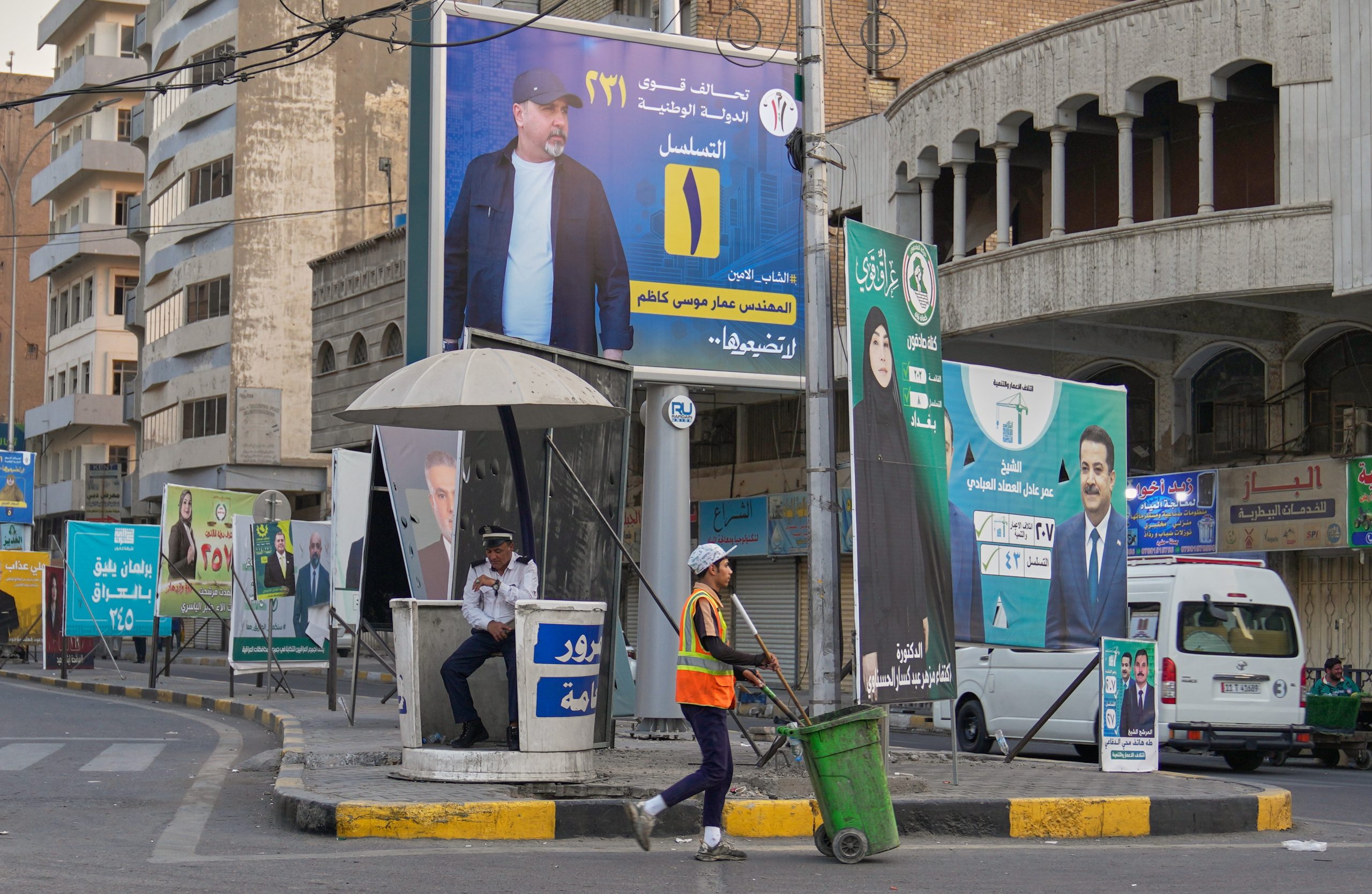
The ruling class has not introduced new discourse or direction in 2025. Identity polarization, fearmongering, and the exclusion of credible competitors continue to shape campaigns. Once effective in consolidating sectarian loyalty, these tactics now reveal the exhaustion of Iraq’s model. Younger Iraqis navigate the system transactionally rather than ideologically, and politics function as an arena in which elites trade patronage for votes and citizens pursue short-term benefits over long-term reform. Iraq has become, in essence, a political marketplace 2.0.
The consequences extend beyond Iraq’s borders. Political stagnation constrains European, U.S., and Gulf efforts to engage Baghdad through economic diplomacy and investment. Outreach in energy, finance, and logistics proceed, yet implementation remains slow and unpredictable. For Iraqi youth, composing over 60% of the population, governance is the main barrier to prosperity. Guided more by survival than strategy, the political class remains caught between Tehran’s entrenched influence and intermittent U.S. pressure.
From Protest to Paralysis
The path to the 2025 elections runs through the Tishreen protest movement of 2019—a rupture between citizens and the post-2003 order. What began as a youth-led uprising against corruption and unemployment became a broader rejection of sectarian governance and elite impunity. The movement forced Prime Minister Adel Abdul-Mahdi’s resignation and ushered in Mustafa al-Kadhimi’s interim government to stabilize the country and organize early elections. Although Kadhimi restored relative calm and oversaw the 2021 vote, his administration failed to translate protest demands into structural reform. Party entrenchment and oil-based clientelism produced a managed transition that preserved elite continuity while ignoring citizen grievances.
Prime Minister Mohammed Shia al-Sudani now governs within the same constraints. A brief stability dividend, buoyed by high oil prices and expansionary spending, has been offset by fiscal vulnerability. Public salaries, pensions, and welfare for over ten million Iraqis consume a large share of the 2024 budget of $116 billion. The IMF warned that the status quo is unsustainable: 87% of operating expenditures go to salaries and social benefits, leaving little for investment. In a rentier economy, a drop in oil prices could trigger a liquidity crunch and unrest by late 2025. Without fiscal correction or diversification, the spending that bought short-term calm will sow future instability.
Given these conditions, disillusioned Iraqis are likely either to boycott the vote or to trade ballots for immediate benefits—a new iteration of transactional politics.
Faint Signals of Change
A few faint shifts hint at changing sources of legitimacy and power.
One sign lies in the relative silence from Najaf’s senior scholars. Grand Ayatollah Ali al-Sistani has not endorsed a list since 2018. This is not secularization; clerical influence still runs deep, but it marks a recalibration as Iraqis no longer view the Marjaiya as the definitive arbiter of political legitimacy.
At the same time, Shia militia factions once unified by the rhetoric of resistance now compete within the very system they once opposed. The Coordination Framework, dominated by Iran-backed parties, reinstated a closed-list system that shields incumbents. Factions such as Asa’ib Ahl al-Haq are fielding separate candidates to consolidate the militia vote. The realignment reflects bargaining over state resources more than ideology. Many of these groups remain embedded in state institutions, blurring the line between coercion and governance and ensuring that seat reshuffles keep the same patrons in control.
Finally, the unusually calm lead-up to the election and its well-managed preparations mark a subtle but notable shift. The 2018 and 2021 elections were clouded by uncertainty over timing, voter registration disputes, and the logistical challenges of integrating internally displaced persons (IDPs) after ISIL’s defeat. In contrast, the 2025 elections have unfolded with relative administrative stability, and there have been no serious doubts about whether the vote would occur on schedule. This consistency likely reflects not institutional strength but rather a convergence of domestic and regional interests favoring continuity amid volatile regional developments.
None of these shifts amount to transformation, but together, they point to where Iraq’s next political fractures may appear: in the slow erosion of clerical authority, in the competition among militias turned politicians, and in a state that prizes stability over reform. Beneath the illusion of calm, Iraq’s old order is barely holding on.
Al-Sadr’s Boycott: Tactical Withdrawal, Strategic Patience
One of the most consequential and least understood factors is Muqtada al-Sadr’s decision to stay out of the running. After winning the largest bloc in 2021, he sought a national majority government with the Kurdistan Democratic Party and Sunni allies. A Federal Supreme Court ruling that handed rivals effective veto power derailed the plan. Al-Sadr withdrew his MPs and called for a boycott that brought protestors into the streets.
His renewed abstention in 2025, framed as an effort to change the faces of power and save Iraq, is strategic deferral. Sadrists explored re-entry in talks with Prime Minister al-Sudani, but the Coordination Framework blocked reopening the candidate lists, confirming that genuine competition remains closed. By staying out of the running, al-Sadr avoids legitimizing a consensus he deems corrupt while preserving his populist brand and grassroots capacity. He is betting that fiscal strain and governance paralysis will weaken his rivals, allowing the Sadrists to return as the only organized alternative. In a system where participation often equals co-option, he wields influence through absence, denying the elite stability while keeping himself central to the political equation.
International and Regional Crosscurrents
The election unfolds amid a triangulation of factors that Iraq cannot escape: Iranian entrenchment, episodic but assertive U.S. engagement, and Gulf economic outreach conditioned on delivery from Baghdad.
Tehran’s leverage is both fiscal and ideological. Parastatal networks extract revenue from borders, fuel, and public contracts, fusing coercion with commerce and embedding militias within the bureaucracy. Governance and capture increasingly overlap, making electoral change feel cosmetic. Moreover, Iran’s militias in Iraq threaten any semblance of stability and continue to shape Baghdad’s regional standing—as seen in the diminished Arab League Summit hosted this year.
Meanwhile, Washington is recalibrating from coalition warfare to a leaner bilateral posture. The drawdown and consolidation in Erbil define a narrower mission: advising forces, deterring escalation with Iran-linked militias, and sustaining counterterrorism cooperation without assuming Iraq’s security burdens. For Baghdad, this shift brings relief and risk. It reduces friction with Iran’s allies but removes an external stabilizer at a delicate moment. In parallel, the Trump administration has pressured the Iraqi government to deepen commercial ties. Recent moves include an LNG contract with Excelerate Energy and negotiations for ExxonMobil’s return to southern oil fields. Yet the durability of this balance given the upcoming election remains uncertain.
The Gulf angle offers Iraq’s most credible near-term path to material gains—if governance can match ambition. The GCC–Iraq power interconnection, built to offset chronic shortfalls and diversify away from Iranian imports, has moved from concept to near-operation. Technical links through Kuwait to southern Iraq are slated to deliver initial flows of energy soon. Progress here demonstrates that regional integration is possible when projects are modular, bankable, and insulated from day-to-day factional bargaining. However, it also exposes the constraint: execution still depends on Iraqi ministries that must regulate, pay, and protect infrastructure over time.
A parallel bet is the “Development Road” corridor to Turkey and Europe—a multimodal route of rail, road, and data pipes meant to reposition Iraq along East-West supply chains. Its financing and timelines remain contingent on post-election clarity in Baghdad and coordination with Ankara, but the enabling moves are underway: TIR customs activation, cross-border telecom integration, and Turkish contracting pipelines are ready to scale if Baghdad can underwrite credible, rules-based concessions. Here again, geopolitics meets administration: without predictable regulation and secure rights-of-way, grand corridors risk becoming announcements rather than arteries.
For Iraq’s youthful electorate, the ballot is a test of whether the state can turn regional openings into daily reliability, with fewer blackouts, faster logistics, and cleaner procurement. Many still see Iraq’s politics as outcomes negotiated abroad and delivered slowly at home. Iran preserves influence through militias, the United States limits exposure while building commercial footholds, and the Gulf offers capital but demands accountability. Iraq’s external options are tightening even as its political core remains locked in low-trust bargains. Unless a coalition trades patronage for performance, the region will continue investing around Iraq’s potential rather than in it.
An Election Without Illusion
The 2025 elections risk becoming an exercise in political maintenance rather than transformation. Sectarian and patronage mobilization, Iranian interference, and institutional fatigue point to lower turnout and weaker legitimacy. What distinguishes this cycle is public recognition of the repetition itself, as Iraqis increasingly doubt that elections alone can deliver structural change.
For U.S. and Gulf policymakers, this is both a challenge and an opening. Governmental paralysis limits cross-border trade and energy integration, yet a young, tech-savvy generation inspired by American and Gulf models remains an untapped partner. If Baghdad’s elite stay trapped in survival politics, Iraq’s alignment with the Gulf and the United States may instead emerge from the bottom up—through entrepreneurship, subnational partnerships, and educational or cultural ties.
Absent meaningful reform, the 2025 elections may cement a system of managed pluralism that is plural in form but static in function. For a country rich in human and natural capital, that outcome would deepen domestic disillusionment and deny the region a natural partner for a more integrated and stable Middle East.
The views and opinions expressed in this article are those of the authors and do not necessarily reflect the views of Gulf International Forum.
Issue: Politics & Governance
Country: Iraq

Dr. Shahla Al Kli is Counterpart International’s Lead Representative in Iraq. Al Kli is also a non-resident scholar at the Middle East Institute. Prior to that, she served as Research Analysis and Knowledge Mobilization Director at Proximity International, the Middle East Deputy Regional Director at Mercy Corps, a Principal Development Specialist at DAI Global, an advisor to the Speaker of the Iraqi Parliament, a senior advisor to the Speaker of the Kurdistan Parliament, a former Country Director for Counterpart’s Iraq programs, and an auditor at the Central Bank of Iraq. She is a long-term development practitioner in the Middle East with expertise in politics, governance, security, state building, and fragile states. Her doctoral dissertation about governance and decentralization in Iraq at the Fletcher School of Law and Diplomacy at Tufts University was awarded the Peter Ackerman Award for outstanding scholarly work.
Why Iran Never Knows When to Stop
July 27, 2026At first glance, Iran’s negotiating difficulties appear to stem from disagreements between pragmatists seeking sanctions relief and hardliners determined to resist compromise. Yet that explanation…
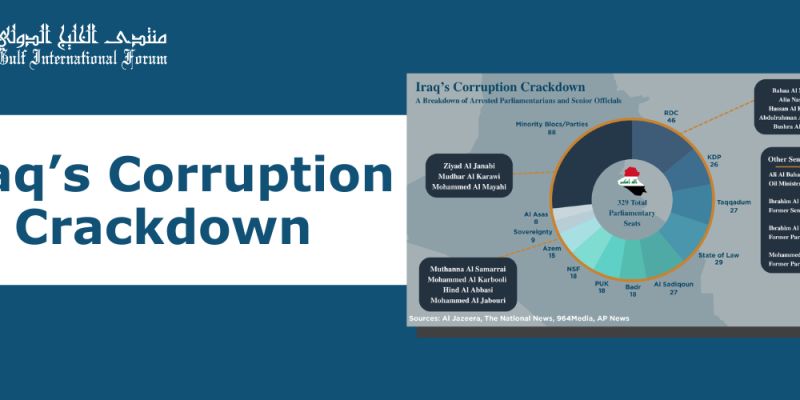
Iraq’s Corruption Crackdown
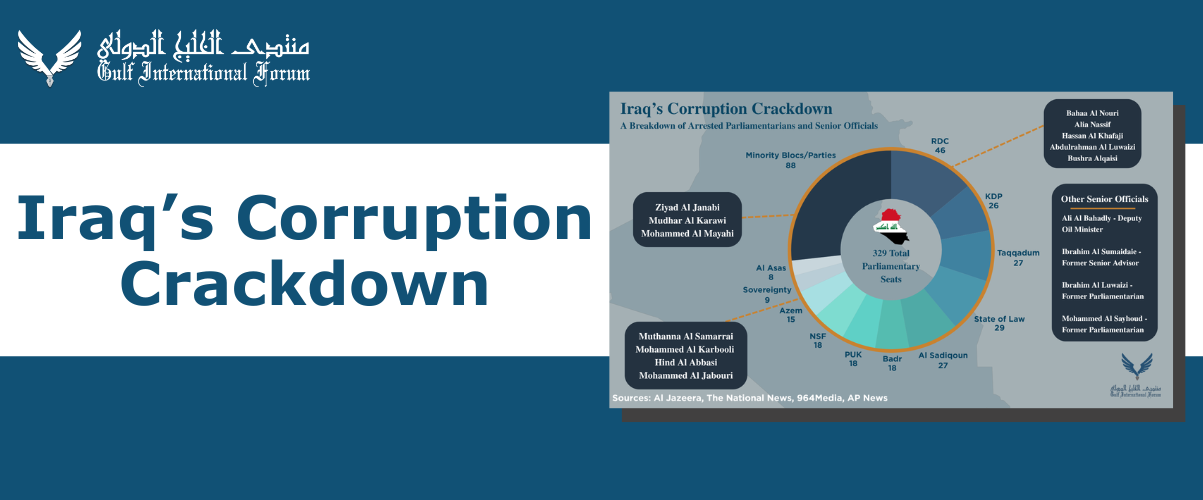
July 22, 2026*A breakdown of arrested parliamentarians and senior officials as of June 28, 2026.
Sheikh Hamad and the Making of Modern Qatar
July 15, 2026There is a question that haunts every small state: how does a nation survive and stay relevant in a region built for giants? For most…