Caught Between Two Powers: The Gulf’s Role in a New Regional Order
The war in the Gulf is underscoring the erosion of the old security order in the Middle East, without producing a viable alternative.

The Middle East is not simply experiencing another cycle of escalation; it is witnessing a collision between competing regional projects. At the center are Israel and Iran. These two states present themselves as security-seeking actors, yet both have contributed to weakening the prospects for a collective regional security order. Their rivalry is often described as ideological, military, or nuclear. Yet its deeper significance lies in the architecture each seeks to build: a region organized around spheres of influence, the penetration of weaker states, forward defense, and strategic fragmentation rather than shared security.
The current war is not only about Iran, Israel, or the United States. It is about the future shape of the Middle East, and whether the region will continue to be managed through external protection, proxy networks, selective normalization, and unilateral deterrence, or whether Gulf states can use this moment to push for a more balanced regional order.
Parallel Logic
Israel and Iran are very different states, with distinct political systems, ideologies, and international relationships. Yet structurally, their regional behavior shares several similarities. First, neither has historically trusted collective regional security as the foundation of order. Iran has relied on a network of allied militias, political movements, and proxy actors across Iraq, Syria, Lebanon, and Yemen. Israel, meanwhile, has prioritized military superiority, preemptive action, intelligence penetration, bilateral security arrangements, and selective normalization rather than a broad regional compact that includes all major actors.
Both states have also sought strategic depth beyond their borders. Iran’s “forward defense” doctrine has relied on pushing confrontation away from Iranian territory by embedding influence in Arab countries by exploiting conflicts and instability. Israel has similarly sought to prevent threats from consolidating near its borders through repeated military operations in Gaza, Lebanon, Syria, Iraq, and now Iran-linked spaces. In both cases, war is displaced outward.
Finally, both states benefit from regional fragmentation. Iran’s influence has expanded most effectively where state authority weakened: Iraq after 2003, Syria after 2011, Lebanon through Hezbollah’s state-within-a-state structure, and Yemen through the Houthis. Israel’s regional project has also benefited from fragmentation, though in a different manner: by normalizing relations with some states while bypassing the unresolved Palestinian question, exploiting Arab divisions, and positioning itself as a security partner against Iran. The result is that regional fragmentation becomes not a side effect, but a strategic condition that enables both visions.
The central problem is not only the Israel-Iran rivalry. It is that the Arab world has become the arena in which non-Arab regional powers test competing visions of order. Iran operates through coercive, destabilizing non-state networks, and Israel often relies on unilateral force and regional exclusion. Both claim defensive motives yet produce regional insecurity.
The Limits of Gulf Alignment
The current war has sharpened this contradiction. Gulf states face an uncomfortable position: they do not want Iranian dominance, but they also do not want an Israeli-led regional order built on permanent escalation. They want credible protection while avoiding deeper entanglement, prolonged escalation, and the normalization of attacks on their territory, energy infrastructure, and maritime routes. Reactions to disruptions in the Strait of Hormuz show that Gulf leaders reject Iranian efforts to exert control over regional chokepoints and are increasingly treating attacks on any Gulf state as a collective security concern.
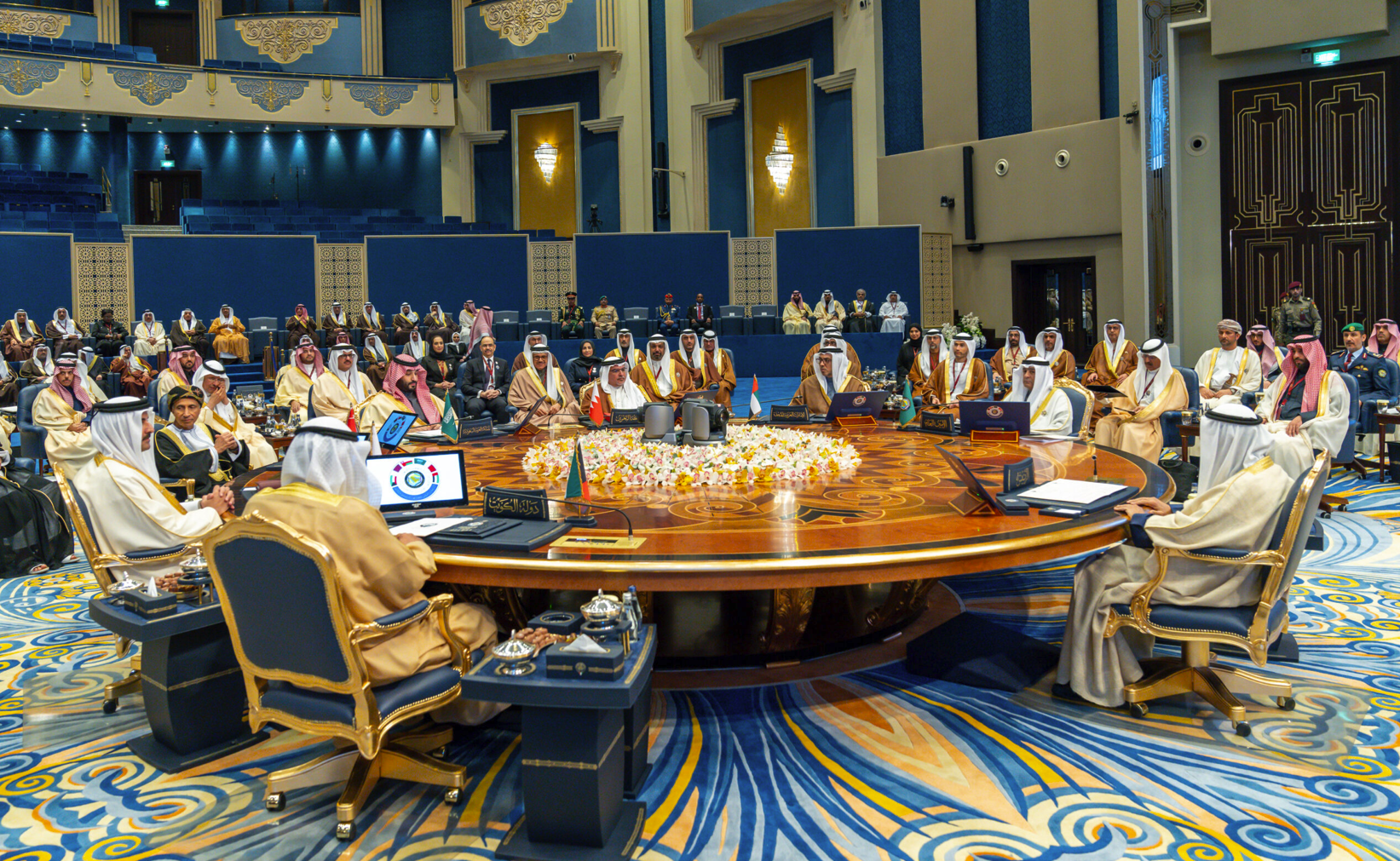
This creates a strategic paradox. Gulf states are economically powerful, diplomatically active, and globally connected, yet their security architecture remains incomplete. They rely heavily on the United States, even as doubts about American reliability persist. They engage China, India, Europe, and Russia, but none can replace Washington as a security provider. The recent Gulf Cooperation Council (GCC) summit in Jeddah showed a tendency toward security coordination within the GCC framework, but threat perceptions remain uneven. Some prioritize Iran as the main threat, while others seek to avoid escalation and prefer managed coexistence. As a result, full unity on Iran remains unlikely, even after the war.
Post-War Scenarios
The future regional architecture will depend heavily on the outcome of the war. Three scenarios are possible. The first is regime survival in Iran with military weakening. In this case, Iran remains a regional actor but with reduced capacity. Its proxy model may be degraded, its economy further constrained, and its deterrence weakened. This could embolden Israel and deepen U.S.-Gulf security coordination alongside other partnerships. But it would not automatically create stability. A weakened but surviving Iran may become more asymmetric, more unpredictable, and more reliant on deniable operations, producing a phase of unstable containment.
The second scenario is regime collapse or regime change. This would transform the Middle East dramatically. If the Islamic Republic falls, the entire axis built around Tehran would fragment. Hezbollah, Iraqi militias, and the Houthis would lose strategic depth, funding, and ideological backing. New alliances could emerge quickly, and Arab states may compete to shape post-Iran outcomes. Yet regime collapse would not guarantee stability. It could produce internal fragmentation, ethnic conflict, border insecurity, nuclear uncertainty, and intensified external competition over Iran’s future. In that sense, the collapse of the regime could either open the door to a more cooperative regional order or produce a second Iraq-style regional shock on a much larger scale. Regime collapse could also redirect Israeli attention toward other regional powers, including Türkiye.
The third scenario is negotiated de-escalation. This is the most desirable outcome for the Gulf states, but also the most difficult to achieve. It would require an agreement that goes beyond nuclear issues to include missiles, proxy activity, maritime security, attacks on Gulf states, and rules of regional conduct. For Gulf states, the objective is not an Iranian or Israeli victory, but a framework that reduces the ability of both powers to export insecurity into Arab spaces. Such an arrangement would require credible guarantees, enforcement mechanisms, and regional participation. A narrow U.S.–Iran bargain that ignores Gulf security would not be sufficient.
In all scenarios, Arab states face a strategic choice: remain arenas for competing projects or become architects of a new regional order. The first path sustains dependency, leaving the Gulf states reliant on the United States, the Levant states exposed to Israeli-Iranian confrontation, and the weaker Arab states penetrated by external actors. The second path requires building an Arab-centered regional architecture based on sovereignty, non-interference, maritime security, economic interdependence, and crisis management.
Toward a Layered Regional Order
An Arab-centered regional architecture does not mean creating an unrealistic “NATO-style” Middle Eastern alliance. The region is too divided for that. What is needed is a layered architecture. At the Gulf level, the GCC must develop stronger collective defense coordination, especially on air defense, cyber security, maritime protection, and energy infrastructure. At the regional level, mechanisms are needed to prevent fragile states from becoming battlegrounds for external actors. Any future security framework must include rules governing both Iran and Israel, without allowing either to dominate the Arab strategic space.
The key principle is simple: no regional order can be stable if it is built on the weakness of Arab states. Fragility creates openings for external actors, which in turn fuels proxy conflict and undermines the prospects for collective security. The war highlights this dynamic clearly.
The old Middle East was built around external protection, regional fragmentation, Israeli military superiority, and Iranian proxy expansion. That order is now cracking, but what replaces it remains uncertain. If the future is shaped only by Israel and Iran, the region will remain trapped between two competing models that displace conflict into Arab spaces. If Gulf states act collectively, however, the post-war moment could open space to redefine the regional architecture on different terms. The real question is not who wins the war, but who writes the rules that follow.
The views and opinions expressed in this article are those of the authors and do not necessarily reflect the views of Gulf International Forum.
Issue: Geopolitics
Country: GCC

Dr. Abdulla Banndar Al-Etaibi is an Assistant Professor at Qatar University, specializing in Foreign Policy Analysis and Gulf international relations. He holds a PhD in Political Science from the Australian National University. His research focuses on Qatari foreign policy, mediation, strategic narratives, and the role of identity in shaping state behavior. He is the author of multiple academic publications, his book (recently published) Shifting Narratives and Evolving Roles of Qatari Foreign Policy (Palgrave Macmillan), examines the transformation of Qatar’s foreign policy and its strategic use of narratives and roles in international affairs.

Beyond Hormuz: Why Balochistan Matters to Gulf Energy Security
October 21, 2026A conflict long treated as peripheral to Gulf security is becoming harder to ignore as the war with Iran puts pressure on the region’s maritime…
Should Syria and Qatar Join the Mecca Pact?
October 9, 2026Three years of cascading conflict have fundamentally transformed the Middle East’s security outlook. American weapons, military deployments, and security guarantees remain central to the region….

China’s Technology Development Push Meets Gulf Diversification
October 6, 2026China’s “new quality productive forces” (NQPF) are often understood as a domestic effort to revive growth, upgrade industry, and reduce dependence on Western technology. Yet…