Art in the Gray Zone: Iran’s Third Space of Resistance
Amid recent protests and a system of pervasive censorship, Iranian artists cultivate a “Third Space,” using ambiguity, metaphor, and coded expression to challenge authority while navigating repression and survival.

When protests swept across Iran in late 2025, one image became a powerful symbol of resistance: a lone man seated in the street, facing a group of special forces. The photograph, which was widely compared to the “Tank Man” of Tiananmen, spread rapidly across social media. The demonstrations, initially triggered by the sharp depreciation of the national currency, quickly escalated into a human tragedy, with government repression leaving thousands of protesters dead.
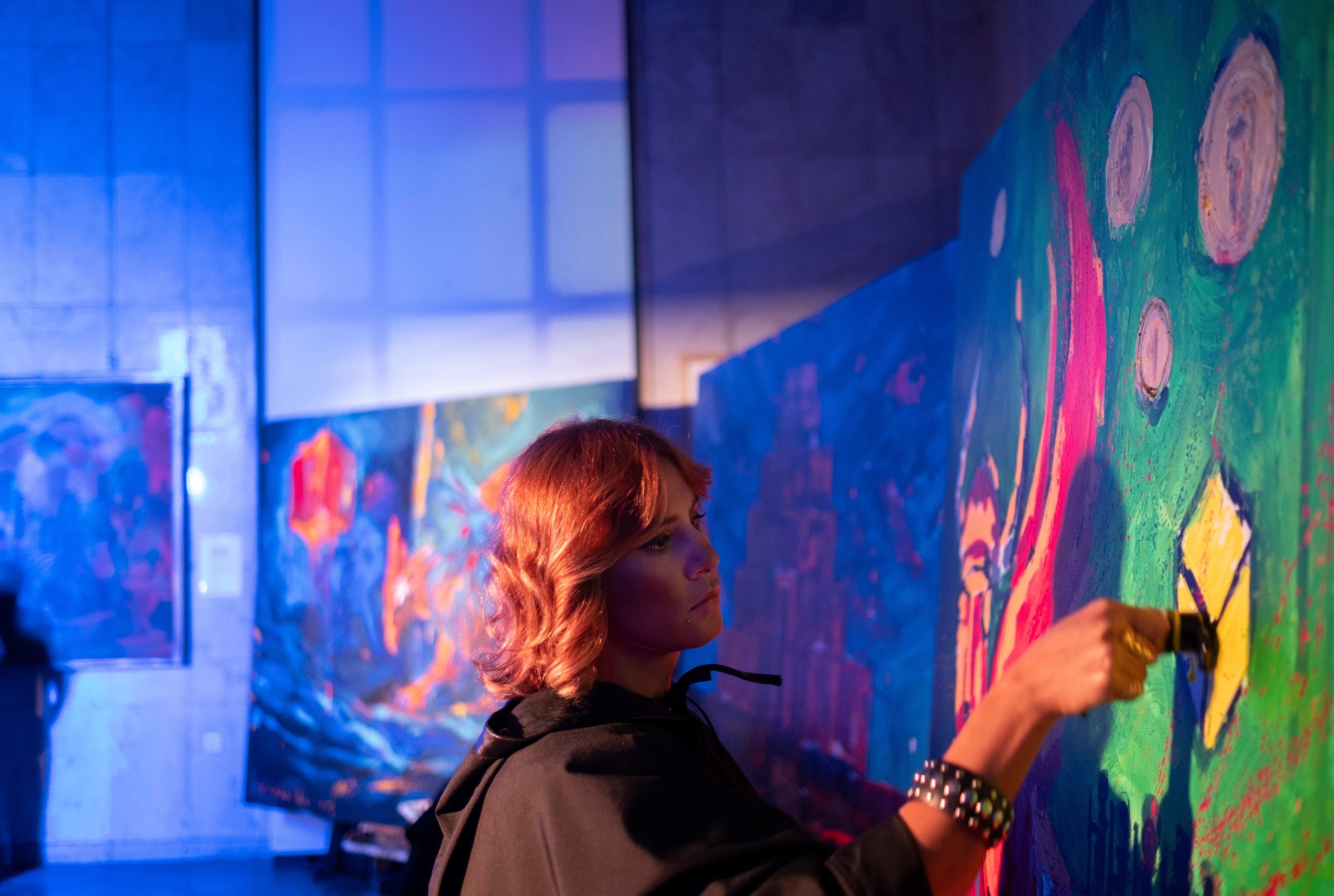
Within days, Iranian artists transformed the scene into graphic and digital works, recreating the events through symbolic layers. Artists such as Romina Zabihian, Mohammad Ardalani, and others recreated the scene as a lone shadow facing the force of repression, without a clear face or direct slogan—an image that could be interpreted as “solitude against violence” or “everyday resistance,” without explicit references to the regime that would increase the risk of censorship. This ambiguity allowed the work to circulate despite internet restrictions, invited personal interpretation, offered a sense of hope for continued resistance, and connected the moment to a global narrative of “individual resistance to power.” The emergence of this visual language of ambiguity did not, however, arise spontaneously; it was shaped by decades of systemic regulation over artistic and cultural life.
Emergence of the Third Space
Music in Iran has long been tightly controlled—even tapping one’s feet, dancing, smiling, or showing any sign of enjoyment is forbidden. Shortly after the 1979 Islamic Revolution, the founder of the Islamic Republic, Ayatollah Khomeini, banned exciting music for his followers, comparing exhilarating melodies and harmonies to drugs that threatened the seriousness of Islamic culture. To enforce the regulation, the government established the Cultural Revolution Headquarters in 1981. Three years later, Tehran created the Ministry of Culture and Islamic Guidance to oversee cultural productions, making it nearly impossible to produce music that clashes with the regime’s standards.
Of course, in Iran, the state exerts extensive control over almost all forms of culture and expression—not just music. Through severe censorship of media, the press, and the internet, the regime has made great efforts to cut its citizens’ access to the outside world. International news is nearly impossible to consume, and public criticism of the regime is dangerous for those who attempt it. In 2024 alone, at least 91 Iranian journalists were imprisoned, some facing sentences of up to 14 years. Many received brutal corporal punishment, including flogging.
Freedom House’s 2024 Freedom on the Net report classified Iran’s internet as “Not Free,” assigning it a score of 12 out of 100. By comparison, China, the world’s lowest-ranked country for internet freedom, received a score of 9. The government has also sought to eliminate the last remaining possibilities for anonymous online navigation through initiatives such as the National Information Network and mandatory online identification, aiming to establish total surveillance over citizens’ cultural and informational activities.
Amid these restrictions, Iranian artists and journalists who seek to articulate what they cannot say openly have created what has come to be known as a “Third Space.” This term denotes a survival and expression strategy that avoids direct confrontation. Instead, through metaphor and ambiguity, Iranians can harness the power of the Third Space to distance themselves from the regime’s cultural and ideological rigidity without directly clashing with its regulations.
The Gray Zone
The concept of the Third Space is attributed to postcolonial scholar Homi K. Bhabha, who uses it to describe a site of cultural hybridity. In post–Islamic Revolution Iran, the first space of cultural expression is the officially sanctioned, ideological domain sustained and directed by the regime. The second is explicit protest, which is swiftly suppressed. The third space is a realm of ambiguity, where artists focus on “how to say” rather than “what to say,” employing codes, metaphors, and multilayered meanings to convey critical messages. The power of the Third Space lies in its ability to bypass censorship laws, inviting audiences into active interpretation, and—due to its inherent ambiguity—allowing works to circulate globally and succeed at international festivals without crossing ideological red lines.
The film A Separation exemplifies the Third Space in Iranian cinema. Directed by the well-known Iranian filmmaker Asghar Farhadi, the film won the Academy Award for Best Foreign Language Film in 2012. Rather than directly criticizing the state, Farhadi highlights social tensions in Iran that the government would prefer to conceal—corruption, class conflict, deep moral fractures, and gender-based limitations. Despite addressing these sensitive issues, the film received official blessing and avoided censorship. Its ambiguity-laden narrative encourages active interpretation, fosters empathy and reflection, and, with its open ending, sustains hope for continued dialogue among audiences.
The Third Space is also evident in Iranian music. Mohsen Namjoo, an Iranian musician, has pushed his work into the Third Space to obtain official permits while simultaneously innovating and pushing the boundaries of acceptable music. He blends traditional Iranian music with classical poetry by renowned poets from centuries past—such as Hafez, Saadi, and Rumi—with Western elements like blues, rock, and jazz. Through multilayered meanings, ambiguity, and hidden humor, he conveys social and political criticism without direct expression that would trigger immediate repression. In his song “Zolf Bar Bad,” Namjoo combines one of Hafez’s famous ghazals with a blues-rock style and a rough vocal delivery, creating layers of meaning that implicitly call for freedom. In Hafez’s original articulation, the poem’s primary meaning centers on earthly or divine love. Namjoo, however, leaves interpretation to the audience, allowing listeners to express their longing for freedom without directly challenging the authorities.
The Third Space also pervades Iranian visual art. Shirin Neshat, a female Iranian artist, explored the Third Space in her Women of Allah series in the 1990s. By depicting Iranian women whose hands and feet are inscribed with Persian calligraphy, she examines identity, gender, and women’s roles in Iranian society. Through these portraits, Neshat highlights the intersection of tradition and modernity, and the social and cultural challenges women in Iran face. In doing so, she transforms the female body into a text, prompting reflection on seeing, reading, clothing, and veiling for women in society—topics that often face heavy censorship.
Forging New Spaces for Art
The quest to establish the Third Space is a matter of survival for Iranian artists. Since taking power in 1979, the regime has severely restricted and closed off the sphere of art and culture, responding to any form of dissent with harsh punishment and isolation. In recent years, artists such as Iranian rapper Toomaj Salehi and cartoonist Atena Farghadani have been arrested, tortured, and imprisoned for work that challenges the regime’s authority; Salehi was even sentenced to death before the ruling was overturned. Other artists have been forced into exile, including director Mohammad Rasoulof, who fled after his Cannes award-winning film, The Seed of the Sacred Fig, portrayed the 2022 protests and featured women without headscarves.
It is precisely under these conditions that the Third Space has become a terrain of struggle—a battlefield that Iranian artists use to create a vital and dynamic realm of expression that neither endorses the state’s cultural ideology nor confronts it head-on. Limitations imposed by the state are mitigated by ambiguity, and direct protest is reshaped into fluid and interpretive forms. By necessity, Iranian artists have discovered that even the quiet act of breaking official artistic conventions can be the most powerful form of protest.
The views and opinions expressed in this article are those of the authors and do not necessarily reflect the views of Gulf International Forum.
Issue: Society & Culture
Country: Iran

Dr. Mohammad Salami holds a Ph.D. in International Relations. He is a specialist in Middle Eastern policy, particularly in Syria, Iran, Yemen, and the Persian Gulf region. His areas of expertise include politics and governance, security, and counterterrorism. He writes as an analyst and columnist in various media outlets. Follow him on Twitter: @moh_salami
Iran’s Embassies Enter the Narrative War
August 24, 2026At key moments in history, embassies have stepped beyond their conventional diplomatic functions to serve the wider interests of their states. They have gathered intelligence,…
Who Leads Gulf Schools Through Crisis?
August 1, 2026Recent discussion has rightly drawn attention to how regional conflict can disrupt education in the Gulf, forcing schools and universities online and exposing risks related…
The Legacy of Sheikh Hamad bin Khalifa Al Thani: Expert Perspectives
July 13, 2026With the passing of His Highness Sheikh Hamad bin Khalifa Al Thani, the Father Emir of Qatar, Gulf International Forum experts assess the legacy of…