Gulf Governments Taking the Wrong Message from the Gorbachev Experience
Young people in Gulf states are no longer oblivious to the political freedoms enjoyed in Western countries, and this fact alone should spur Gulf governments to real action.

The death of the last Soviet President Mikhail Gorbachev, on August 30, 2022 provides opportunity to review his role in ending the Cold War. The West regards him as a man of history for his leadership in the final years of the Soviet Union. However, what is less well understood is that he started a reform process that took the Soviet system down a path from which it never recovered. By trying to transform the Soviet system with the ultimate goal of making the Soviet Union and Communism stronger, he inadvertently unleashed forces that led to his country’s demise. This legacy was not lost on authoritarian leaders around the world. Indeed, Middle Eastern governments have consciously avoided implementing the same bedrock political reforms to preclude such an outcome for their own regimes.
A Slippery Slope
It is important to remember that Gorbachev was a true believer in Communism and rose through the ranks to eventually reach the top position of the party and state. The problem, as Gorbachev saw it, was that the party had deviated from the principles of the Soviet Union’s founder, Vladimir Lenin. In Gorbachev’s view, Lenin’s successor, Joseph Stalin, not only imposed a vicious and arbitrary police state but created a grossly inefficient and uncompetitive economic system. And while Stalin’s successors may have curbed the worst excesses of the police state, they paid insufficient attention to free thought and innovation as solutions to the Soviet Union’s myriad problems, particularly in the economic sphere.
Gorbachev would occasionally spend time in the countryside to read Lenin’s works, believing he would find the answer to the Soviet Union’s problems in these writings. What Gorbachev did not foresee was that the majority of the peoples of the Soviet Union had become so fed up with the system under which they lived (and which Lenin created) that partial reform would no longer satisfy them—they wanted to get rid of the system in its entirety. Hence, when Gorbachev started his reform process, glasnost (opening) and perestroika (restructuring), it created enough political freedom for citizens to declare that enough was enough. The Soviet Union crumbled.
In the aftermath of the botched coup against him by some Soviet hardliners in August of 1991, Gorbachev returned to Moscow and addressed the Soviet parliament. His speech was interspersed with comments that suggested he still believed in the Communist system, telling one questioner that “nobody has the right to say that socialism should be driven out of the Soviet Union.” Gorbachev looked bewildered and frazzled that such anti-Communist sentiments were being expressed. A group of citizens marched to the statue of Felix Dzerzhinsky, the person Lenin had chosen to head the dreaded Soviet secret police, and tore it down. This symbolic act signaled the coming end of a failed political system. A few months later, the Soviet Union ceased to exist, as non-Communists took power and the Soviet republics achieved independence.
Lessons of History
In the minds of authoritarian leaders, reform—partial or otherwise— poses a serious threat to the regime because they cannot control the second-order effects of change. Middle Eastern leaders have taken note of this. While they have occasionally given lip service to reform, most have instead pursued repressive policies and, if they are lucky enough to possess the resources to do so, embraced financial largess to buy the allegiance of their people.
For example, Egyptian President Abdel Fatah el-Sisi apparently believes that former President Hosni Mubarak’s biggest mistake was his efforts to liberalize the Egyptian political system in the decade preceding the so-called Arab Spring. El-Sisi is determined not to repeat the perceived blunders of his predecessor. The president has continued to harass one of the leaders of the 2011 uprising, Alaa Abdel Fattah, keeping him in and out of prison, as well as arresting other dissidents. In Saudi Arabia, Crown Prince Muhammad bin Salman has drawn a clear distinction between between social reforms (which he has imposed from the top) and political reforms (which he has vehemently opposed). Arrests against dissidents in Saudi Arabia are on the rise, as they are in some other Gulf states.
However, history has shown that repression is not a long-term winning strategy. Moreover, reform does not necessarily have to lead to the breakdown of the state and the overthrow of the political leaders. On the contrary, political reforms can grant much-needed legitimacy to leaders of authoritarian states, as many political activists and citizens would be grateful to operate and live in a country where expressing one’s views does not lead to prison time. Monarchies in the Gulf can persevere, provided they take on features of true constitutional monarchies (not just pseudo-parliaments) that serve the interests of their burgeoning youth populations. Young people in Gulf states are no longer oblivious to the political freedoms enjoyed in Western countries, and this fact alone should spur Gulf governments to real action.
To avoid the fate of the Soviet Union, Middle Eastern leaders need to lay out a road map to true reform that will be gradual—but nonetheless meaningful—in order to give young people a sense that they will have a say on issues that matter to them. One fact is clear: Arab youth want a better future, and not just a better economic outlook but political rights as well. Perceiving political reform as something to avoid at all costs betrays the aspirations of young people, estranges the regime from the people over whom it rules, and hurts the long-term viability of the current model of government in the Gulf.
The views and opinions expressed in this article are those of the authors and do not necessarily reflect the views of Gulf International Forum.
Issue: Politics & Governance
Country: GCC

Professor Gregory Aftandilian is a Non-resident Fellow at the Arab Center Washington DC, and a Senior Professorial Lecturer at American University where he teaches courses on U.S. foreign policy. Professor Aftandilian is also an adjunct faculty member at Boston University and George Mason University, teaching courses on Middle East politics. Previously, he worked for the U.S. government for over 20 years in such capacities as Professional Staff Member of the Senate Foreign Relations Committee and Middle East Analyst at the U.S. Department of State. He holds B.A. in History from Dartmouth College, M.A. in Middle Eastern Studies from University of Chicago, and M.Sc. in International Relations from London School of Economics.
Why Iran Never Knows When to Stop
July 27, 2026At first glance, Iran’s negotiating difficulties appear to stem from disagreements between pragmatists seeking sanctions relief and hardliners determined to resist compromise. Yet that explanation…
Iraq’s Corruption Crackdown
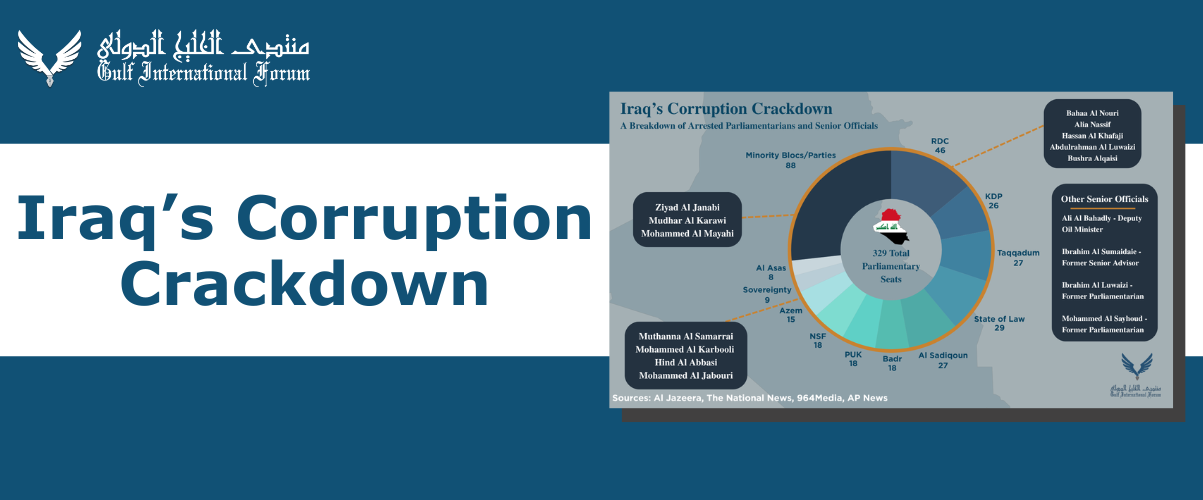
July 22, 2026*A breakdown of arrested parliamentarians and senior officials as of June 28, 2026.
Sheikh Hamad and the Making of Modern Qatar
July 15, 2026There is a question that haunts every small state: how does a nation survive and stay relevant in a region built for giants? For most…