The STC Makes its Move in Yemen: What it Means for the Country’s Future
As the STC consolidates power in Yemen’s south, longstanding rivalries between local factions and regional backers threaten to reshape the country’s fragile political and military landscape.

In what is arguably the most significant moment in the Yemeni conflict since the fall of Sana’a in 2015, the Southern Transitional Council (STC) largely took over southern Yemen after a relatively bloodless shock campaign. Though the situation remains fluid—with new setbacks following its shock offensive—the armed group and political faction have further consolidated their position as the strongest actor in the anti-Houthi block, sharpening longstanding questions about Yemen’s future. The STC operation and the subsequent Saudi response represents a clear turning point, one that increases the likelihood that Yemen’s de facto partition will become more entrenched alongside an expanded civil conflict in the south, even if that outcome is not yet guaranteed.
The STC’s Calculated Push for Dominance
For those monitoring Yemen, operation “Promising Future” was not a surprising endeavor, as the STC had long advocated for greater influence within the Presidential Leadership Council (PLC)—the executive arm of the Internationally Recognized Government (IRG). Those calls included demands for deeper involvement in Saudi-led talks with the Houthis, aimed at ending the decade-long civil war. In parallel, the group steadily expanded its influence across IRG territory in the south and east since 2020, including in the resource-rich Hadramaut Governorate. It was therefore unsurprising that the STC initially targeted the relatively government-friendly but increasingly autonomous tribal alliance in Hadramout during its flash offensive, seeking to consolidate gains quickly amid widening fissures between local actors, the IRG, and Riyadh.
That environment opened a vacuum for the STC’s operations. Hadramaut and the neighboring al-Mahra Governorate fell into the group’s hands in rapid succession, followed by much of the broader south. This was hardly a coincidence for the UAE-backed faction. Large swaths of both governorates—including the strategic wadi and desert areas under the First Military Region—were controlled by local tribal forces led by Amr Bin Habrish and the Muslim Brotherhood-aligned Islah Party, another major player in the anti-Houthi coalition and a stated enemy of the anti-Islamist Emiratis. At the same time, the STC rapidly seized control of the presidential palace in Aden, the IRG’s southern capital.
In an official statement at the time, senior STC official Amr al-Bidh claimed that all eight southern governorates in Yemen were “under the protection of the Southern Armed Forces.” He emphasized that the group was focused on unifying its forces to improve coordination, reinforce stability and security in the south, and maintain readiness against the Houthis.
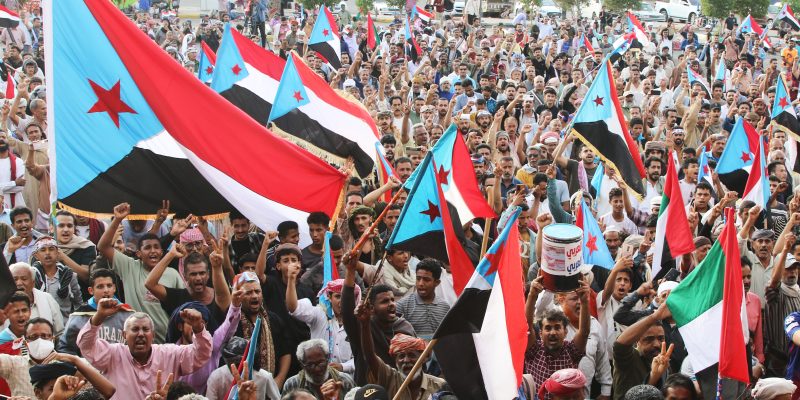
On December 10, STC leader Aidarous al-Zubaidi, speaking from the Aden presidential palace, declared that “the next goal must be Sana’a, peacefully or through war, until justice returns to its people and aggression is defeated.” In photographs from meetings held that week, the official flag of the Republic of Yemen was notably absent, instead replaced by the flag of southern Yemen. During a gathering of southern political and military leaders, al-Zubaidi indicated that the coming period would focus on building a “south Arabian state,” reflecting the STC’s broader support for southern autonomy. Then, on January 2, the group announced a new, two-year constitution and its intent to declare independence, either after that period or immediately if faced with ongoing attacks by the IRG and its Saudi backers.
Meanwhile, the head of the PLC, Rashid al-Alimi, fled Aden amid the STC’s advance at the time, alongside the IRG’s prime minister and other major faction leaders not aligned with the southern secessionist push. Al-Alimi traveled to Riyadh—the primary backer of the IRG—for talks on the unfolding situation, and later condemned the STC’s actions as “a direct threat to the unity of security and military decision-making” that undermined the government’s authority. Ongoing efforts to negotiate a truce have largely fallen on deaf ears, though ongoing efforts to foster a Saudi-STC meeting continue after the latter largely blocked Riyadh’s delegations from traveling to Aden beforehand.
Power Struggles and Regional Escalations
Statements from STC and IRG leaders, as well as their respective factions, reflect a long-running rivalry for influence in the south, driven by their regional backers—Saudi Arabia and the United Arab Emirates. While both countries have long supported the anti-Houthi coalition broadly, providing military support in the form of arms, funds, and direct military action, they have increasingly disagreed on the direction of the conflict, grand strategy and tactics, and Yemen’s future. Riyadh prefers an end to the conflict that preserves some measure of Yemeni unity and includes the country’s diverse anti-Houthi actors. Abu Dhabi, by contrast, prioritizes eliminating Islamist influence in the country and appears more open to a Yemeni partition, at least through its support for the more secular STC. Such a stance would reflect its broader foreign policy actions across the Horn of Africa, in which it supports breakaway actors to increase its influence.
The STC’s takeover underscores just how far Saudi Arabia and the UAE’s interests in Yemen have diverged in recent years, even as the conflict has taken a backseat to other regional crises. This divergence helped create space for the STC to advance its operations—although local dynamics dominated the group’s move with the UAE’s approval—and is now driving the ongoing escalation between Riyadh and Abu Dhabi.
These competing regional priorities operate in parallel to intensifying factional rivalries within Yemen, operating as mutual reinforcement for each other. Outside of the STC’s demand for greater involvement in peace talks, the IRG and its aligned elements have been vying for influence within the PLC since its creation in April 2022. Al-Zubaidi, a member of the PLC, has gradually built alliances with other members. He has also established himself and the STC as the dominant powerbroker in southern Yemen, a region already inclined toward independence.
While the group has been less influential in Hadramaut and al-Mahra given historical rivalries between the southwest and south east regions of Yemen that led to a brief civil conflict before Yemeni unification in 1990, recent inroads laid the groundwork for Operation Promising Future. The Saudi-led response quickly followed the STC’s advances. On December 27, the Saudi Defense Minister urged the STC to withdraw peacefully from the territories it had seized, warning that any military moves undermining de-escalation efforts in the southern region would be countered. However, the STC rejected the call, stating it would continue securing eastern provinces and signaling it was nearing a “declaration of statehood” in the south.
Tensions escalated further after UAE-linked STC media released videos showing airstrikes near STC positions in the Hadramaut governorate. The following day, Saudi fighter jets carried out intensive overflights across Hadramaut while dropping flare bombs around Seiyun Airport. The escalation then took a sharp turn when Saudi Arabia launched airstrikes on the port city of Mukalla, accusing the UAE of delivering weapons and combat vehicles to separatist forces and describing the actions as a threat to Saudi national security. Abu Dhabi initially rejected the accusations and expressed surprise at the strikes, but later announced it would withdraw remaining Emirati forces from Yemen following Saudi demand.
On January 7, the confrontation deepened after Saudi Arabia conducted airstrikes in al-Dhalea governorate, al-Zubaidi’s home region, and publicly accused the STC leader of treason and mobilizing armed forces to destabilize the south. Saudi and PLC forces then moved on Aden, leaving the STC’s territorial holdings in serious question. The strikes followed al-Zubaidi’s failure to board a flight to Riyadh for crisis talks and reports of STC mobilization, further shaking hopes for a diplomatic solution.
Southern Ambitions and National Fragmentation
The future of a unified Yemen hangs in the balance. Despite inconsistencies in its statements on independence, the issue remains central to the STC’s political platform. Its leaders draw their roots from the former People’s Democratic Republic of Yemen. While independence is popular in the south, support is not universal—particularly in places like Hadramaut, where locals prefer autonomy due to longstanding resource-sharing issues. Nevertheless, few obstacles would prevent the STC from declaring a southern Yemeni state if conditions were favorable.
Those conditions, however, do not yet fully exist. Any formal declaration would require Emirati approval, which is not guaranteed. The Houthis—the most powerful armed element across Yemen—also remain a major constraint, motivated in part by limited resource stockpiles and significant population pressures in territories under its control. Indeed, in Yemen’s north, support for southern independence is almost non-existent, offering the Houthis a new narrative as a unifying force fighting factions interested in dismantling the country.
Whether the Houthis view shifting power dynamics in the south as an opportunity to fully reignite the dormant civil conflict, despite a fragile and informal UN-brokered truce in place since 2022, remains to be seen. The group faces its own constraints, including Israeli and U.S. strikes that have weakened its governing and military capabilities over the past year. It is unclear whether future strikes would resume amid a new STC offensive, even amid renewed Saudi-Houthi talks, or whether the Houthis will focus on consolidating their territorial hold amid difficult economic and governance conditions.
As the dust settles in the south, one outcome is clear: the composition of the anti-Houthi coalition has fundamentally changed, with lasting implications for Yemen’s future. Partition now seems to be a question of “when,” rather than “if,” even after Saudi pushback that has forced the STC to withdraw and regroup. Yet even amid apparent Saudi and PLC success in pushing back the STC, the group’s organic nature in the south means it will not merely disappear. Thus, any future conflict in the south, alongside partition, would likely deepen instability and violence in a country already devastated by decades of conflict.
The views and opinions expressed in this article are those of the authors and do not necessarily reflect the views of Gulf International Forum.
Issue: Defense & Security, Geopolitics, Politics & Governance
Country: Yemen

Alexander Langlois is Senior Editor of DAWN’s Democracy in Exile journal and a foreign policy analyst focused on the Middle East and North Africa.

Toward a New Order in MENA Regional Geopolitics
September 2, 2026This report is a byproduct of the workshop “Toward a New Order in MENA Regional Geopolitics: What’s Next for the Region’s Geopolitical Equilibrium?,” hosted in…
Yemen’s Emerging Role in the Red Sea
August 27, 2026On August 4, 2026, the Yemeni Coast Guard (YCG) rescued the 14-member crew of the Indian-flagged commercial vessel Faize Noore Oliya. Transiting the Red Sea…
The Iran War Is Rewriting Kuwait’s Defense Architecture
July 14, 2026Since the outbreak of the Iran war in February 2026, Kuwait has announced a series of major defense acquisitions, including a $1 billion contract for…