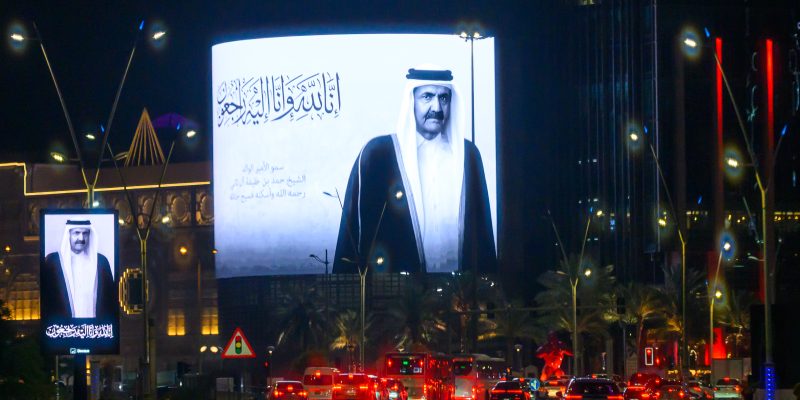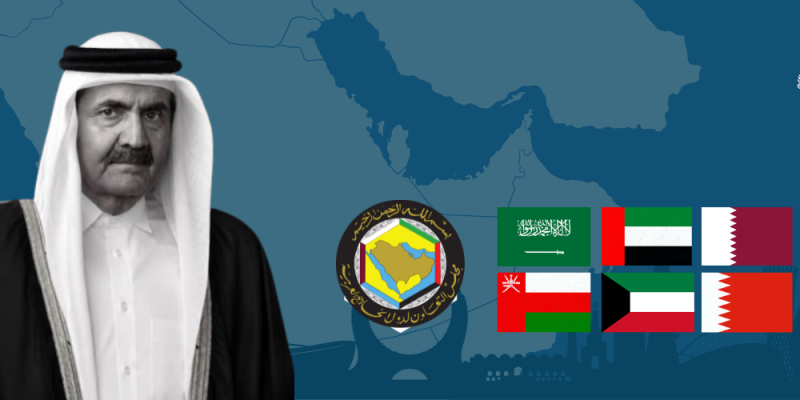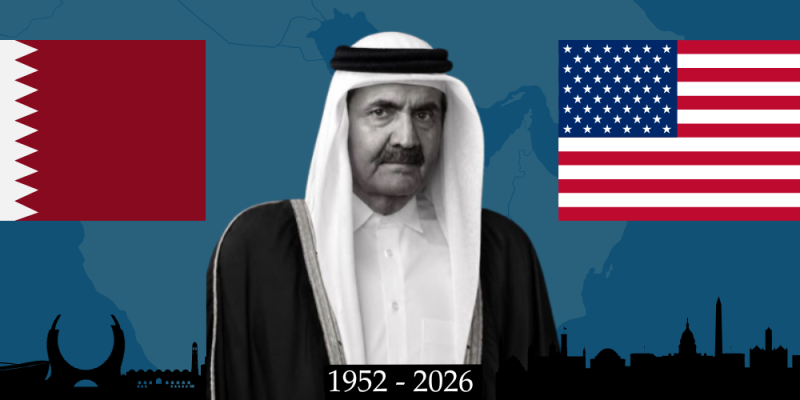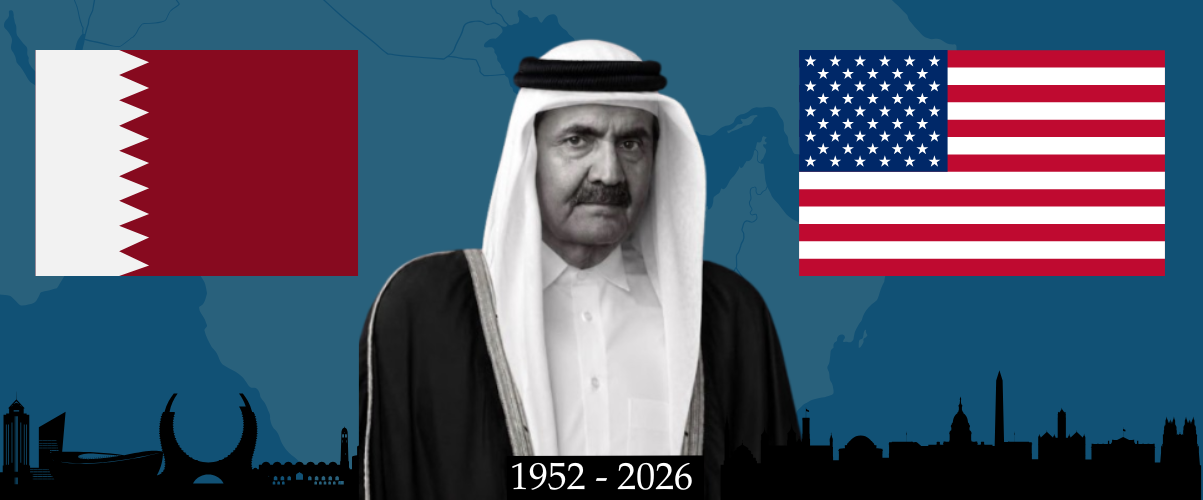
In Memoriam: Sheikh Hamad bin Khalifa Al Thani
Former U.S. Ambassador to Qatar Patrick Theros reflects on the life, leadership, and enduring legacy of Sheikh Hamad bin Khalifa Al Thani.

The Arab world has lost a giant of a man, a ruler unique among the Arab leaders of my lifetime who consistently placed the interests of his people and his country above those of his own tenure in power. Indeed, I am hard pressed to identify many non-Arab leaders of my lifetime of whom I could honestly say the same.
I first had the honor, and indeed the pleasure, of meeting His Highness the Father Emir, Sheikh Hamad bin Khalifa Al Thani, when I presented my credentials as Ambassador of the United States to the State of Qatar in December 1995. The Chief of Amiri Protocol had told me that His Highness customarily spent fifteen minutes over tea with each newly arrived ambassador after the presentation ceremony. Our conversation lasted well over an hour. That explained why my credentials were presented last that day and after those of another ambassador who had arrived a week or so later.
Sheikh Hamad began by telling me that he intended to make Qatar America’s best friend, in a smiling tone that suggested this would happen “whether we liked it or not.” He explained that this was not a decision lightly reached. He recognized the obstacles but believed that America’s democratic, educational, and social values—no less than its geostrategic and economic importance—made such a relationship essential.
Building a Strategic Partnership
At this time, he had already begun tying the United States economically to Qatar by partnering with Mobil Oil to develop the first large-scale LNG projects, then still regarded by many as financially impractical. They succeeded beyond anyone’s expectations, transforming Qatar—and its American partners—into the world’s leading exporter of liquefied natural gas. That decision permanently altered Qatar’s economic future and reshaped global energy markets.
Sheikh Hamad had begun drawing closer to the United States in defense matters well before my arrival, while still Crown Prince and Prime Minister. A Qatari Army regiment had fought with distinction alongside American Marines at the Battle of Khafji in 1991. He had authorized negotiations on a series of military agreements with the United States, including a remarkably generous Status of Forces Agreement, under which American combat and logistics aircraft operated from Doha International Airport.
Most remarkably, he possessed the strategic foresight to recognize that a permanent American military presence in Saudi Arabia would eventually become politically untenable in both Riyadh and Washington. Rather than waiting for the crisis, he built the solution before the problem became manifest. He committed some two billion dollars to construct Al Udeid Air Base years before the United States had even begun searching for an alternative to Prince Sultan Air Base. When the time finally came to relocate, Qatar was the inevitable choice.
He understood something many governments never grasp: allowing the United States almost unrestricted access to those facilities would bind our two countries together strategically. I fear we often took that generosity for granted. Today Al Udeid stands as the largest and most important American military and logistics hub between the Mediterranean and the Western Pacific.
Education, Diplomacy, and Soft Power
Sheikh Hamad appreciated the value of soft power better than almost any contemporary Arab leader. He launched Qatar on its long trajectory of offering to mediate virtually every major regional crisis, particularly those that, if left unattended, might ultimately damage American interests.
Because he regarded Qatar as America’s friend, he also believed friendship required honesty. He did not hesitate to tell us when he thought we were making mistakes. As an American ambassador, I can attest that Washington does not enjoy being told we have gotten something wrong. He nevertheless persevered.
He once told me that he wished to be remembered as the “Education Emir” and intended to bring an American university to Qatar. This ambition proved every bit as successful. I refrained from telling him at the time that my predecessor, and indeed almost everyone in the tiny corner of the State Department then responsible for Qatar, had warned me not to encourage what they regarded as his “pipe dream.” Washington feared, legitimately, that no first-rate American university would be interested and that Qatar would instead end up with some obscure diploma mill that would embarrass both countries.
The result was rather different. Education City today hosts branch campuses of Cornell Weill Medical College, Virginia Commonwealth University’s School of the Arts, Carnegie Mellon’s computer science program, Georgetown University’s School of Foreign Service, Northwestern University’s School of Journalism, and, until recently, Texas A&M’s School of Engineering. Together they have become perhaps the most ambitious experiment in international higher education ever attempted.
Sheikh Hamad also transformed the Arab media landscape by creating Al Jazeera, the first major Arab satellite news network willing to challenge established governments and conventional narratives. Critics point out that Al Jazeera seldom broadcasts stories highly critical of Qatar itself. That observation is fair enough. As I once asked a CNN interviewer, “When was the last time CNN aired a truly critical investigation of (then CEO) Ted Turner?”
Together, Al Jazeera and the remarkable conferences Qatar hosted during the first decade of this century made Doha the intellectual center of gravity of the Arab world. Those debates helped create the intellectual climate from which the Arab Spring emerged.
Tolerance and Openness
Religious tolerance was another of Sheikh Hamad’s overlooked achievements. When I arrived in the country, churches were officially prohibited, although private Christian worship was quietly tolerated. During my first Easter in Qatar, Washington refused permission for me to travel to Jordan to attend services. I therefore asked Foreign Minister Hamad bin Jassim Al Thani whether I might instead bring a priest to Doha. He agreed.
When the priest arrived, Sheikh Hamad insisted that I bring him to the Amiri Diwan. He then scolded me for bringing him dressed in civilian clothes.
“Next time,” he said, “bring him in his robes.”
Two years later he welcomed His Beatitude the Greek Orthodox Patriarch of Jerusalem on what amounted to a state visit and made it a headline in almost every Doha newspaper.
Today Qatar hosts roughly twenty Christian churches representing numerous denominations, with land and infrastructure provided by the Qatari government. It remains one of the more remarkable examples of religious accommodation anywhere in the Gulf.
His consort and partner, Sheikha Moza bint Nasser, shared that same vision.
When I accompanied Georgetown University’s first delegation to discuss joining Education City, our dean, Bob Gallucci, surprised everyone by opening the meeting with an observation. Georgetown, he explained, was not merely an American university; it was a Roman Catholic Jesuit university. If Qatar invited Georgetown, it had to accept Georgetown as Georgetown.
To our surprise, Sheikha Moza replied, “I am so happy you said that. That is one of the reasons we invited you. Catholic universities have learned how to study their own faith critically without losing their faith. Muslims once knew how to do that. We have forgotten. I want to learn how you do it.”
That exchange has remained with me ever since.
A Lasting Legacy
The last time I spent meaningful time with Sheikh Hamad was during the 2024 Doha Forum. Despite his age, his wit, wisdom, humor, curiosity, and generosity of spirit remained entirely intact. A month later I saw him again during the 25th anniversary celebrations of the Qatar Foundation. I had fully expected to see him again this year.
Instead, I find myself mourning not only a friend, but one of the genuinely consequential statesmen of our era.
It saddens me deeply that the final years of his life were darkened by policies pursued by my own country—policies against which Qatar had warned us repeatedly and which ultimately inflicted disproportionate damage upon Qatar itself and placed at risk much of the strategic partnership that Sheikh Hamad had labored so hard to build.
History will remember him as the architect of modern Qatar: the builder of its prosperity, the founder of its educational renaissance, the strategist who anchored its security, the champion of dialogue over isolation, and the leader who transformed a small Gulf state into a country whose influence reached far beyond its size.
I will remember him simply as a remarkable man—and I shall miss him.
The views and opinions expressed in this article are those of the authors and do not necessarily reflect the views of Gulf International Forum.
Issue: U.S. – Gulf Policy
Country: Qatar

Ambassador Patrick Theros is a Strategic Adviser for Gulf International Forum. Previously he held positions as Political Advisor to the Commander in Chief, Central Command; Deputy Chief of Mission and Political officer in Amman; Charge D’affaires and Deputy Chief of Mission in Abu Dhabi; Economic Counselor in Damascus; and U.S. Ambassador to the State of Qatar. In a career spanning almost 36 years, he also has served in diplomatic positions in Beirut, Managua, Dharan and Abu Dhabi, as well as in the Department of State. During that period, he earned four Superior Honor Awards. After retirement Ambassador Theros served as President of the U.S. Qatar Business Council in 2000-2017.

The Geopolitics of the U.S.–Saudi Nuclear Deal
August 18, 2026In late July, the Trump administration announced a landmark civil nuclear cooperation agreement with Saudi Arabia. Signed in accordance with Section 123 of the Atomic…
Turkey’s F-35 Return and Saudi Arabia’s Fighter Ambitions
August 7, 2026Turkey’s renewed push to rejoin the F-35 Joint Strike Fighter program, from which it was expelled in 2019 over its acquisition of Russian S-400 air…
Washington Wants a Partner, But Iraq Still Needs a State
July 16, 2026Iraqi Prime Minister Ali Al-Zaidi’s visit to Washington represents the latest attempt to strengthen U.S.–Iraq relations at a time when Baghdad is seeking greater economic…