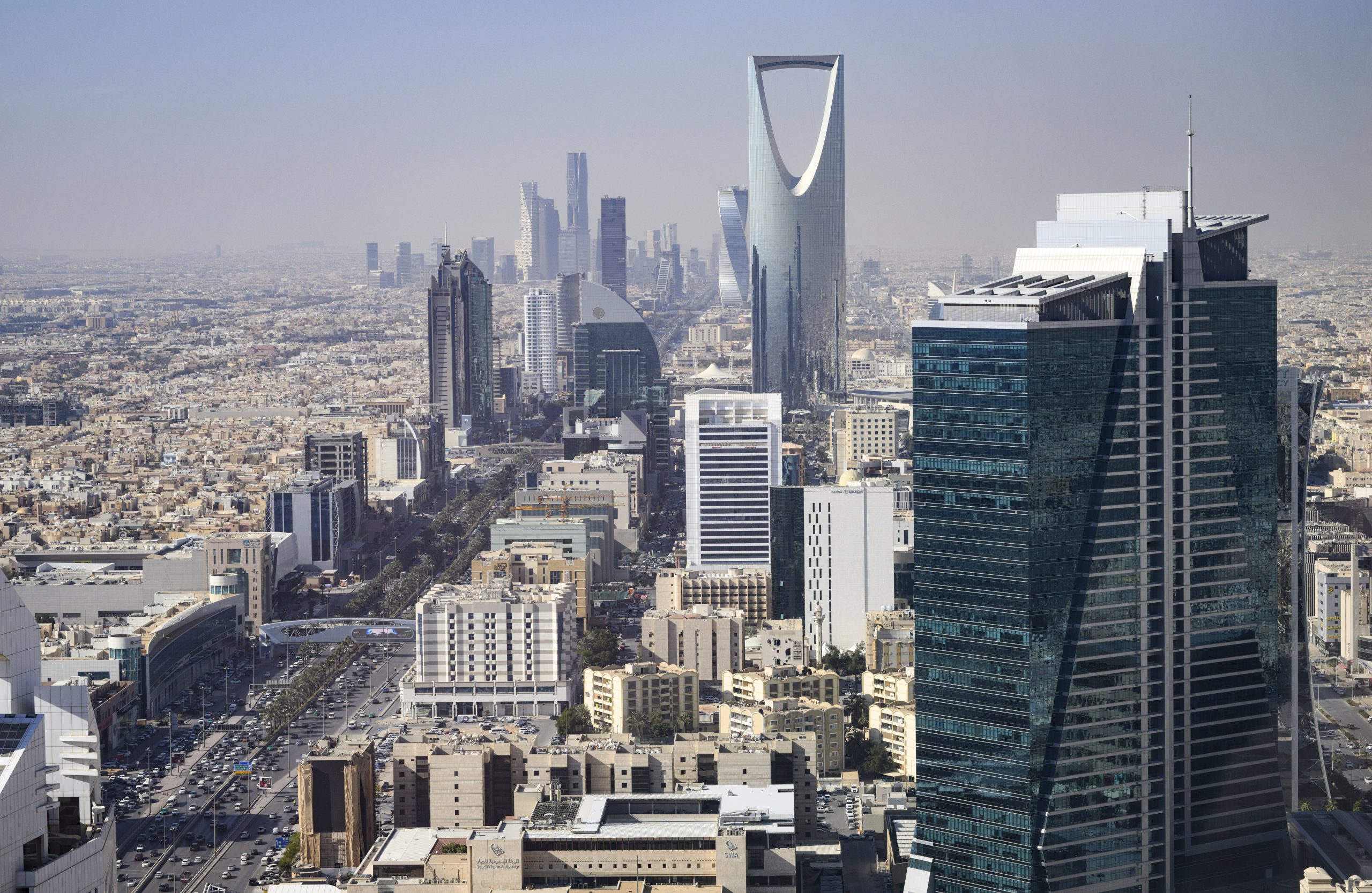
Rebalancing Ambition: Saudi Arabia’s Megaproject Pivot
Saudi Arabia is quietly scaling back the ambitions that once defined Vision 2030, as headline megaprojects give way to a more disciplined approach shaped by fiscal constraints, shifting investment priorities, and a more volatile regional environment.

Saudi Arabia’s Vision 2030 has entered a sobering phase. The kingdom’s most ambitious megaprojects, conceived a decade ago during an era of oil-fueled confidence, are colliding with fiscal reality and a far more volatile external environment shaped by regional conflict and energy market disruption. What is unfolding is not the collapse of Crown Prince Mohammed bin Salman’s (MBS) diversification agenda, but a forced recalibration: a shift away from architectural spectacle toward economic pragmatism, reinforced by tightening fiscal space, institutional reprioritization under the Public Investment Fund’s (PIF) new strategy, and growing exposure to regional security risks.
Futuristic Visions Coming to Pass
Announced in 2017, NEOM, the Red Sea Project, and Qiddiya were presented as the flagship giga‑projects of Vision 2030 and as central pillars of Saudi Arabia’s post‑oil transformation. These projects were designed to demonstrate economic diversification, global integration, and social modernization, signaling a new era of ambition for the country. They embodied a vision of a more open, internationally connected Saudi Arabia capable of unlocking its social, cultural, and economic potential.
Over the past few years, the kingdom has recorded tangible progress. Hegra opened to visitors in 2020 and continues to expand its services and cultural programming, though timelines for marquee additions remain fluid. Six Flags Qiddiya City debuted in December 2025, and the Aquarabia theme park opened in April of this year. Amaala, featuring nine resorts and more than 1,200 rooms, is nearing completion, though like other giga-projects, its timeline has slipped and its scope has been revised.
The Anatomy of Retrenchment
Over the past 18 months, signs of retrenchment in Vision 2030 have become increasingly evident, raising the question of whether the kingdom may be witnessing a familiar cycle. Saudi Arabia’s 2005–2006 Economic Cities Program fell far short of its aims, leaving King Abdullah Economic City (KAEC), the lone project to reach completion, struggling to attract residents. Vision 2030 was explicitly framed as a corrective to these earlier shortcomings, with greater emphasis on private-sector participation and commercial logic. Yet the kingdom now appears to be running up against similar constraints as flagship projects once presented as irreversible are being delayed, downsized, or quietly shelved.
The first clear sign of retrenchment emerged in April 2024, when Bloomberg reported that The Line, a planned 170-kilometer futuristic city and NEOM’s most ambitious component, was being scaled back. As designs advanced, ambition gave way to reality. By November 2025, the Financial Times reported that the project’s architects had begun to doubt its feasibility. Costs had ballooned, timelines slipped, and the foreign investment that Riyadh anticipated failed to materialize. Following an internal review, the $500 billion flagship project is now undergoing a fundamental redesign, with the linear city expected to shrink dramatically and emphasis shifting toward more commercially viable infrastructure, including data centers and AI facilities.
Other marquee elements have also faltered. The 2029 Asian Winter Games at Trojena, a ski resort central to NEOM’s futuristic vision, has been postponed indefinitely. The Mukaab, a 400-meter cubic skyscraper intended to anchor Riyadh’s New Murabba district, has reportedly stalled after early excavation as the PIF reassesses financing and feasibility. Economy Minister Faisal al-Ibrahim has acknowledged that projects may be “shifted, delayed, or rescoped,” a stark departure from the triumphalist rhetoric that marked Vision 2030’s early years.
The Fiscal Vise Tightens
The retrenchment of Saudi megaprojects has been driven primarily by fiscal pressures. While the kingdom continues to pursue ambitious external commitments, including the $600 billion investment pledge to the United States, it faces an urgent need to attract inward capital to sustain MBS’s diversification agenda.
These cutbacks are not signs of panic but of pragmatic prioritization. The PIF has narrowed its focus to sectors with near-term commercial returns, including logistics, mineral extraction, and religious tourism, while extending timelines and trimming costs on higher-risk ventures. The kingdom projects a deficit of roughly $44 billion for 2026, following significant shortfalls in 2025, while rising debt and ongoing spending commitments further tighten the budgetary vise.
The omission of NEOM from the 2026 pre-budget statement, alongside the drying up of new contracts by 2025, speaks louder than official reassurances. The PIF has written down billions in giga-project investments and pivoted toward revenue-generating areas like mining, logistics, and AI infrastructure. The IMF’s 2025 Article IV welcomed Saudi spending reviews and efficiency measures amid Vision 2030 projects, urging PIF interventions to remain targeted and temporary to avoid crowding out private investment. Saudi Finance Minister Mohammed al-Jadaan confirmed in late 2025 that the kingdom is willing to defer or cancel projects within its Vision 2030 program “without blinking” if they no longer make economic sense or fail to deliver value.
Internal documents explain why corrective action came so late. A leaked 2023 NEOM board presentation, reported by The Wall Street Journal in March 2025, projected total costs of $8.8 trillion by 2080 ($370 billion for Phase 1 by 2035), far exceeding fiscal capacity. The projections incorporated deliberate input manipulations, such as inflated tourism revenues and optimistic population growth assumptions, that audits later deemed improbable, masking cost overruns and sustaining PIF funding.
This shift has now been formalized. The PIF’s 2026–2030 strategy restructures its portfolio around “vision, strategy, and finance,” while emphasizing investment efficiency, domestic value creation, and the development of competitive national ecosystems. In practice, this marks a move away from capital-intensive, long-horizon megaprojects toward assets capable of generating returns and reinforcing economic resilience.
This reprioritization is extending beyond domestic megaprojects. PIF confirmed that it would withdraw its financial support from LIV Golf, the circuit launched four years ago to challenge the PGA Tour, at the end of the 2026 season. This decision underscores a broader move away from prestige-driven external ventures toward investments more closely aligned with domestic economic returns and strategic needs. This shift has been accelerated by the war with Iran, which exposed the physical vulnerability not only of the kingdom’s energy and transportation infrastructure but also of frontier initiatives such as data ecosystems and digital assets. The experience is likely to push Riyadh into a more security-first posture in the near term, reinforcing the move toward resilient, defensible investments over globally branded but non-essential projects.
A Hierarchy Takes Shape
Yet retrenchment is not uniform. NEOM’s experience is not representative of Vision 2030 as a whole. Delayed at times, these flagship projects have nonetheless reached completion or made significant progress. The six lines of the Riyadh Metro, for example, opened after delays, with a seventh line now out for tender. The King Abdullah Financial District was restructured but now functions as a successful example of a modern urban hub in the capital. The AlUla ecotourism site has completed its first phase, while PIF-backed Roshn is constructing 400,000 housing units across the kingdom. Qiddiya, the entertainment city, and Diriyah Gate, around the old Al Saud capital, remain on track.
Saudi Arabia’s giga-project hierarchy appears to be crystallizing around commercial viability, Riyadh proximity, and alignment with locked-in events like the 2034 FIFA World Cup. Diriyah thrives on its UNESCO heritage assets and steady $14.5 billion contract flow, while Qiddiya’s entertainment playbook and World Cup tie-ins will likely shield it from cuts.
By contrast, the most experimental and capital-intensive ventures face existential questions. NEOM is being reoriented from “sci-fi urbanism” toward conventional development anchored in data centers and logistics. Proposed restructuring would transfer key components to other state entities and could effectively dissolve NEOM as a unified megaproject, implicitly acknowledging the fundamental impracticality of its original vision.
Managed Expectations and Strategic Recalibration
Saudi officials have recast project delays and scaling back as a form of strategic maturation. In a January 2026 Reuters interview, Economy Minister Faisal al-Ibrahim described 2026 as the start of Vision 2030’s “third phase,” shifting “from launching economic reforms to maximizing their impact.” Finance Minister Mohammed al-Jadaan echoed this in late 2025 Cabinet remarks on the National Privatization Strategy, framing it as a “new phase” centered on execution, private-sector delivery, and long-term fiscal sustainability. This rhetoric casts retrenchment as “quality growth” aligned with more disciplined resource allocation. It also reflects a broader transfer of risk to private capital through public-private partnerships. Yet investor reluctance to back projects like The Line suggests that this turn toward “investment-led” development formalizes constraints markets had already imposed.
External shocks have reinforced this trajectory. The war with Iran exposed vulnerabilities not only in energy and transport infrastructure but also in emerging digital and data systems, pushing Riyadh toward a more security-conscious investment posture that favors resilience and defensibility over scale and spectacle.
Viewed optimistically, the kingdom appears to be learning from experience. By prioritizing sectors with clearer economic and strategic logic—such as data centers, logistics hubs, mining, and heritage tourism—Saudi Arabia may still advance meaningful diversification, albeit without the spectacle that once defined Vision 2030.
A more pessimistic reading suggests adaptation driven by necessity rather than learning. Downsizing The Line while preserving projects like Diriyah does little to resolve deeper constraints in governance, private-sector development, and the rule of law, leaving questions about long-term sustainability unresolved.
Vision 2030 is not being abandoned but reoriented. The broader agenda of economic diversification and social reform remains intact, even as the kingdom scales back its most ambitious giga-projects in favor of more commercially viable and strategically resilient investments. What is being relinquished is not the diversification project itself, but the assumption that ambition and capital alone can override economic, institutional, and security constraints.
The views and opinions expressed in this article are those of the authors and do not necessarily reflect the views of Gulf International Forum.
Issue: Economy & Innovation
Country: KSA

Dr. John Calabrese teaches international relations at American University in Washington, DC. He is the book review editor of The Middle East Journal and a Non-Resident Senior Fellow at the Middle East Institute (MEI). He previously served as director of MEI’s Middle East-Asia Project (MAP). Follow him on X: @Dr_J_Calabrese and at LinkedIn: https://www.linkedin.com/in/john-calabrese-755274a/.
Saudi Arabia’s E-Commerce Boom: Why Traditional Small Businesses Risk Falling Behind
November 5, 2026Saudi Arabia’s digital marketplace is expanding rapidly. By the third quarter of 2026, the kingdom had 52,259 active e-commerce commercial registrations, up 25 percent from…
The Middle East’s Corridor Boom Meets Reality
July 22, 2026In recent years, particularly since the outbreak of the recent conflicts in Gaza and Iran, the Middle East has seen a resurgence of connectivity projects….
Iraq’s Fiscal Shock and the New Government’s Bargain
July 20, 2026The disruptions to shipping through the Strait of Hormuz have left Iraq facing more than an immediate export shock. Transport has remained constrained, insurance and…