The Significance of Hydrocarbons to Gulf States and Their Citizens
Small populations, huge production figures, and low costs combine to fill Gulf states’ coffers and fund critical social spending.

This article is the second of a three-part series on hydrocarbons and wealth in the Gulf states. Part one can be found here.
The United States dominates global oil and gas output in absolute terms and has been responsible for the vast majority of the global production increase since the early 2000s. However, production figures alone reveal little about the importance of fossil fuels to the producing country. Instead, observers should also examine global oil and gas production in per-capita terms, which reveals huge disparities between large and small countries. For example, Nigeria is a major hydrocarbon producer, with an oil output comparable to Qatar and a gas output on par with Oman, yet Nigeria’s production figures are negligible in relation to its more than 200 million inhabitants. The GCC countries, by contrast, are unique among oil- and gas-producing states. Qatar and Kuwait lead in oil production per capita, while Qatar’s per-capita gas production is in a league of its own; it produces three times more gas per person than Brunei or Norway, the next largest per-capita producers. Qatar’s hydrocarbon wealth and tiny population places it first globally in per-capita economic value generated from oil and gas, with Kuwait and the UAE following closely.
Low production costs amplify these gains, with Qatar, the UAE, and Kuwait achieving exceptionally high hydrocarbon rent per citizen. Even excluding gas, Qatar’s oil output alone places it second globally in per-capita value after Kuwait. This analysis underscores the GCC’s success in maximizing the per-capita value of its natural resources. However, the bloc’s countries have progressed unevenly on their way to convert resource wealth into the financial assets that fund long-term economic diversification initiatives and public spending.
Hydrocarbon Production Per Capita

Chart 1a: Largest oil producers per capita, 2023. GCC countries are highlighted.

Chart 1b: Largest natural gas producers per capita, 2023. GCC countries are highlighted.
As Charts 1a and 1b show, the GCC has some of the highest hydrocarbon production figures per capita, with five GCC countries placing in the top seven. Due to their small populations, Kuwait and Qatar lead the list with more than 0.65 barrels per day (bpd) per capita, with newcomer Guyana in third place (Guyana started producing oil in December 2019, but the small South American country only has 800,000 residents). The UAE produces 0.41 bpd per capita, Saudi Arabia 0.31, Oman 0.23, and Bahrain 0.12. Some of the world’s largest oil producers in absolute terms rank rather low in terms of per capita production, with Iraq, Russia, the United States, and Iran producing less than 0.1 bpd per person. China, Brazil, and Nigeria do not even appear in the top 20.
Qatar, the sixth largest gas producer in absolute terms, is the undisputed leader in per-capita gas production, with an annual output of 66,600 cubic meters (m3) per person. Brunei and Norway lag far behind, with barely one-third of Qatar’s output. The remaining GCC countries with significant per-capita production levels are Bahrain (11,200 m3), Oman (9,300 m3), and the UAE (5,800 m3). The UAE is, in fact, a net importer of natural gas from Qatar through the Dolphin Gas Project. As with oil, many of the largest gas producers in absolute terms have markedly lower production compared to their population, including Canada (4,700 m3 per capita), Russia (4,100 m3), the United States, Saudi Arabia, and Kuwait (each at 3,100 m3), and Iran (2,800 m3).
Hydrocarbon Value for Citizens and Residents
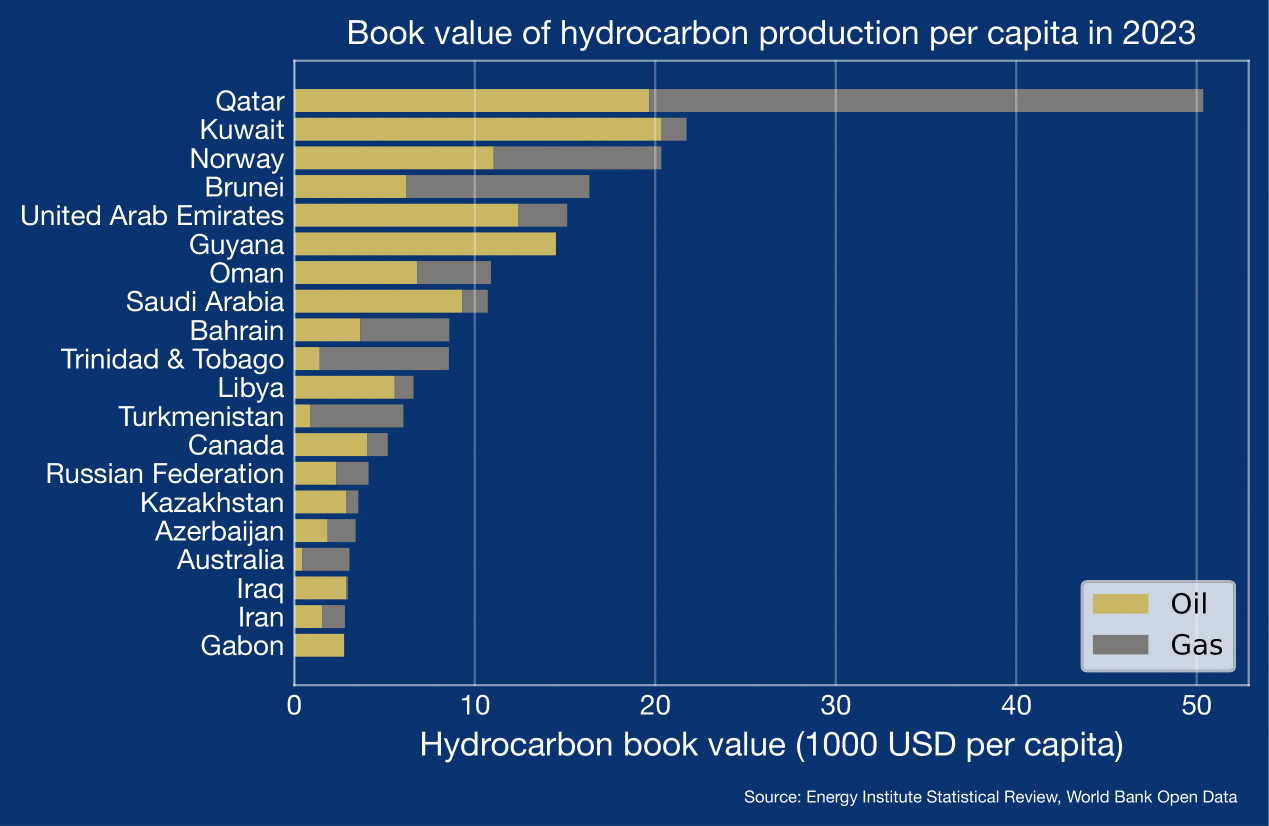
Chart 2a: Annual book value of hydrocarbons per capita, 2023.
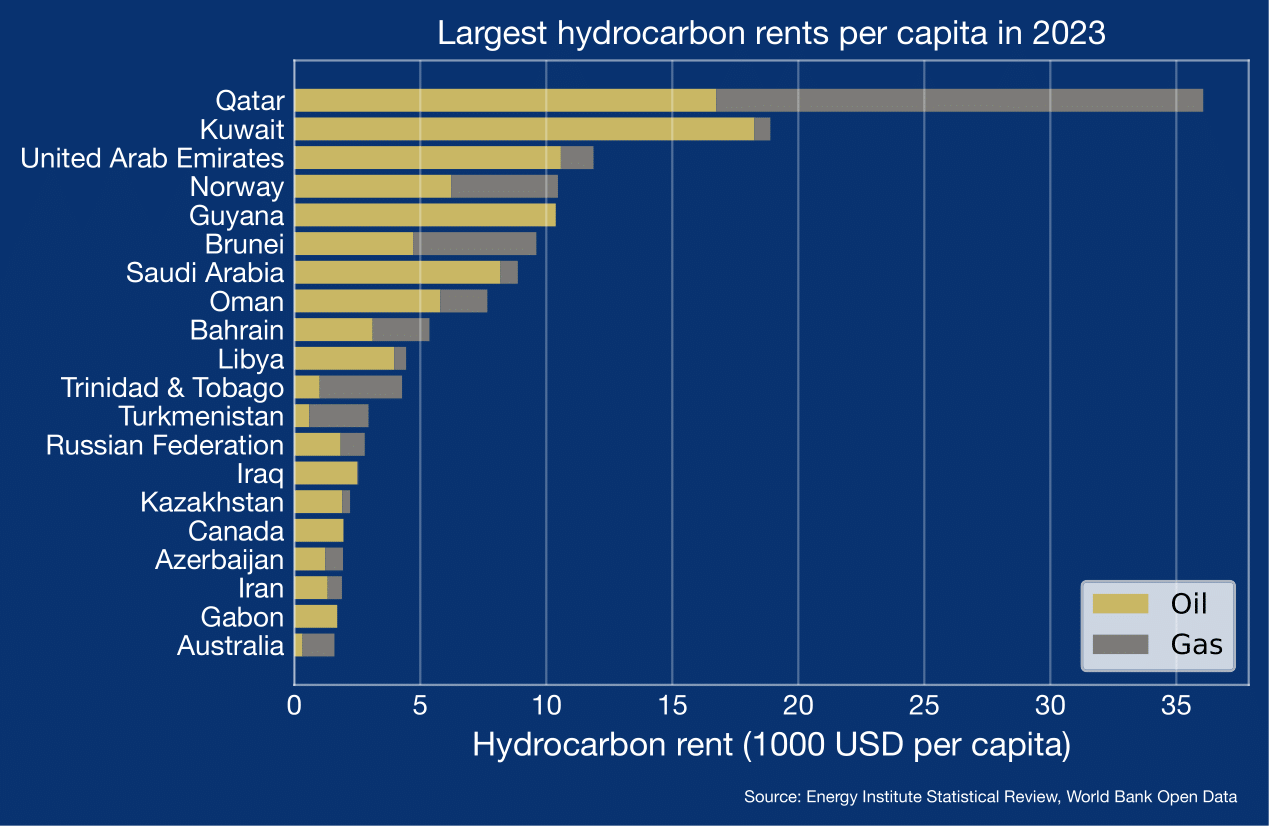
Chart 2b: Annual hydrocarbon rent value per capita, 2023.
What matters most to a country’s population, of course, is the economic value of hydrocarbon extraction. As an approximation of the value of hydrocarbon trade, we can multiply the quantities produced by the average spot-market oil or gas price. Although we cannot directly observe the true price at which oil and gas are sold for each transaction (as most hydrocarbons are not traded on spot markets but are paid out through longer-term contracts), the annual average of spot-market prices can still serve as a reasonable proxy for the economic value generated per person (Chart 2a).
Qatar, the undisputed leader in gas production per capita and a close second in oil production per capita, tops this list, with about $50,000 book value of hydrocarbon production per capita. Kuwait comes in as a distant second, at $22,000 of production per capita. All GCC states place in the top 10. The UAE sits in fifth place at $15,000 of value per person, Oman and Saudi Arabia at $11,000, and Bahrain at $9,000. The two remaining Gulf countries, Iraq ($4,000) and Iran ($4,000), are also the most populous and consequently lower on the list, on par in value per capita with Russia ($4,000). Again, many top producers in absolute terms, like China, the United States, and Nigeria, have populations so large that their hydrocarbon output has little economic value per capita.
Of course, the market price of hydrocarbons is only an indicator of the potential revenue generated by these producers and does not reflect production costs, which vary greatly by country. If we subtract costs, we obtain what is called the fossil fuel rent: the net income from fossil fuel production (see Chart 2b). Production costs depend on many location-specific geological, technical and logistical factors, meaning that some countries command a higher margin than others. For example, natural gas is often a byproduct of oil production, but its production and transformation into a transportable product such as LNG can be prohibitively high. Thus, margins for gas—especially LNG—are usually substantially lower than for oil. Because precise country-wide production cost data are difficult to calculate, the figures presented here should be taken as approximate.
Nevertheless, including production costs in our analysis does not significantly alter the ranking of hydrocarbon producers. As depicted in Chart 2b, the Gulf region has some of the most cost-favorable sites and, thus, generally enjoys high margins. Qatar, at $36,000, leads in hydrocarbon rent per capita by a wide margin, with its easy-to-access gas reservoir and small population. Qatar is followed by its fellow Gulf states Kuwait ($19,000) and the UAE ($12,000), whose low production costs enable them to surpass Norway ($10,000), which relies on more costly offshore production platforms.
Translating Rent into Wealth
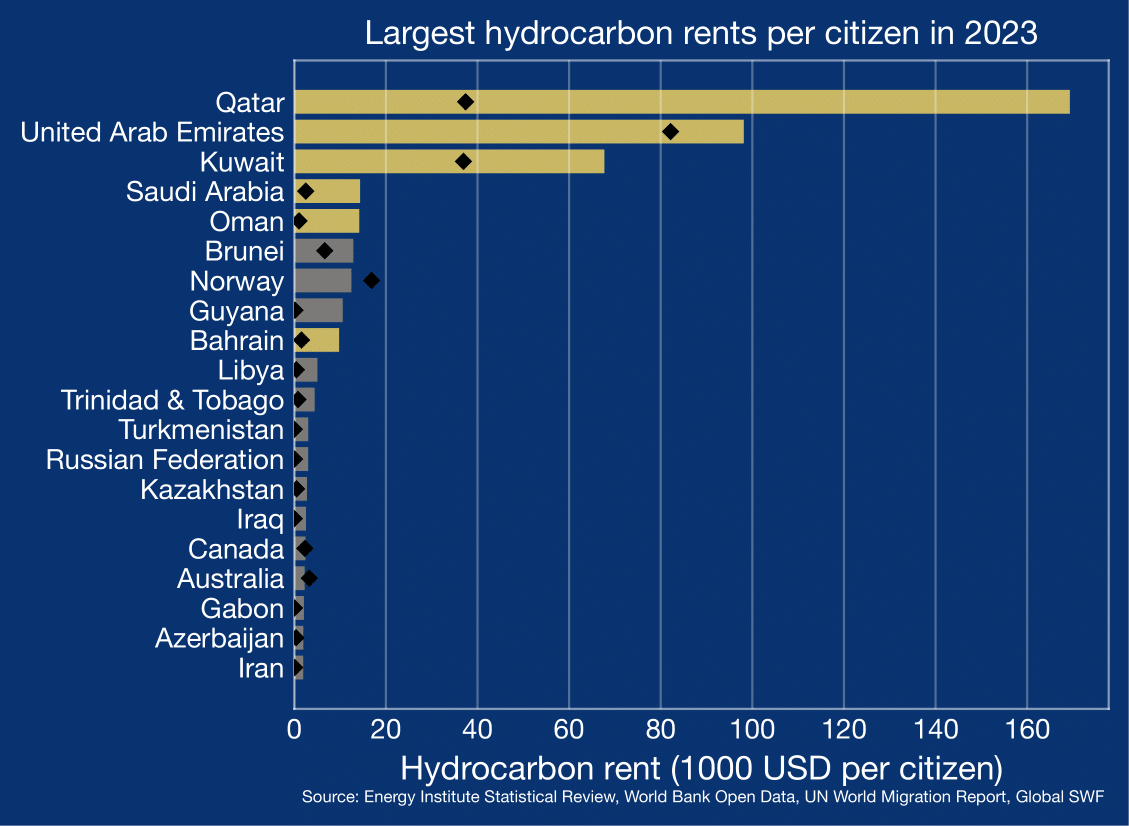
Chart 3: Annual hydrocarbon rent per citizen. Black diamonds: return from SWFs and public pension funds.
The population group that tends to benefit most from hydrocarbon wealth is the citizenry, which usually has privileged access to welfare and pension systems and enjoys guaranteed residency status. This is especially true for the GCC countries, where more than half of the population comprises non-citizens with restricted access to free healthcare, education, pensions, or public-sector jobs. As a result, in terms of annual hydrocarbon rents per citizen, these countries form a league of their own. As Chart 3 demonstrates, Qatar tops this metric at roughly $169,000 per citizen, followed by the UAE ($98,000 per citizen) and Kuwait ($68,000 per citizen). Saudi Arabia and Oman also feature in the top five, at $14,000 per citizen. Bahrain comes in 9th place with about $10,000 in hydrocarbon rent per citizen.
Most hydrocarbon-rich countries invest their fossil fuel rents into sovereign wealth funds (SWFs) and public pension funds. These investments are meant to provide an alternative income stream to replace hydrocarbon income in the long term. A rough estimate for the gross return on investment for large, diversified portfolios like SWFs and pension funds is 6 percent (the long-term average return of the exceptionally well-managed Norwegian SWF serves as a helpful benchmark). Allowing for managing costs and the frequent strategic use of SWFs for purposes other than maximizing return (e.g., prestige projects or defense investments), it is not unreasonable to assume a net return of about 4 percent. Under this assumption, few countries have come close to matching their hydrocarbon rent with portfolio income. Norway and Australia’s fund incomes have already surpassed their hydrocarbon profits, while the only GCC country that comes close is the UAE ($82,000 per citizen). To move on from a resource-rentier model to a portfolio-rentier model, some GCC states have a long way to go: Qatar, for example, would have to more than quadruple its endowment for its return to match the country’s current hydrocarbon rent.
Just how much GCC countries benefit from hydrocarbon production often goes unnoticed. They combine some of the world’s highest production figures with small populations and low production costs—resulting in high hydrocarbon income per capita. For some Gulf countries, this formula is further skewed by the high share of non-citizens, meaning that Gulf hydrocarbons produce by far the most income per citizen globally. This contrasts with other countries that are major producers in absolute terms, like China or Nigeria, where hydrocarbon income is simply not significant in relation to the immense population. The uniquely high hydrocarbon income per citizen in Qatar, the UAE, and Kuwait also means that these governments can invest large amounts in their SWFs and state pension funds to replace hydrocarbon income with portfolio returns. However, with the exception of the UAE, they still have a long way to go to convert their oil rent into commensurate endowments.
The views and opinions expressed in this article are those of the authors and do not necessarily reflect the views of Gulf International Forum.
Issue: Economy & Innovation, Energy & Environment
Country: GCC

Dr. Frederic Schneider is a Senior Fellow at the Middle East Council on Global Affairs. He holds a PhD in economics from the University of Zurich. He specializes in labor economics and consults on Middle Eastern economic policy, particularly post-oil economic transition in the GCC. He has held posts at Yale University, the University of California at Berkeley, and the University of Cambridge. His academic research has been cited over 800 times and published in world-leading journals such as the Proceedings of the National Academy of Sciences, the American Economic Journal, the Economic Journal, and the Journal of the European Economic Association. His policy analysis has appeared in news outlets like the Washington Post, Al-Monitor, Orient XII, and The National, and with institutions such as the Arab Gulf States Institute in Washington, the Washington Institute for Near East Policy, the Anwar Gargash Diplomatic Academy, and the London School of Economics’ Middle East Centre.
Saudi Arabia’s E-Commerce Boom: Why Traditional Small Businesses Risk Falling Behind
November 5, 2026Saudi Arabia’s digital marketplace is expanding rapidly. By the third quarter of 2026, the kingdom had 52,259 active e-commerce commercial registrations, up 25 percent from…
The Middle East’s Corridor Boom Meets Reality
July 22, 2026In recent years, particularly since the outbreak of the recent conflicts in Gaza and Iran, the Middle East has seen a resurgence of connectivity projects….
Iraq’s Fiscal Shock and the New Government’s Bargain
July 20, 2026The disruptions to shipping through the Strait of Hormuz have left Iraq facing more than an immediate export shock. Transport has remained constrained, insurance and…