Trump’s Blockade of Iranian Ports Raises the Stakes of the War
A U.S. naval blockade of the Iranian ports will test the limits of maritime coercion while simultaneously raising the risk of direct escalation with Iran.

After the collapse of U.S.–Iran negotiations in Islamabad over the weekend, President Donald Trump inaugurated a new phase in the conflict by announcing a naval blockade of Iranian ports. While Washington has an established track record of maritime interdiction operations, ranging from enforcing sanctions regimes against Serbia in the 1990s and Libya in the 2010s to the recent seizure of sanctioned oil shipments linked to Venezuela, the blockade of Iranian ports around the Strait of Hormuz marks a qualitatively different development.
Although the U.S. Navy’s current posture in the Gulf suggests the blockade is militarily feasible, it introduces a far more complex threat environment. It puts tremendous pressure on Tehran, exposes U.S. forces to a broader spectrum of Iranian retaliation, while simultaneously creating security and economic risks for Washington’s regional partners.
The Foundations of a Maritime Blockade
A naval blockade is generally defined as a belligerent measure intended to restrict or halt maritime traffic to and from an adversary’s ports and coastal infrastructure. Its effectiveness rests on the ability of the enforcing power to establish and sustain a sufficient degree of sea control over the target’s maritime approaches.
Operationally, a blockade depends on three core functions: detection, denial, and enforcement. First, it requires persistent monitoring of the designated area through full-spectrum intelligence, surveillance, and reconnaissance (ISR) to maintain awareness of maritime traffic. Second, it depends on the capacity to deny access to shipping lanes by deterring violations and shaping routing behavior through the visible presence of naval forces. Finally, it requires credible enforcement mechanisms, including interception, boarding, and seizure of non-compliant vessels, to demonstrate that the blockade is coercive and backed by force.
Given the scale of modern maritime traffic, effective blockade operations demand a layered force structure, including integrated capabilities across air, surface, and subsurface domains.
Washington’s Blockade Strategy
On April 12, U.S. Central Command (CENTCOM) announced that, effective April 13, U.S. forces would implement “a blockade of all maritime traffic entering and exiting Iranian ports.” The measure targets merchant vessels with demonstrable links to Iran, regardless of flag, while formally preserving freedom of navigation by recognizing neutral transit passage for vessels bound to non-Iranian ports elsewhere in the Gulf.
CENTCOM stated that vessels breaching the blockade without authorization would be liable to interception, diversion, and capture by U.S. forces. Operationally, the U.S. Navy has positioned enforcement east of the Strait of Hormuz, across international waters spanning the Gulf of Oman and the northern Arabian Sea, effectively covering the principal maritime approaches to the Gulf.
The decision to enforce the blockade at extended range reflects clear tactical trade-offs. Although U.S. guided-missile destroyers have recently transited the Strait of Hormuz, the chokepoint remains a contested operating environment. Mine countermeasure requirements and proximity to the Iranian littoral compress reaction timelines and expose surface combatants to concentrated salvos of Iranian anti-ship missiles and unmanned systems. Operating further offshore will not remove U.S. forces from the range of Iranian strike capabilities, but it will increase engagement timelines, expand maneuver space, and marginally improve the U.S. Navy’s defensive depth against coordinated attacks.
The U.S. Navy’s Force Posture
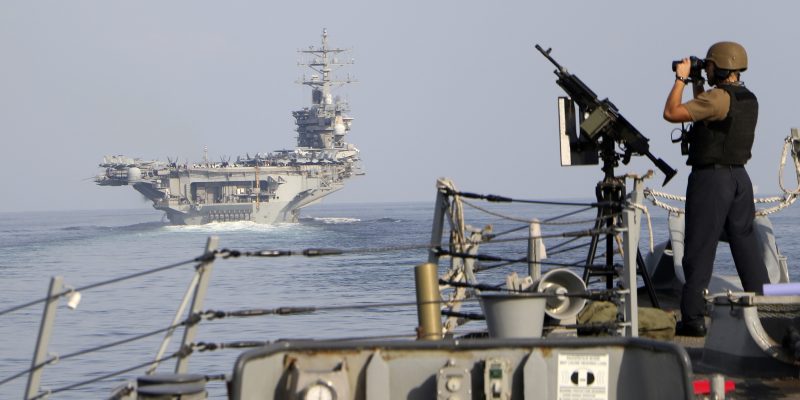
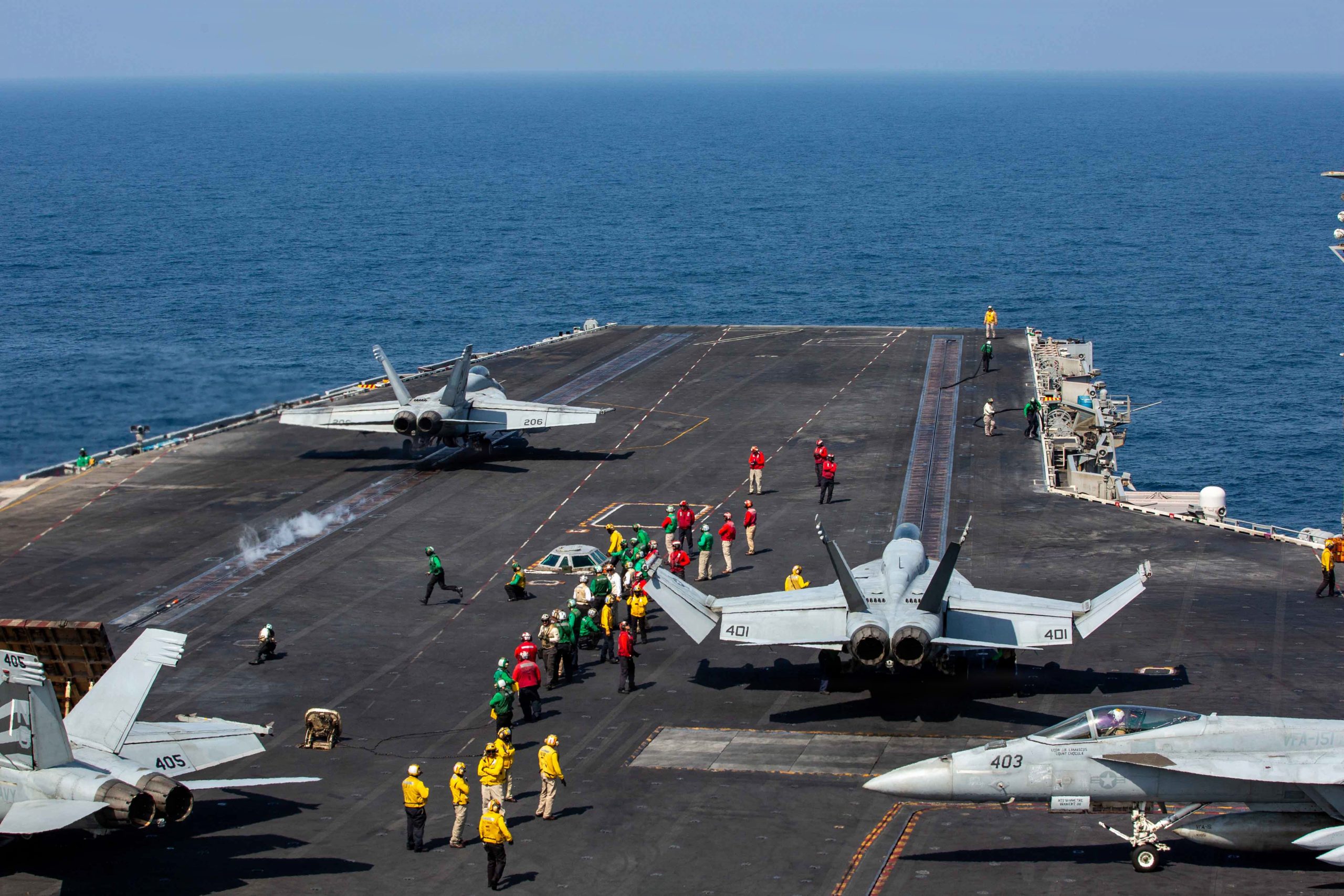
As part of Operation Epic Fury’s maritime component, the U.S. Navy has pursued a substantial force buildup in the Middle East, including the USS Gerald R. Ford and USS Abraham Lincoln carrier strike groups, approximately fifteen guided-missile destroyers, and the Tripoli amphibious ready group (ARG). This posture provides significant flexibility, but not all assets are likely to be re-tasked for blockade enforcement.
Force allocation suggests that the Ford and a subset of surface combatants will remain in the Eastern Mediterranean and Red Sea to deter attacks against Israel and contain potential Houthi escalation across the Bab el-Mandeb. The blockade’s core relies on the air wing of the Lincoln and the surface warfare capacity of roughly a dozen guided-missile destroyers. At current force levels, the U.S. Navy appears to possess sufficient assets in theater to sustain a credible blockade posture.
Extending enforcement beyond the immediate sensor horizon of surface combatants requires a robust ISR architecture. Airborne surveillance and early warning assets are essential to maintaining a comprehensive maritime picture across a dispersed operational environment. Maritime patrol aircraft and long-range unmanned aircraft, both land- and carrier-based, would play a central role in tracking commercial traffic, identifying anomalous routing behavior, and detecting vessels attempting to evade monitoring by disabling automatic identification systems.
Surface combatants form the primary enforcement layer. This inner screen is tasked with interdiction operations, including vessel interception, diversion, and enforcement of exclusion zones, while simultaneously providing area air and missile defense. The Lincoln carrier strike group operates as the outer layer, leveraging embarked air wings to establish air superiority, conduct long-range strike missions, and deliver persistent ISR coverage in support of surface units.
While guided-missile destroyers retain limited seizure capabilities via embarked helicopters and specialized teams, they are not optimized for sustained detention or complex boarding operations, with amphibious forces partially offsetting this limitation. Although ARGs are designed primarily for power projection ashore rather than sea control, their aviation assets and embarked Marine forces provide a flexible capability set for blockade enforcement.
CENTCOM has not specified where seized vessels would be processed or held. Political constraints make access to Gulf port facilities unlikely. A more plausible course of action would involve transferring detained vessels to U.S.-controlled facilities at Diego Garcia in the central Indian Ocean.
Additional reinforcements are en route. The Boxer ARG is approximately two weeks from the CENTCOM area of responsibility, while the USS George H.W. Bush carrier strike group is set to transit via the Cape of Good Hope to augment naval forces in the Arabian Sea. Together, these movements indicate an effort to deepen force redundancy and sustain operational tempo over an extended blockade period.
During the first 48 hours of the operation, U.S. forces effectively curtailed maritime traffic to and from Iranian ports, with nine vessels, including a sanctioned Chinese chemical tanker, complying with CENTCOM directives to alter course, indicating that the blockade is demonstrably in force.
Risks and Trajectories
Enforcing a time-bound naval blockade presents a more viable coercive option for the United States than high-risk amphibious operations against Iranian islands and littorals. It allows Washington to exert pressure while avoiding the escalatory and operational burdens of land engagement.
Iran’s use of maritime disruption to enforce a “Hormuz toll” system demonstrated its ability to impose costs while containing repercussions. The blockade appears intended to reverse that dynamic by denying Tehran the ability to strategically weaponize the Strait. Its effectiveness, however, hinges on sustained enforcement and the ability to impose tangible costs sufficient to alter Iranian decision-making.
At the same time, the move carries significant legal and political implications for the Trump administration. A blockade is widely understood as a belligerent act; its implementation risks crossing the threshold into open conflict, with potential consequences under the War Powers Resolution and heightened scrutiny in Washington.
Direct risks to U.S. naval forces engaged in the blockade remain manageable but not negligible. While operating within range of Iranian missile and drone systems, forward-deployed assets in the Arabian Sea have thus far avoided significant losses. The more acute risk lies in asymmetric responses. The Islamic Revolutionary Guard Corps Navy could embed personnel aboard Iranian-flagged commercial vessels to resist boarding operations, or employ decoy and booby-trapped ships to draw U.S. forces into high-risk engagements.
The broader strategic risk, however, falls disproportionately on U.S. regional partners and the shipping community. As seen in earlier phases of Operation Epic Fury, Iran is likely to retaliate indirectly against the United States, targeting Gulf states to signal that regional security is indivisible. This could include strikes on critical infrastructure or harassment of shipping tied to partner economies reminiscent of the 1986–87 “Tanker War.” Commercial maritime traffic also remains particularly vulnerable. Despite its battered conventional navy, Iran retains credible anti-ship and strike capabilities. With U.S. surface combatants positioned east of Hormuz, merchant vessels transiting the Gulf without escort would be easy targets for Iranian retaliatory strikes, fueling further economic disruption. Whether the blockade ultimately remains a short-term instrument of leverage during renewed rounds of negotiations or evolves into sustained escalation will depend on whether the United States and Iran, alongside their respective partners, can reach an agreement on Hormuz’s sovereignty status and manage the rising costs of instability at sea.
The views and opinions expressed in this article are those of the authors and do not necessarily reflect the views of Gulf International Forum.
Issue: U.S. – Gulf Policy
Country: Iran

Leonardo Jacopo Maria Mazzucco is a PhD candidate in Institutions and Policies at the Catholic University of Milan, Italy. His research interests revolve around the foreign policy and security affairs of the Gulf region. He tweets at @mazz_Leonardo.

The Midterms Might Change Washington’s Gulf Debate, But Not the Relationship
October 27, 2026The ongoing U.S.–Iran war comes at a pivotal moment for U.S. foreign policy. With the increasingly unpopular and drawn-out conflict taking place amid the campaign…

Saudi Arabia’s F-35 Deal Is Taking Shape
October 16, 2026Less than a year after U.S. President Donald Trump publicly backed the sale of F-35 fighter jets to Saudi Arabia, the kingdom’s long-running effort to…

Trump’s War on Iran Runs Through Baghdad
October 8, 2026Seven months into the war with Iran, the Strait of Hormuz remains a major point of contention. Goldman Sachs estimates that Gulf oil flows have…