New Faces, New Elections, Unchanging System in Kuwait
It is doubtful that these elections and a new cabinet will change the underlying dynamics that have caused increasing political deadlock in Kuwait over the last decade.

Having announced that a new cabinet would be formed and parliament dissolved at the end of June, Kuwaiti Crown Prince Shaykh Mishaal al-Ahmed al-Sabah formally issued an Emiri Decree on August 2 to dissolve the body that had been elected in December 2020 (two years before their elections are mandated.) According to the Kuwaiti constitution, new polls must be held within two months, meaning they will be scheduled by October 2, at the latest. The crown prince, to whom Emir Shaykh Nawaf al-Ahmed al-Jaber al-Sabah temporarily granted considerable authority in November 2021, explained that the dissolution was meant “to rectify the political scene which involved lack of harmony and non-cooperation (sic), differences and disputes, giving precedence to personal interests and…undertaking practices and actions that undermine national unity.” In my view, it is doubtful that these elections and a new cabinet will change the underlying dynamics that have caused increasing political deadlock in Kuwait over the last decade.
Although the last premature dissolution of parliament took place in 2016, this most recent parliament has had a troubled relationship with the cabinet. Indeed, in February 2021, the interior and defense ministers—both members of the ruling al-Sabah family—submitted their resignations, stating that “it has unfortunately become almost impossible to achieve reform, especially in light of this atmosphere.” Two months later, the entire cabinet resigned one day before a vote of no-confidence was due to be held. The cabinet’s widespread resignation was the fourth such occurrence since the most recent parliamentary elections in December 2020. Over the course of the 2020 parliament’s tenure, numerous interpellations of several ministers took place, and a dispute arose regarding the legislature’s desire to interpellate the prime minister on charges of corruption—a saga detailed below.
Surface-Level Stopgaps
One day before announcing parliament’s official dissolution, Prime Minister Shaykh Ahmed Nawaf al-Ahmed al-Sabah, who had been appointed at the end of July 2022, announced the formation of a new 12-member cabinet to replace the cabinet, which resigned in April and has stayed on as a caretaker. The oil, finance, municipality affairs, communication and information technology, and foreign ministers have remained the same, while Shaykh Talal Khaled al-Ahmed al-Sabah remained deputy prime minister and also serves as minister of defense and acting interior minister. Reactions to the new prime minister were generally positive, as Shaykh Ahmed, the emir’s son, had gained a reputation as a reformer within the Ministry of Interior. Further, the previous prime minister, Sabah al-Khaled al-Sabah, first appointed in November 2019, had come under fire for the government’s handling of the COVID-19 pandemic and alleged support for parliamentary speaker Marzouq al-Ghanem. Parliament tried to secure the right to interpellate him about these issues, but the interpellation was pushed back to 2022, to a session which opposition members boycotted. Despite the new faces introduced into the cabinet, issues with the Kuwaiti political system are more systemic than personal. As long as parliament’s primary mode of opposition to the cabinet is expressed through interpellations—rather than through the implementation of new policies—the relationship between the cabinet and the parliament will remain contentious.
One way to change this arrangement, which has been proposed by many segments of the opposition, would be for parliament to elect the prime minister and potentially of the rest of the cabinet. Such an arrangement would remove a reliable voting bloc from the ruling family and loyalists within parliament, as cabinet members (many of whom are members of the al-Sabah family) vote equally alongside elected MPs on policy issues—except votes of no confidence for ministers. It is, incidentally, the existence of a rather reliable pro-government bloc in parliament made up of cabinet members that dooms the legislative efforts of the opposition. Similarly, while appointment of a new prime minister may ease tensions with parliament, an opposition-led legislature would likely continue the same tactics of interpellations to effect policy changes. If the elections are held under the current electoral laws, which is expected, drastic changes are unlikely to occur
The Four Horsemen of Kuwaiti Politics
Four main issues will likely emerge in the upcoming parliamentary elections. The first is that of tribal primaries. Although technically illegal, primaries to select candidates for major tribes have been held since the 1970s and were even held in the 2020 election amid COVID-19-related restrictions. This time, however, the government has made clear that it intends to crack down on tribal primaries, which are believed to grant tribes an unfair electoral advantage. Indeed, it is no coincidence that the suppression of tribal primaries takes place at a time when outspoken members of the political opposition increasingly come from segments of the tribal population who tend to reside in the gerrymandered electoral districts four and five.
The second issue will almost certainly be corruption and economic reform. Corruption has long been viewed as a major issue in Kuwaiti politics, and one that has potentially slowed the country’s economic diversification. Although a rebound in oil prices has taken some immediate pressure off diversification efforts, Kuwait must still pass a debt financing law to help sustain current levels of spending.
The third controversy will surround the election of the speaker of parliament, which became a flashpoint in 2020. Indeed, 37 opposition MPs stated their intention to vote for Marzouq al-Ghanim’s opponent as speaker in December 2020, yet al-Ghanim won the position through a system of secret ballot voting. This led to demands to make the vote more transparent and spurred charges of government interference in ensuring the election of a loyalist as speaker. With the election of a new parliament, this issue will arise again. Perhaps anticipating political backlash, Crown Prince Shaykh Mishaal confirmed in his speech announcing new elections that the government would not interfere with the election of the next parliamentary speaker.
A fourth issue that may arise concerns existing electoral law. In October 2012, following widespread success for opposition candidates in previous elections, Emir Shaykh Sabah al-Ahmed al-Jaber al-Sabah introduced the single non-transferable vote (SNTV) system, in effect limiting the political choices available to the average constituent. While each Kuwaiti voter once had four votes, each was now granted only one. Though the emir claimed that the system was necessary “to preserve national unity and to strengthen the practice of democracy,” the SNTV system spurred an opposition-wide boycott until 2016. Since their return to the legislature, opposition MPs have proposed several revisions to Kuwaiti electoral law, as the current system is thought to disadvantage organized political blocs and tribes; feelings of disenfranchisement encouraged by this legislation has further facilitated increasingly vocal opposition. A change in electoral law could potentially change the composition of parliament and further complicate relations with the cabinet if more opposition figures appear in the legislature.
All in all, recent developments in Kuwait follow a pattern that is well-known to Kuwait watchers. First, an opposition-led parliament goes too far in interpellating ministers and faces dissolution. Absent a new system in which cabinet members are not voting members of parliament, the gridlock between elected and unelected members of parliament—and of government more broadly—persists. Interestingly, this system appears to have produced an increasingly ideologically diverse opposition. Disillusionment with the status quo has united Islamists, tribal members, and secular leftists in their desire to reform the system. If the opposition bloc does not splinter, as has happened in the past, it could grow powerful enough to pass sweeping systemic changes. Of course, the details of that fundamental transformation are unclear as of now.
The views and opinions expressed in this article are those of the authors and do not necessarily reflect the views of Gulf International Forum.
Issue: Politics & Governance
Country: Kuwait

Dr. Courtney Freer is an Assistant Professor in the Department of Middle Eastern and South Asian Studies at Emory University and a senior nonresident fellow at the Gulf International Forum. Her academic work focuses on domestic politics and Islamism in the Gulf states; she is the author of Rentier Islamism: The Influence of the Muslim Brotherhood in Gulf Monarchies (Oxford University Press, 2018), The Resilience of Parliamentary Politics in Kuwait: Rentierism, Ideology, and Mobilization (Oxford University Press, 2024) and co-author with Alanoud al-Sharekh of Tribalism and Political Power in the Gulf: State-Building and National Identity in Kuwait, Qatar and the UAE (IB Tauris, 2021). Courtney holds a BA in Near Eastern Studies from Princeton University, an MA in Middle Eastern Studies from The George Washington University, and. DPhil in Politics from the University of Oxford. She has held positions at the US-Saudi Arabian Business Council, Brookings Doha Center, and the London School of Economics and Political Science.
Why Iran Never Knows When to Stop
July 27, 2026At first glance, Iran’s negotiating difficulties appear to stem from disagreements between pragmatists seeking sanctions relief and hardliners determined to resist compromise. Yet that explanation…
Iraq’s Corruption Crackdown
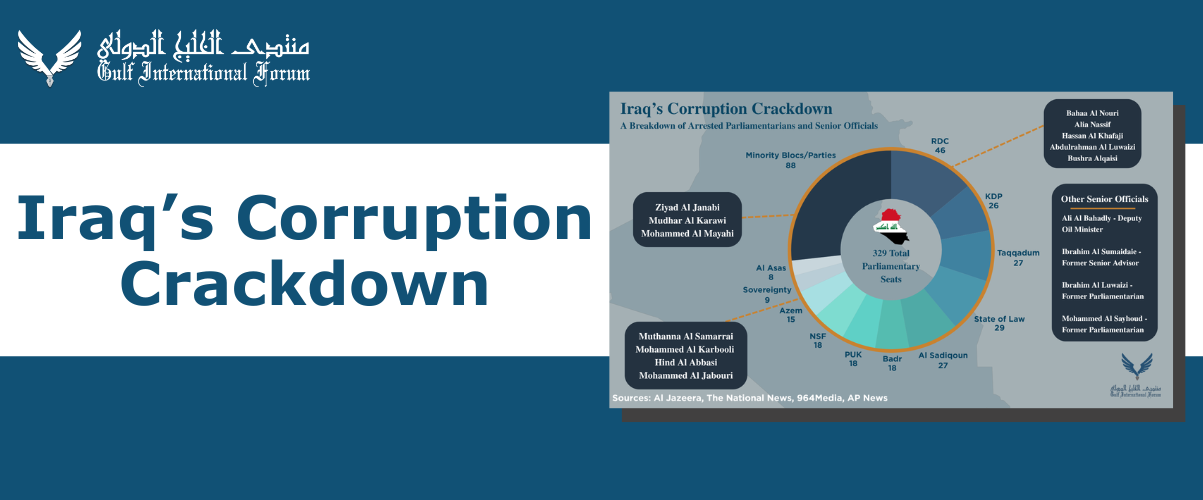
July 22, 2026*A breakdown of arrested parliamentarians and senior officials as of June 28, 2026.
Sheikh Hamad and the Making of Modern Qatar
July 15, 2026There is a question that haunts every small state: how does a nation survive and stay relevant in a region built for giants? For most…