Not Just the F-35: Saudi Arabia, KAAN, and a New Phase in Gulf Airpower
As Gulf states reassess security after the Iran war, Riyadh is exploring new airpower partnerships beyond traditional Western suppliers, signaling a shift toward layered airpower, industrial partnerships, and strategic autonomy in the Middle East.

Saudi Arabia’s potential engagement with Turkey’s KAAN fighter jet program has gained renewed relevance in light of recent regional development. More than a question of platform acquisition, it increasingly reflects a broader transformation in regional security dynamics, where high-end airpower procurement is becoming a tool of diversification, leverage, and long-term strategic positioning. In the weeks preceding the outbreak of the war in the Gulf, discussions around the program had already begun shifting to a more concrete policy debate. During his early February 2026 visit to Riyadh, Turkish President Recep Tayyip Erdoğan suggested that joint investment in KAAN “could happen at any moment,” framing the aircraft as a symbol of Turkey’s defense-industrial prowess.
Just days before the war, Turkish Aerospace Industries (TAI) indicated that discussions had already entered a decisive phase. At the World Defense Show in February, General Manager Mehmet Demiroğlu described the talks with Saudi Arabia as being in the “final stages of the decision-making process,” with a potential agreement expected within the year. He outlined a range of possible cooperation models, from the acquisition of aircraft to deeper industrial participation, underscoring that Riyadh was choosing not whether to engage, but at what level. The public display of a KAAN mock-up bearing Saudi markings at the World Defense Show reinforced the perception that talks are progressing beyond exploratory contacts.
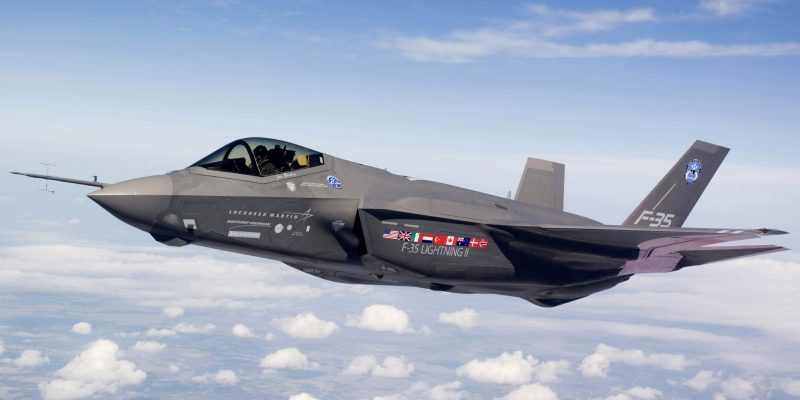
The regional war has accelerated this dynamic. The conflict has reinforced Gulf perceptions of a more volatile security environment, pushing regional actors to reassess both defense partnerships and long-term procurement strategies. Riyadh’s parallel engagement with both the U.S. F-35 and Turkey’s KAAN reflects a more flexible, multi-vector approach to airpower development. While Washington signaled openness to a potential sale in November 2025, and Lockheed Martin’s display of a full-scale model in Royal Saudi Air Force (RSAF) markings suggested industrial momentum, the deal remains politically sensitive and procedurally incomplete. The question now is how both the F-35 and the KAAN can fit within a broader, multi-vector airpower strategy.
For Saudi Arabia, acquiring new fighter jets reflects its ambitions tied to Vision 2030 by strengthening domestic defense industry capabilities, expanding technology partnerships, and positioning the Kingdom as a consequential security actor across the Middle East and adjacent regions. This shift is increasingly embedded within a broader regional trend toward more autonomous security coordination. At the April 2026 Antalya Diplomacy Forum, Turkish Foreign Minister Hakan Fidan explicitly called for the development of a structured regional security framework involving actors such as Saudi Arabia, Pakistan, and Egypt, signaling that key regional powers are beginning to explore more institutionalized forms of defense cooperation beyond traditional reliance on external guarantors.
Saudi Arabia’s Fighter Roadmap
Saudi Arabia already fields one of the Middle East’s most capable combat air fleets, built around advanced U.S.-made F-15 variants, a substantial fleet of Eurofighter Typhoons, and legacy Panavia Tornado strike aircraft. Within this context, any acquisition of fifth-generation fighters—often discussed around 48 F-35s—would represent a qualitative enhancement rather than a wholesale fleet replacement. Such aircraft would sit at the apex of the RSAF’s structure, providing high-end penetration and survivability capabilities in contested environments.
Saudi interest in KAAN is not an alternative to the F-35, rather a longstanding pattern of diversifying suppliers and industrial ecosystems. The Kingdom has historically balanced U.S. and European defense partnerships to optimize operational capability while preserving diplomatic flexibility and industrial leverage.
Arms procurement in the Gulf has also long functioned as a diplomatic instrument. Exploring parallel high-end platforms can enhance negotiating leverage with primary suppliers, particularly when advanced systems are subject to political conditions. In this sense, engagement with KAAN may serve as a broader bargaining logic within Riyadh’s relationship with Washington.
Turkey’s offer introduces a different dimension. Beyond the aircraft itself, KAAN potentially comes bundled with opportunities for industrial participation and localized production, both priorities explicitly embedded in Saudi Arabia’s Vision 2030 defense localization targets. Recent Turkish-Saudi cooperation on unmanned systems, helicopters, and armored vehicles illustrates how such partnerships incrementally evolve, building institutional trust before expanding into more complex aerospace projects.
The Realities of KAAN Cooperation
While political signaling around Saudi participation in Turkey’s KAAN fighter program has intensified, the practical meaning of such cooperation remains unknown. Statements from TAI suggest that multiple models are under discussion, ranging from limited procurement to deeper forms of industrial collaboration, including localized production in Saudi Arabia.
A modest purchase—often discussed as roughly 20 aircraft, equivalent to a small operational squadron—would represent the most straightforward pathway. Such an acquisition could allow Riyadh to familiarize its air force with the platform, signal political support for Turkey’s indigenous fighter program, and hedge against uncertainties surrounding Western fifth-generation procurement timelines.
More ambitious industrial cooperation would require significantly larger commitments. Turkish industry representatives have indicated that localization in Saudi Arabia would necessitate orders of at least 50 aircraft, with 100 providing a more sustainable benchmark for production infrastructure and supply-chain integration. Establishing a final assembly line in Riyadh would therefore depend directly on acquisition volume. Such an approach would align closely with Saudi Arabia’s Vision 2030 objective of localizing approximately half of defense expenditure by the end of the decade. Riyadh increasingly prioritizes agreements with industrial participation, technology transfer, and domestic production capacity rather than simple off-the-shelf acquisitions.
Even so, translating political interest into a fully-fledged fifth-generation fighter partnership presents considerable technical and institutional challenges. The KAAN fighter conducted its maiden flight in February 2024, and additional flight prototypes are expected to continue through 2026 and beyond, with initial deliveries projected toward the end of the decade. Early production batches are expected to use U.S.-made F110 engines, while Turkey simultaneously pursues development of an indigenous powerplant for later blocks.
These factors suggest that any Saudi involvement is likely to follow a phased trajectory. Initial procurement combined with selective industrial participation, such as maintenance and repair, appears more plausible in the near term than immediate co-production. Only as the program matures and trust deepens between Ankara and Riyadh would more extensive industrial integration become realistic.
Technology, Timelines, and Strategic Autonomy
Saudi engagement with KAAN ultimately hinges on technological maturity and delivery timelines. While Turkey has made progress, KAAN remains a developing program rather than a fully operational fifth-generation platform. For Riyadh, which must balance immediate requirements with long-term strategic positioning, this distinction carries significant weight.
One of the central variables concerns propulsion. Current KAAN prototypes rely on U.S.-made F110 engines, facilitating near-term testing but introducing export-control sensitivities. Turkey’s longer-term objective is to equip later production blocks with a homegrown engine, a technically demanding undertaking likely extending into the early-to-mid 2030s. Until such a capability matures, the program remains partially exposed to regulatory constraints associated with Western-origin defense technologies.
Questions surrounding configuration specifications also remain relevant on the American side. Discussions around preserving Israel’s qualitative military edge could influence the variant or capability level offered to Saudi Arabia. Even marginal differences in software architecture, sensor integration, or weapons packages may shape Riyadh’s perception of long-term F-35 operational parity—and, indirectly, reinforce interest in complementary high-end platforms.
Technological maturity also intersects with broader fleet planning considerations. Saudi Arabia’s current fighter inventory remains centered on highly capable fourth-generation platforms. Introducing a fifth-generation aircraft still in prototype phases requires careful sequencing to avoid capability gaps while maintaining operational readiness. This reality helps explain why analysts often view KAAN involvement as a longer-term industrial and strategic investment.
Strategic Signaling and the Future of Gulf Airpower
The significance of potential Saudi engagement with the KAAN program extends beyond the technical characteristics of any single aircraft. Fighter procurement in the Gulf has long carried political, industrial, and symbolic dimensions alongside operational ones, and the current debate reflects a broader evolution in how regional powers conceive of airpower partnerships.
For Saudi Arabia, maintaining simultaneous discussions with both Western suppliers and emerging defense producers reflects a pragmatic approach to uncertainty. At a broader level, these dynamics are unfolding against a perceived recalibration of U.S. strategic priorities. As Washington emphasizes burden sharing and signals a more selective regional engagement, Gulf states are increasingly adapting by expanding their network of defense partners, including Ukraine and South Korea, rather than relying exclusively on a single provider. Moreover, defense-industrial alignment increasingly mirrors evolving regional partnerships. As Riyadh deepens coordination with actors across multiple theaters, aerospace cooperation may also carry signaling value within a gradually reconfiguring Middle Eastern security landscape.
Regionally, a layered Saudi airpower strategy would signal diversification rather than rupture. In this sense, Saudi engagement with KAAN reflects not only a procurement choice, but also the emergence of a more multipolar security environment in which regional powers increasingly combine partnerships rather than align exclusively with a single bloc.
Seen through this wider lens, Saudi interest in KAAN is less about immediate platform substitution and more about positioning. It reflects a broader trend in which Gulf states seek to combine operational capability, industrial development, and diplomatic flexibility. Whether or not Riyadh ultimately joins the KAAN program at scale, the discussions highlight how airpower procurement is becoming a tool not only of defense policy, but of industrial strategy and strategic positioning in a more fragmented and competitive regional order.
The views and opinions expressed in this article are those of the authors and do not necessarily reflect the views of Gulf International Forum.
Issue: Defense & Security, Geopolitics
Country: KSA

Francesco Salesio Schiavi is an independent Middle East analyst and consultant specializing in the international relations and security architecture of the Levant and the Gulf. His expertise includes military and diplomatic interventions by international actors in the Middle East and North Africa and the military technologies of some of the leading Middle Eastern actors in this sector. He is a non-resident fellow at the Middle East Institute of Switzerland (MEIS), and advisor to the Rome Office of TRENDS, Research & Advisory, and a contributor to several international outlets, including Al- Monitor, Amwaj, The New Arab, and the NATO Defense College Foundation. Previously, he was a researcher at the Middle East and North Africa Centre of the Italian Institute for International Political Studies and a coordinator of the scientific team for “Rome MED – Mediterranean Dialogues” for five years. From 2023-24, he also served as an advisor to the Steering Committee for the Euromesco Annual Conference, organized by the European Institute of the Mediterranean in partnership with the Spanish Ministry of Foreign Affairs.
Confirmed Houthi Attacks on Saudi Arabia: July 13 to October 26
October 28, 2026
Toward a New Order in MENA Regional Geopolitics
September 2, 2026This report is a byproduct of the workshop “Toward a New Order in MENA Regional Geopolitics: What’s Next for the Region’s Geopolitical Equilibrium?,” hosted in…
Yemen’s Emerging Role in the Red Sea
August 27, 2026On August 4, 2026, the Yemeni Coast Guard (YCG) rescued the 14-member crew of the Indian-flagged commercial vessel Faize Noore Oliya. Transiting the Red Sea…